Addition:
The “what does what”-table:
| Connector | Signal L | Signal R | Signal !L | Signal !R | GND |
|---|---|---|---|---|---|
| 2 pole jack “mono” |  |
|
|||
| 3 pole jack “stereo” | |
|
|
||
| 3-pin XLR | |
|
|
||
| 4-pin XLR | |
|
|
|
|
| 5-pin XLR | DMX SIGNAL! | DO NOT | PLUG IN | TO AUDIO | GEAR! |
As another note: 3 pin jack can also be used for balanced signal (common on mixers and audio interfaces. Then the pinout is T = Hot (Signal L), R = Cold (Signal !L), S = GND
Where is Ground on a headphone?
There is none.
A headphone has no grounding. At the powers involved, radio frequencies and other EMF is simply too weak to make a more-than-measureable difference. (When you can measure the difference, you are one step away from building a radio).
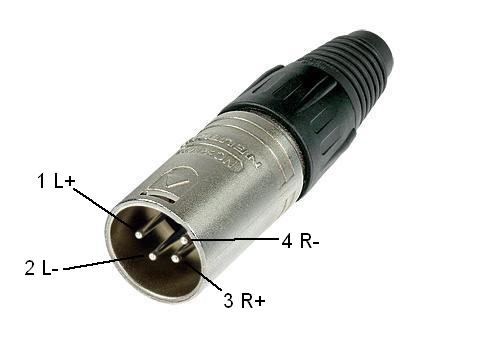
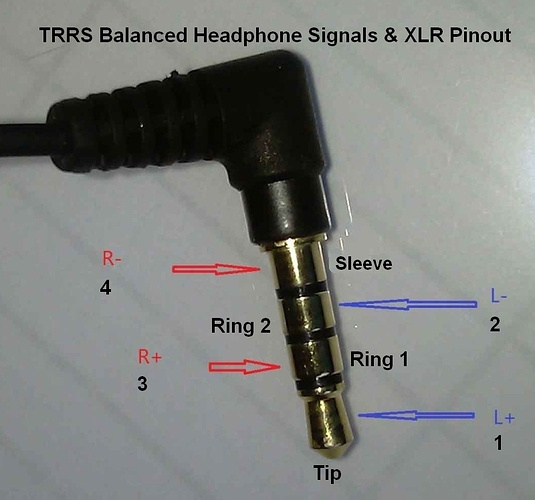
So, how do my headphones make sound without Ground?
Look at the first image in this thread again. When the signal is balanced, the signals are the inverse of another, meaning you have a voltage difference. A voltage difference will cause a current to flow. (Technically speaking, the lack of current causes voltage, different story).
Your headphone simply connects from the high of one signal to the low of another. This increased voltage is also the reason why balanced has more power (Power P = Voltage U x Current I), double the voltage, the power doubles too.