Everything depends on the technology, as well as the skill and experience of the people creating these IEMs. A DD+BA+Planar configuration sounds interesting, though I haven’t tried such a combination myself. Personally, I prefer a tri-hybrid—DD+BA+EST. Another favorite of mine is a capable single-DD IEM. But… any technology without good tuning…
What is your favorite driver configuration? What do you think about the BСD?
Maybe DD+BA+Planar. But a good single DD is great, too.
As for BCD, I think BCD can add more depth and immersion to the listening experience, especially in terms of bass texture and overall atmosphere. But their effectiveness really depends on the implementation and tuning. Adding a bone conduction driver doesn’t automatically make an IEM sound better. It comes down to how it actually sounds.
I’m a consumer, i don’t care what’s inside the shells, i don’t have to maintain it, only put it in my ears and enjoy music. It may be branded BA or “custom”, it may be 5 types of drivers or one, just give me good final result and i’ll be happy.
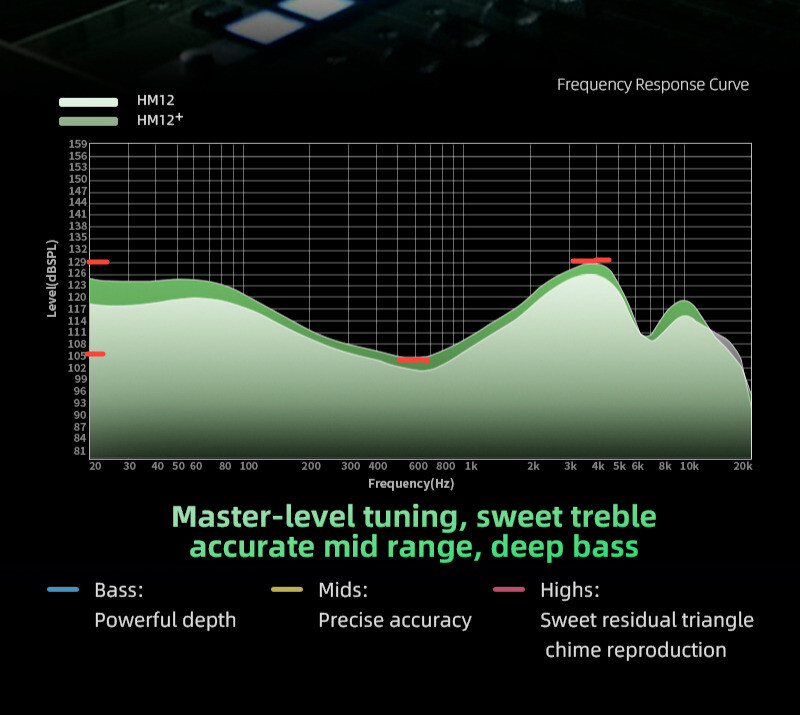
I agree that the final sound matters more than the number or type of drivers. FR graphs don’t tell the whole story, but that dip is definitely worth looking into.
I have 2 tribrid that has DD/BA/planar that is the the custom art hybrid 3 pro and the tri i3 mk3. I dont know much about custom art but KBEar/TRI has abused the same DD/BA to the point where they know how it reacts to its suroundings/enclosure and are basiclly just tuning to accomodate the planar tweeter.
Also looking at your website you folks are very daring to use a cremeic substrate for your planar driver since cremic tends to sound like fireworks in your ear to quote akros.
That being said generally each driver you add is just gonna compicate things so Im off the camp that less is more unless you can really make use of the querks of the added driver.
That’s a really interesting perspective. I agree that adding more drivers doesn’t automatically make an IEM better. The real challenge is getting all the drivers to work together properly, rather than just adding more for the sake of the numbers.
Your point about the ceramic substrate is interesting too. I think the implementation and tuning matter just as much as the material itself. A material might have certain characteristics, but how it’s integrated into the driver and the overall acoustic design makes a big difference.
I also appreciate the “less is more” approach. A well-executed single DD can be just as impressive as a complicated hybrid.
Curious to hear more about your experience with the TRI i3 MK3. How do you find its planar driver integration?
Yes,The reason incoherency and all are mentioned in acoustics engineering is always from the POV of On/Over the ear Headphones or Speaker systems, where it is hard to control non-minimum phase behaviours due to things like crossover / earcanal interaction. (FYI - Audio systems should work like a minimum phase system which means they should follow a transfer function that is predictable and mostly constant).
The reson IEMs don’t have this issue is
They bypass most of the directionality inhibiting ear (like Pinnea, Cheeks, Ear Entrance Point) , so making the drivers fire sound waves deep into earcanals make them extremely simple in theory from ***psychoacoustic viewpoint.
We have come a long way implimenting tiny crossovers of all kinds like Zobel, Partial Zobel, Simple Resistor etc. that works beautifully with filters such as highpass and lowpass, and being so tiny the impulse resonse difference is negligable by human brain.
So, coming to the question Useful or Overcomplicated ? It is simple, if it works - it’s useful. if it doesnt - it is not. Depends totally on the approach and what the maker is trying to do.
If you are getting a wonky signature with extremely odd colouration - then it is safe to assume the drivers are for esoteric signature that you don’t like which makes it Overcomplicated and unworthy.
If you are getting extremely smooth peaks and dips that matches your preference then yes, the more tha marrier. It’s not a static answer, it’s more like a multivariate equation that takes your feedback as a variable.
If you ask me about my opinion, I don’t care. Shove as much drivers as you want, I don’t care. Just give me a good tuning at a reasonable price.
I like that perspective. At the end of the day, the driver configuration is just a tool to achieve a certain sound, not a measure of quality by itself.
A well-executed single DD can be just as enjoyable as a well-designed hybrid. It really comes down to how well everything is implemented and tuned. Thanks for the detailed explanation!