Aurorus Quasar Review
I receive and review the Aurorus Audio Quasar within two weeks.
Presentation
The product is captured in a flight-case-like container, I believe, made of plastic that is similar, if not identical, in dimension to other Aurorus models and providing ample containment for travel.
Build
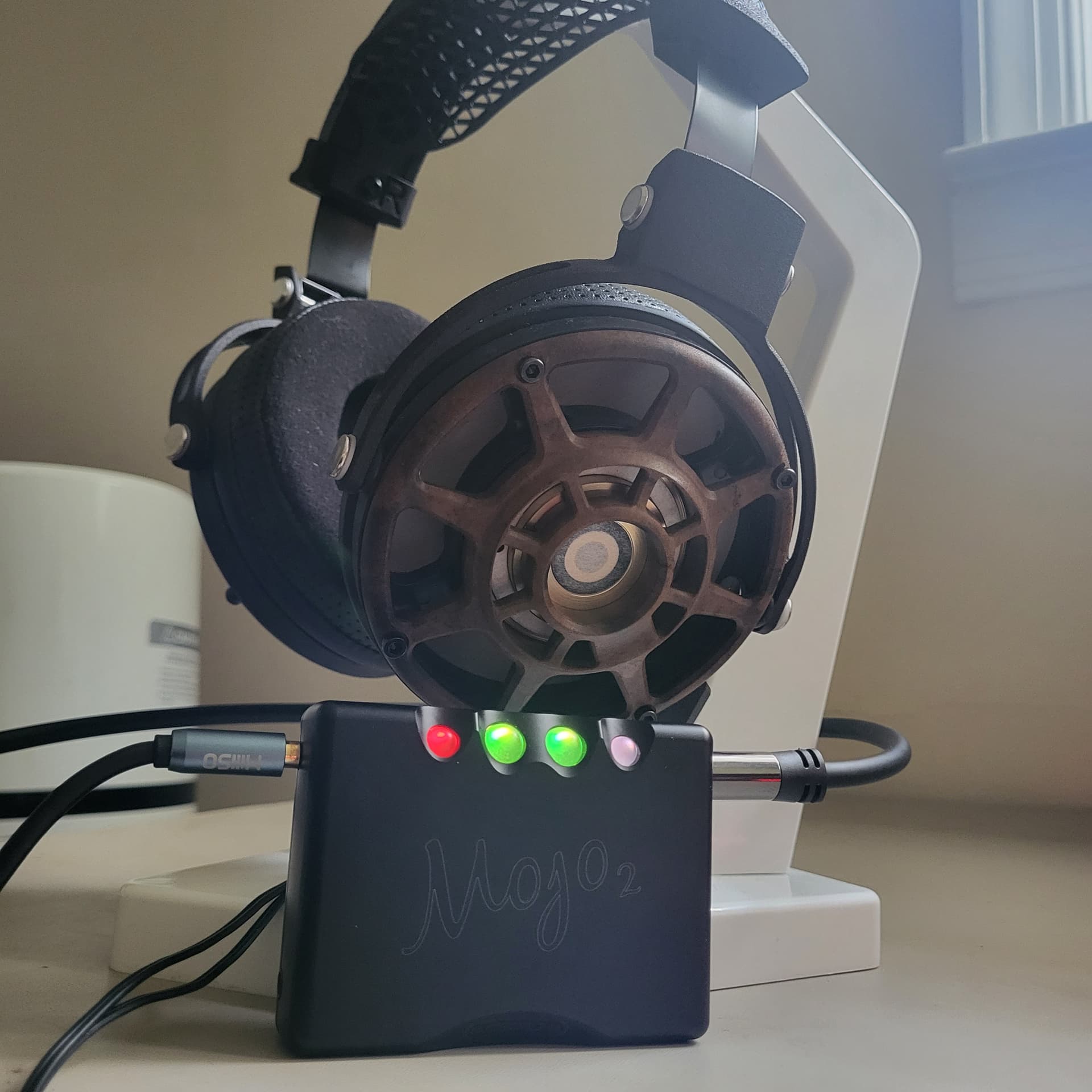
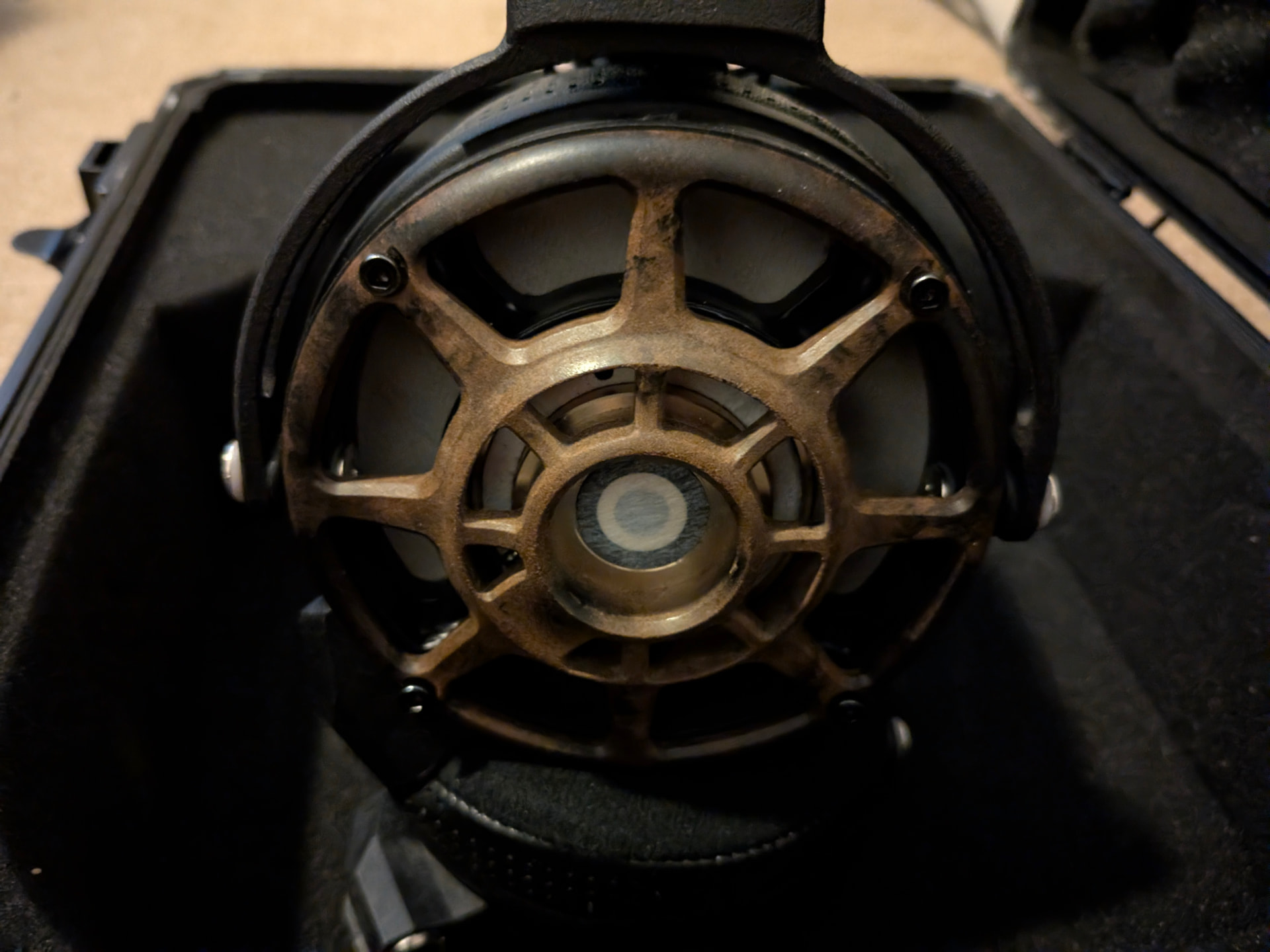
The Quasar build is quite serviceable, with various adjustments including rotating and folding cups for various head geometries. This is welcome in a sea of rigid inflexibility among manufacturers and remains reasonably light feeling despite weighing around 485 g. Much of the construction appears to be 3D-printed plastic headband yokes and cup rings.
While heavier than my daily driver, the weight distribution feels proportional across the headband and cups, making it largely unnoticeable during normal listening sessions.
Compared to the floppy headband of my prior trials with the Borealis and Australis, the new strap is welcome. Replacing the nitinol with a 3D-printed headband is acceptable, and the branding design along with the functional adjustment is well executed. The height extension accommodates a variety of head shapes and provides the right amount of clamp force.
The ear pads are the same as prior models, with round ear holes of the same depth and width that taper slightly from rear to front. For my ear geometry, with the right side being a few millimeters larger, a deeper pad would have been preferred, but rotating the cups helps relieve pressure.
Sound
For this trial I used the following components:
HQPlayer PC via Ethernet isolated on the network
Fiber media converter to Ethernet
Puritan 156 conditioner
Holo Audio Red via USB
Holo Audio May KTE
Holo Audio Bliss KTE
Using standard oversampling from the Holo May, which samples to 352.8 kHz or 384 kHz depending on the base rate, Quasar presents according to my HRTF with a treble tilt compared to my preference.
Female vocals sound slightly pitched up, and the overall signature I would describe as bright. Upper treble notes have air remnants that linger longer than I am used to from what I perceive as elevated upper frequencies. Leaving upper-range notes that result in sounding thin or frail.
When using NOS mode only at base rates, the overall signature remains bright-tilted on my head, with less spatial separation between notes and instruments compared to engaging basic oversampling.
Bass in stock form does provide dynamic impact in attack and weight in kicks. As noted in my Borealis review, and common with other dynamic driver types, Quasar presents ample rumble and facial sensations within the circumference of the pads and even at lower volumes.
Headstage
Stock stage presentation is proportional in width with stock May oversampling.
There is decent separation in the sound field, although imaging is somewhat on the smaller side and lacks height in note placement within the mix. Panning is convincing, with no three-blob effect as found in some Sennheiser models. However, center vocals feel slightly spread out in the mix instead of being projected forward, centered, and focused.
Headstage, coherency, and imaging fluctuate relative to the rate and DSP applied, as noted below.
PEQ and HQPlayer
For my trial, I tested −1 dB, −2 dB, and −3 dB tilt, ultimately settling on −3 dB.
As with my prior Borealis trial, I utilized various modes.
NOS with 44.1 base source
PCM 44.1 / 48
PCM to 1411 / 1536
PCM to May internal DSD oversampling
PCM to DSD1024 oversampling
HQPlayer DSD settings used were my usual preferred configuration of poly-sinc-gauss-hires-lp filter and amsdm7ec 512+ modulator.
Noted Tracks
Samba – Chatter
Good width and stage coherency with solid mid-bass attack, only missing deeper sub-bass information. Hi-hats have a slightly shimmery, grainy trailing edge.
The Prodigy – Smack My Bitch Up
At 2:50, stabbing guitar-like synths throughout the vocal passage are a bit thin, lacking sub definition. Vocals have good reverb, although missing sub-tonal support.
Krafty Kuts – Running
Good display of mid-bass with ample decay to relieve sub duties.
Charli XCX – Forever
Mid-bass kick is a bit muddy in busy passages, but the lack of sub information is mostly acceptable. Sub notes that start at the beginning throughout are lighter than preference.
Charli XCX – Emotional
Mid-bass overpowers with a bit too much decay where less mid and more sub would serve to tighten and delineate.
Charli XCX – Set Me Free
At 2:01, piano timbre sounds thin and lacking weight.
With this minor tilt adjustment, I report no extreme abnormalities. Only subtle sub to mid bass deficiency and slight upper treble emphasis on female vocals and hihats, which present as slight excess decay or air in percussive electronic music where incisiveness is paramount.
Final Adjustment
As a final test I added slight touches to the −3 dB tilt above and retested.
35 Hz +2.5 dB Q 0.6
7600 Hz −0.5 dB Q 1.0
Engaged, sub-bass is no longer lacking and vocal weight is recovered, with the upper register no longer displaying hints of sibilance or lingering treble air artifacts.
Conclusion
In similar regard to my prior Borealis review, much can be reiterated here.
As with any head unit, and the overwhelming number of variables such as source and head geometry, Quasar will present variably.
If grazing only from the surface level, one would be remiss to comment on anything but tone.
While the tonal nature was not aligned with my HRTF as the creator intended, it is not without redeemable qualities outside of that.
With limited time and the ease of applying a downward tilt to balance tonal concerns, Quasar becomes an easily malleable headpiece.
For those comfortable using PEQ or DSP, Quasar can be further dialed in with a specific sub-bass rise and reduction of excess air frequencies to further enhance note weight, body, and richness. Coupled with upsampling, Quasar surprised me with a remarkable ability to resolve and render transients when engaged with the various modulators and filters available with my components.
Without the availability to make the above adjustments one might unfortunately dismiss it. While not expected for typical use to embrace or discover, I credit the ability to easily conform and reach tonal balance while displaying cohesive sound imaging once extracted. A reaffirming reminder that enjoyment beyond initial judgment is possible when defying tonal confinement.
In standard form, a darker-tilted amplifier or DAC combination would further help tonal shaping if coming from a more neutral-to-bright source.
If access to the above modifications is available, or if one has an HRTF that matches these adjustments, it is possible to reach great heights at a modest cost with the Quasar.
In memory of Borealis, Quasar represents further refinement and technical progression from before. If this were to be my only headpiece, I would have no reservation in daily use due to what I was able to achieve in a short time, reaching a near-preferred signature while achieving spatial delineation of surrounding notes and maintaining quality stage coherency when challenged.
While not an immediate replacement for my inordinate standards, I must commend the effort and potential uncovered during this short stint.
Final Scores
Stock + May NOS – 7.03
Stock + May PCM 352/384 Oversampling – 7.48
Stock + HQP PCM 1411/1532 Oversampling – 7.79
Stock + May DSD Oversampling – 7.60
Stock + HQP DSD 1024 Oversampling – 8.12
−3 dB Tilt + NOS – 7.55
−3 dB Tilt + May PCM 352/384 Oversampling – 7.83
−3 dB Tilt + HQP PCM 1411/1532 Oversampling – 8.09
−3 dB Tilt + May DSD Oversampling – 7.90
−3 dB Tilt + HQP DSD 1024 Oversampling – 8.38
−3 dB Tilt + PEQ + May NOS – 8.16
−3 dB Tilt + PEQ + May PCM 352/384 Oversampling – 8.11
−3 dB Tilt + PEQ + HQP PCM 1411/1532 Oversampling – 8.27
−3 dB Tilt + PEQ + May DSD Oversampling – 8.08
−3 dB Tilt + PEQ + HQP DSD 1024 Oversampling – 8.58
I hope one finds this either useless or useful in their journey.
I appreciate Aurorus Audio for sharing in this experience.







 Our last correspondence was a year ago and I completely forgot about this. But they didn’t. Big thanks to Aurorus Audio for that.