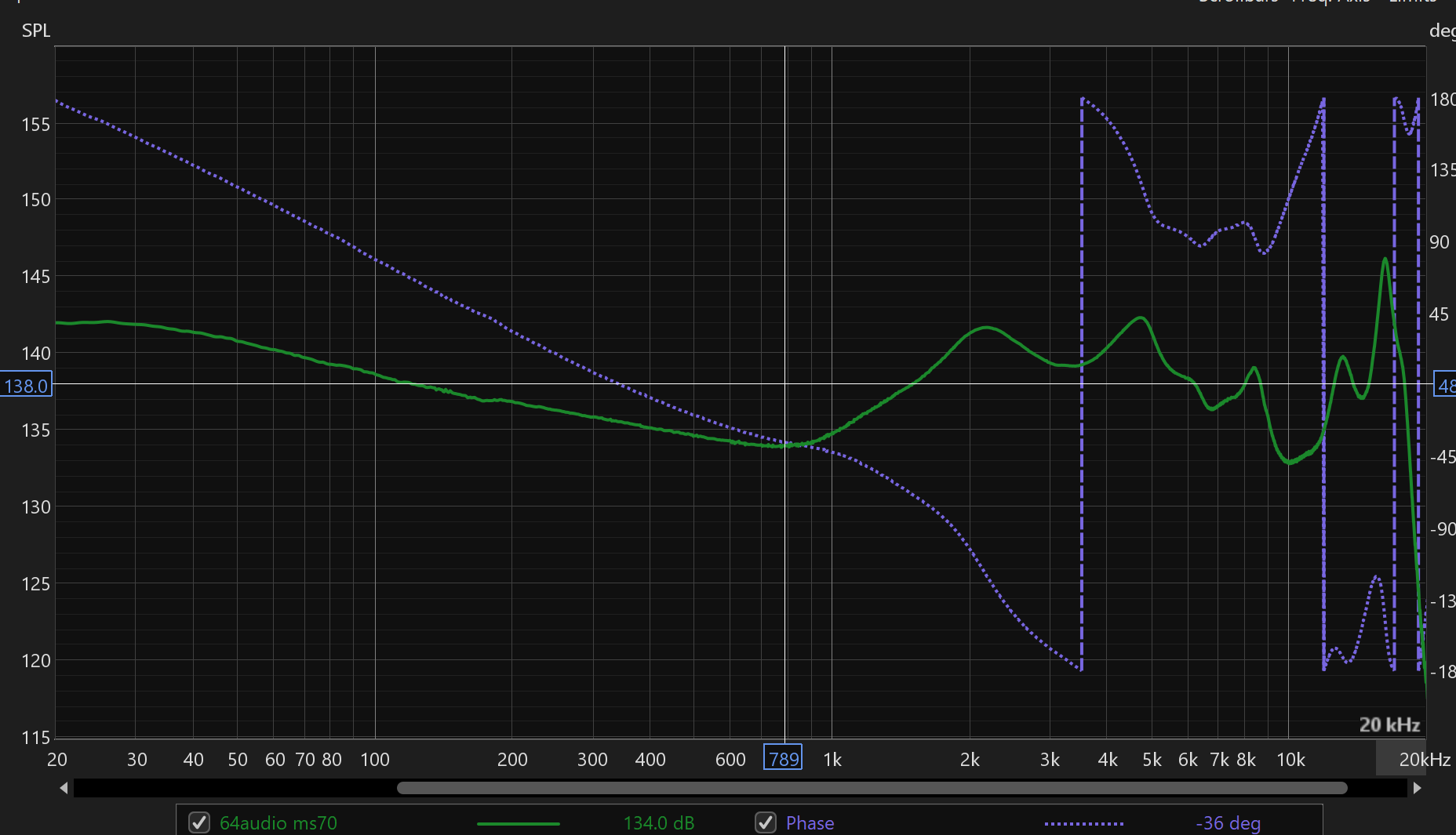
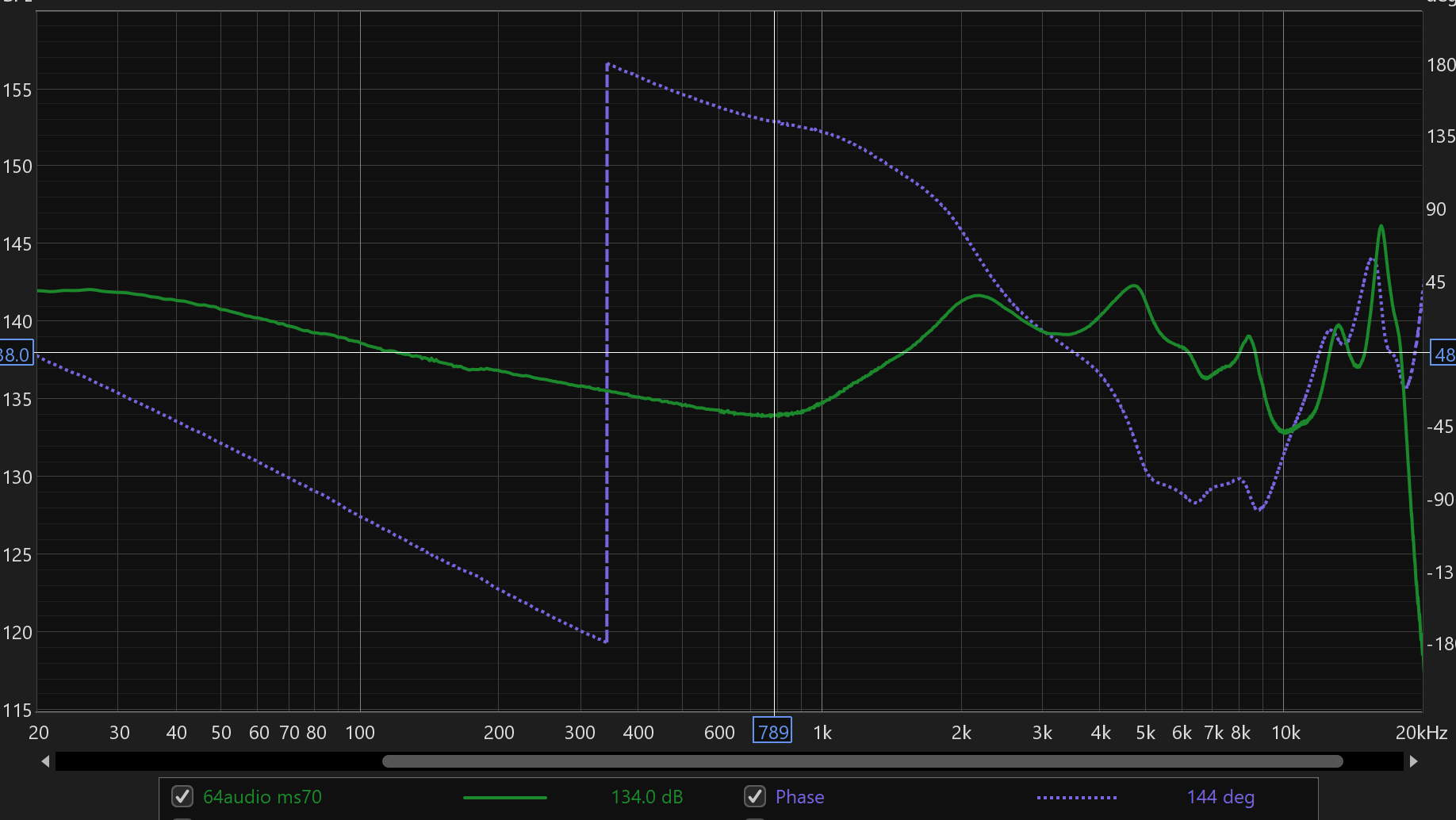
i was just getting the phase graph but maybe i might have had the polarity incorrect, Just wanted to see why the phase wrap happened before i conclude that the crossover is the case…
there are two plausible explanations, the DDs cross over right there, also if phase exceeds -180deg, it rotates to the start apparently in measurement softwares…
That’s fuckin weird and honestly imo inexcusable. I know people like to quote phase as being a non-issue and totally inaudible but I routinely have a hunch on weird phase problems and end up looking into it and get proved right almost every time. I think if people knew what to listen for, they could pick up on phase issues a lot better than they think and in my experience, phase issues are a common problem that goes totally unnoticed because FR looks totally normal. I think a lot of companies are using phase as a free cheat code to subdue certain frequencies artificially without having to design that regions crossover and it’s resulting in a lot of audible staging and warbling effects in those regions.
Humans can sense phase till like 1khz, they just need songs, specific track, beats and cues to listen to, that can help them pickup on the phase issues.
I haven’t really picked up on it, but I do like checking measurements and listening to stuff. Im not the guy to just go by the graphs as there’s a lot that can be missed that way.
I’ve been able to pick up on bad phase issues even in the treble from obsessing over video game staging accuracy for so long. It’s not super noticeable in most songs and in a lot of songs it’s almost impossible to pick up on in upper treble, but in games where staging is a visible thing you can reference in real time, some of those wonky phase issues in the mids and treble are very much audible and do contribute to a lot of the end result of what you’re hearing.
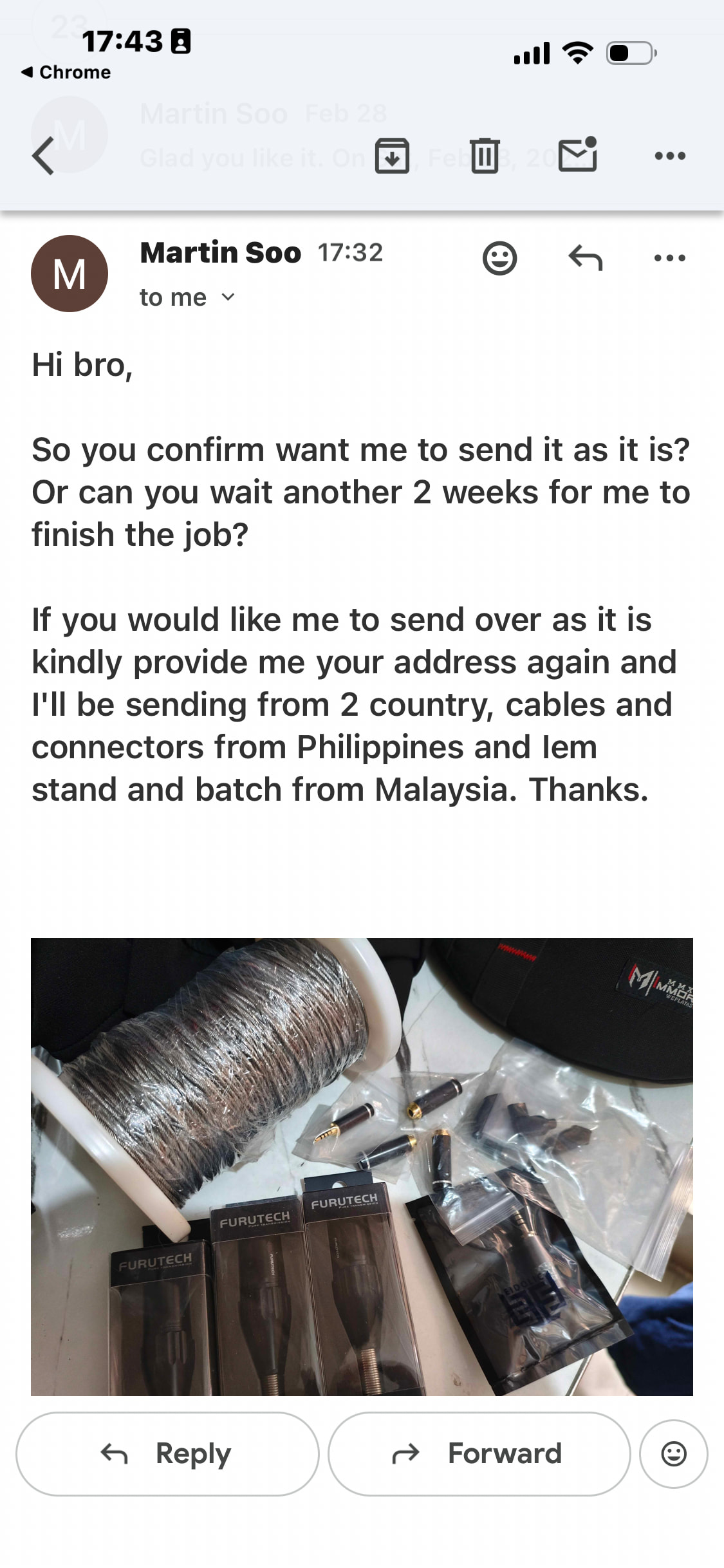
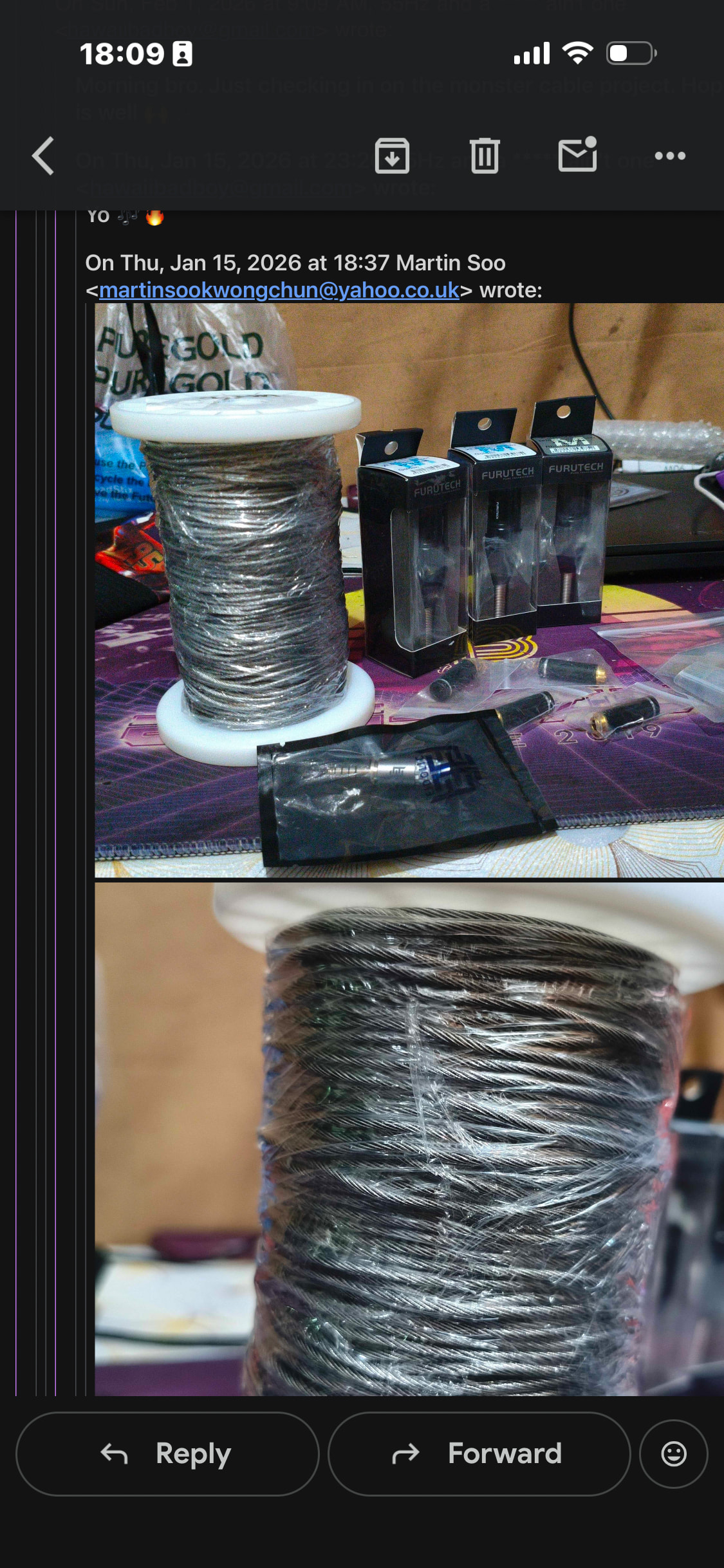
It was the holidays that caused the delay except I know people who have been buying stuff all through the holidays and the build being done by other people was never mentioned till after 2 missed deadlines. February 14 and the last day of February
I have a son and I just got fucked.
Why not just wait 2 more weeks?
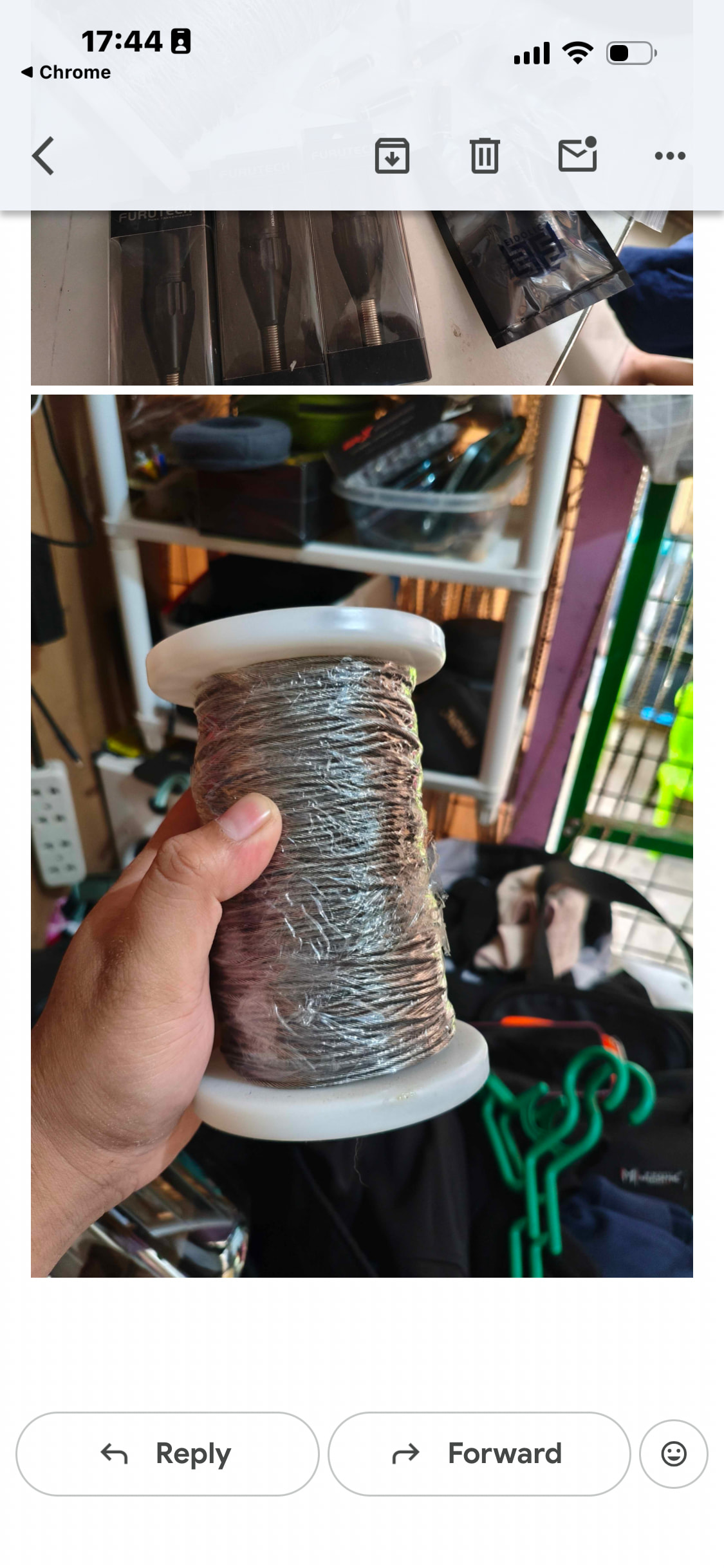
Because the photos above are in the same state as 1st week….of January
Gaming, visuals to sound latency across certain frequencies, yep you can map out phase irregularities that way since it does work in the time domain. Didn’t think about that till now.
Damn, sorry to hear that. And his replies do not seem to exhibit any remorse, nor does he seem to apologise. And the ‘bro’ is way too familiar for something like this IMO.
I don’t want to say 3k cable was a bad decision. What made you go for it in the first place tho, surely you would have heard about it somewhere from someone, could have come across delay issues like that… Or is this the first time that’s happened with this guy?
I know this is a borderline stupid thing to say, but I think video games are honestly the only way to evaluate any form of staging whatsoever. Any amount of evaluation of staging done with music alone is basically just evaluating the level of engagement it results in without visual stimulus. If you have an orchestral song on a staging monster like an HE1000se, you can artificially exaggerate that staging presence in all kinds of ways to make it seem even more expansive and grandiose with all kinds of phase, tuning, panning/imaging effects, and occlusion to make it do whatever you want and it can all be incredibly immersive and engaging, but if you had a visual representation of what is happening in front of you, that whole façade would collapse because you can tune in on individual instruments being played and notice that they aren’t actually 10 feet back from the instrument in front of them and it destroys the illusion entirely. Video games, while not always entirely accurate, can sometimes strike that balance where even if they aren’t ruthlessly accurate, can show differences and flaws in staging that music never could in a million years. I’m a total whore for music, I listen at all times and try to pack as much listening time into my life as I can, but when it comes to evaluating gear, music is firmly HALF the equation. Not 75%, not 60%, not a hair over half. Staging in music is all up to your imagination, staging in games is raw data.
A few things I would like to guide on based on my experience, never tune iem to a particular instrument. I don’t remember who told me that, but, it doesn’t work like that… is how i can put it for now.
You can sort of apply that to stage tuning also I guess.
Tune for a good smooth correct sounding tonality and get a driver and crossover combo to get the bass you want.
Tune the bass driver, the back volume - tighten or loosen the response apart from the low pass. Have good venting, could make sound stage feel less congested and a bit wider… It could be an acceptable idea to smoothen treble for sense of space to create sound dispersion in the area of the sound (like high hats), unless you want sharp undamped pin point treble for precise imaging.
Some of the tricks I think that can help with soundstage. Also ofc the phase alignment as we discussed before.
Yeah there’s endless amounts of tricks you can play at to modulate any spatial queues. And in a lot of ways, they work fine and result in totally acceptable listening conditions that present zero issues whatsoever with almost or entirely every kind of music. Its a really weird psychological phenomena where you can paint a picture in your head of what you’re hearing and be almost able to decide in your head where the outer bounds of a recording room are and what’s in it and then have it totally fall apart when you have a visual representation of what that soundscape actually would look like. I appreciate the illusion some songs create and, in my opinion, that’s where the art of music comes into play a lot of times, creating a scene that pulls emotions out of you with nothing other than sound, and that’s fine and can’t be critically evaluated and broken down. Fine. Games with the visuals they give you as a reference can be infinitely helpful in finding some specific issues in sets that you can’t find with music easily or without some seriously tedious track looping of 3 second sections to figure out what the fuck is going on with spectrum analyzers and some visual tools. There’s some elements of audio that, without any visual representation, are so impossible to properly assess that it’s almost pointless to even try. I really wish someone could come up with a visual audio test that is just a pure sandbox of 3d visual queues you could modulate freely to place to point out strong points and weak points of imaging and spatial abilities that removed the bias of certain tuning tilts. One with a slew of HRTF calibrations to pick from would be infinitely helpful and if it could help people find their HRTF within a couple % of perfect, that would make a world of differences to their tuning choices/preferences and how their ears interact with the tuning/phase in general and could give a lot more of a finite answer to what would work specifically with that person. Idk this shit is so stupid but most of it is still just locked behind proper frequency response and until then, nobody is gonna care or even be able to even really tell what’s going on with all the stuff that happens the second tuning changes.
Whelp, it happened. Price for 1 metric ton of marine diesel went over 1k USD.
And the EUR/USD rate is back to 1.16.
Last time this happened was near the end of Februari 2022. Want to take guess what caused it then?
Looks like I’ll be re-evaluating creditlines for our clients for the rest of the week.
I remember doing a flying Bee test. You drag that thing across/around a virtual head and sound is simulated exactly as if the bee is flying around you according to your mouse positioning the bee virtually around your head…
But i don’t think that buzz is enough for you to judge accoustic phase response with that since it is very limited…
Yeah but they don’t allow control. That’s literally the only part that matters when it comes to defining how it all reacts to minute changes in direction. Like I’ve had people even play songs in games with proximity chat just so I can stand next to them and rotate slightly by a couple degrees or move away and closer and hear how it effects some of the staging. The game I used to use for that specific test that didn’t add any processing to the prox chat was really helpful, but it’s shut down now.
Those spatial audio tests allow for visual, but they don’t allow you to control the X/Y/Z panning yourself so it’s almost useless for comparison because you can’t modulate it at all by yourself. It’s like not even a half measure to the final issue and while it’s better than just music for evaluation, it’s still not even remotely accurate or close to being a test bench. When there’s repeatable sounds in games and you can use that sound point to walk around, turn, change floors, move to walls where they have occlusion effects, and adjust placement of that sound source point object, you can really get a good idea of how well something images and stages in practice and in some scenarios, it can be as meaningful as 30 seconds spent in a game will tell you more than you could find out from 100 years of listening to music when it comes to spatial accuracy. Tonality is almost infinitely easier to assess from music, spatial queues are infinitely easier to assess from a video game with a well developed and designed sound engine.