Excellent review Kevin description was spot on.
And thanks for doing the Hype 10 Comparison that should others decide what model would be best for themselves.
Excellent review Kevin description was spot on.
And thanks for doing the Hype 10 Comparison that should others decide what model would be best for themselves.
Meze 109 Pro – Lively Musicality Lives & Breathes Here
Preamble:
Meze Audio is a celebrated brand that manufactures headphones and their associated accessories. Founded in 2011, this Romanian-based company has garnered an enviable worldwide reputation for high-quality products.
The $800 109 Pro lands in the middle, actually lower middle, of their range. There has obviously been a good amount of effort both from an engineering standpoint and in the audio characteristics. Meze also states that they designed the headphones in a modular fashion, allowing users to disassemble and service them endlessly. Impressive indeed.
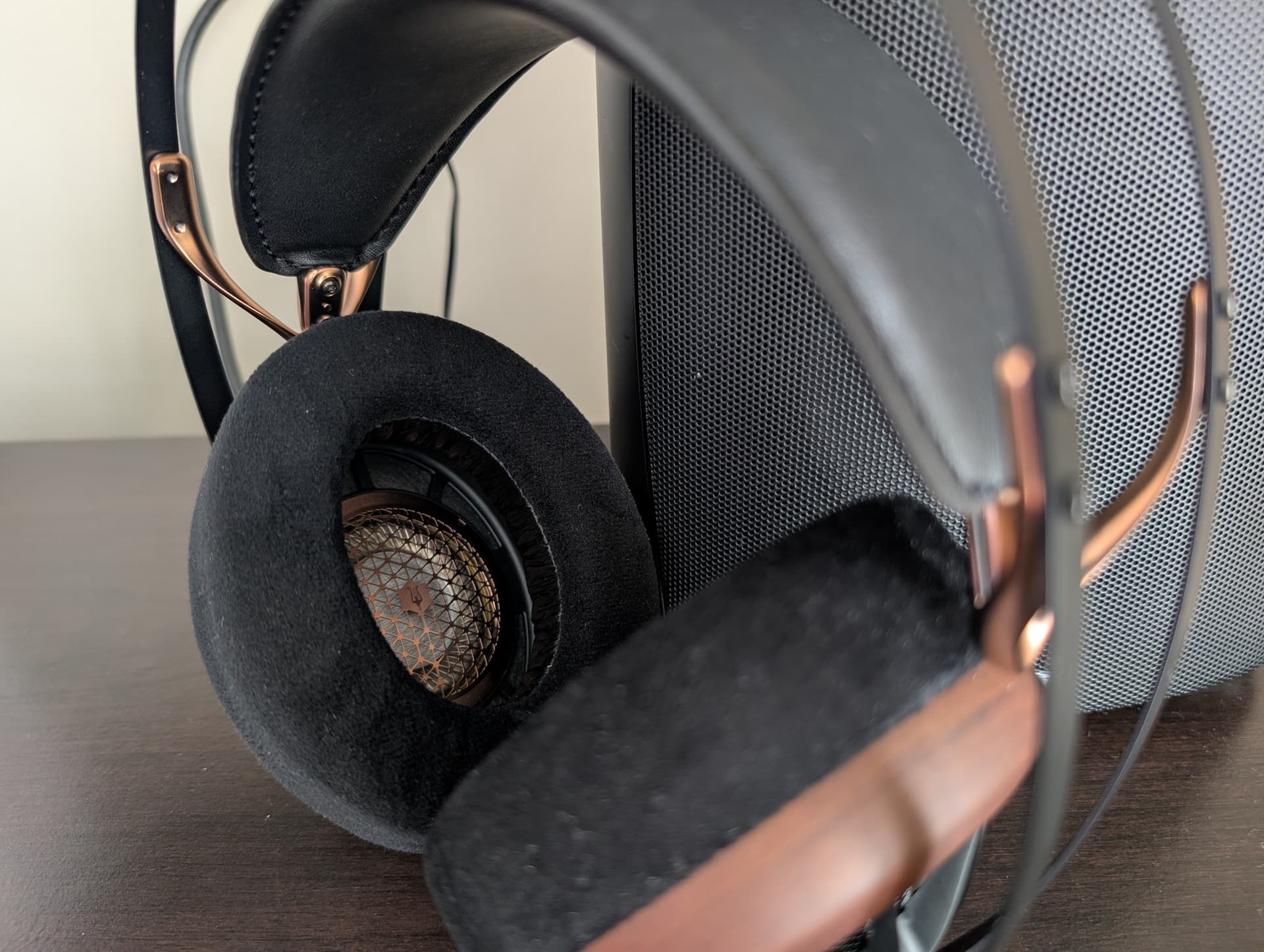
The open-back 109 Pro uses a single in-house dynamic driver with a W-shaped fibre-reinforced cellulose composite dome. The torus around the dome is made of the 22-micron thick beryllium-coated semicrystalline polymer. The diaphragm sits in a high-precision aluminium frame with a copper-zinc alloy stabilizer, positioned around the membrane.
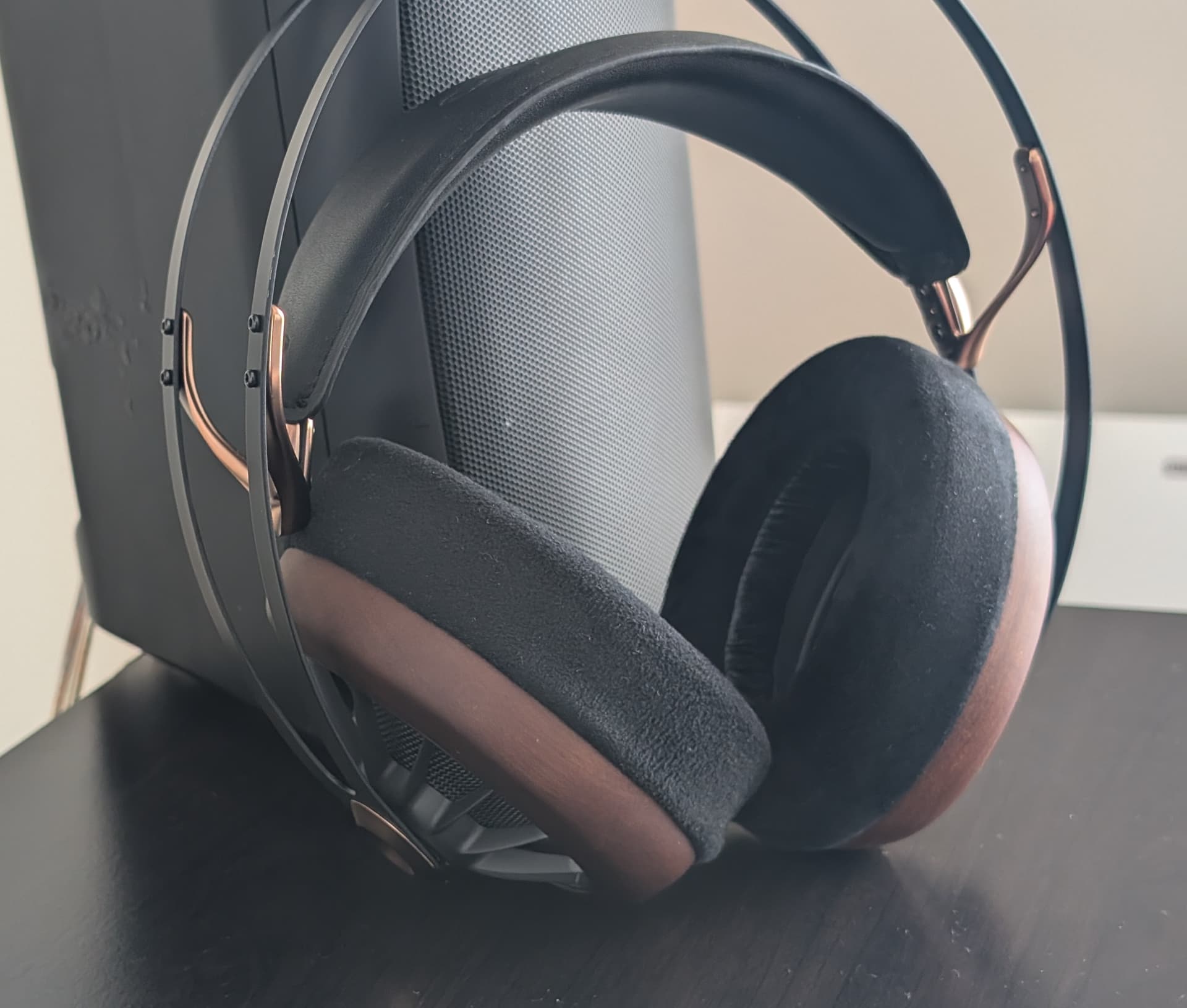
With great build quality, the design is fabulous and attractive, IMHO. The 109 Pro is also easy to drive, and while it definitely scales with better sources, it plays well with less powerful sources. I though, would not power this worthy headphone from any old source. A clean source with either a balanced or just slightly warm sound signature will do the Meze 109 Pro proud.
But how do the Meze 109 Pro sound? After all, this is what this review is all about. Well, it sounds like they look. Luscious and intricate, with a pleasing balance of technicalities and musicality. It offers a balanced tonality with a touch of upper-frequency boost.
Specs:
Driver Information: 50mm Dynamic
Impedance: 40ohms
Sensitivity: 112dB SPL/mW at 1khz
Rated Power: 10mW
Maximum Power: 20mW
Frequency Range: 5Hz–30kHz
Total Harmonic Distortion (THD): Less than .1% 1 khz
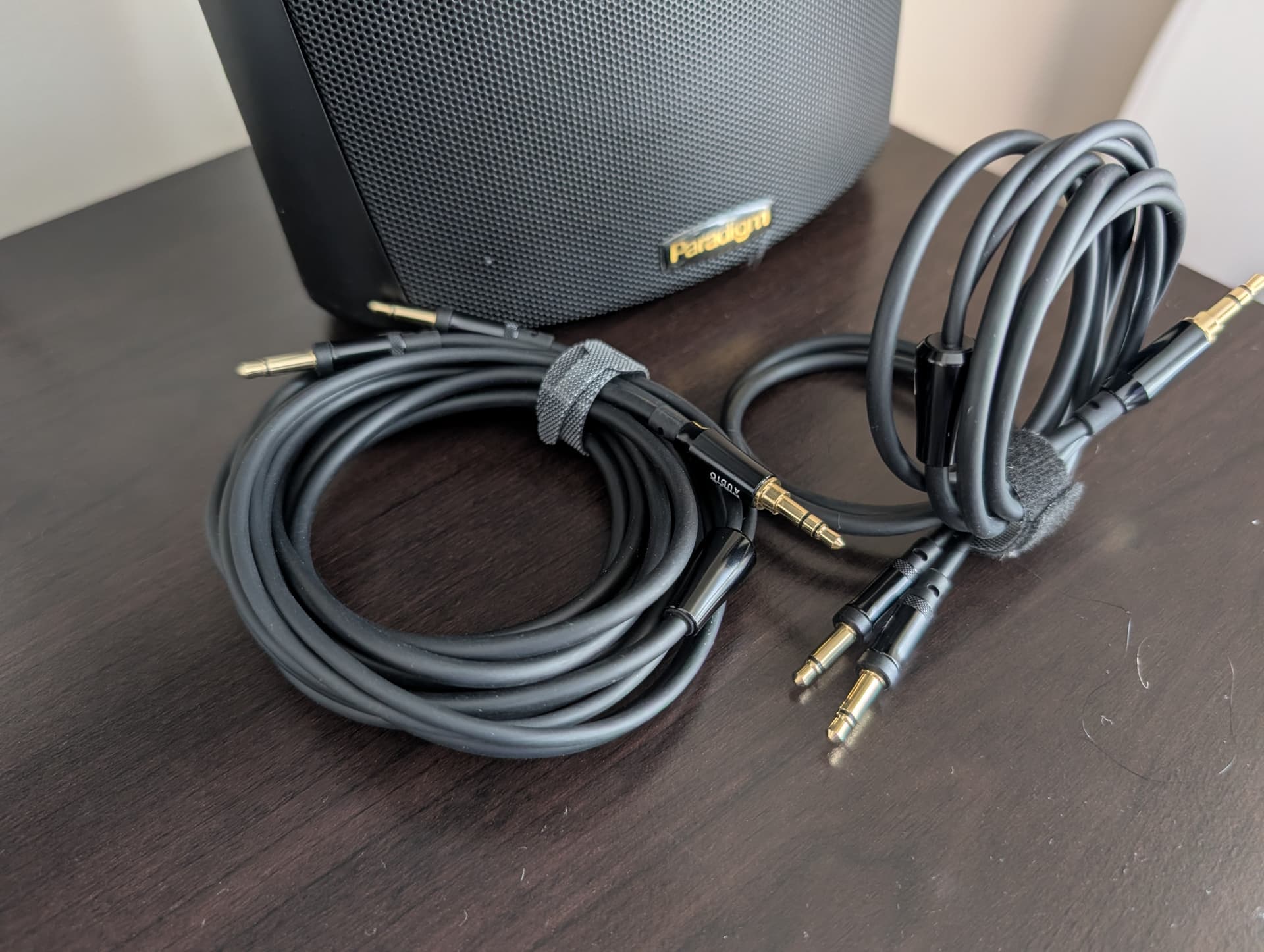
Input Connector: Dual 3.5mm TS Jack
Build & Fit:
SOURCES:
SOUND:
Bass:
Midrange:
Treble:
The treble has good extension.
Smooth treble with notable sparkle and air. No harshness or overhang.
Detail retrieval is quite good.
There is a natural liveliness in the treble but never fatigues.
The treble adds notable spaciousness to tracks.
Treble presentation is organic. Cymbal work sounds natural.
The relaying of treble nuances and texturing is also notable.
The Meze 109 Pro is a great-sounding headphone. It’s not for bassheads , or for those who want excessive embellishments to the sound. The 109 Pro delivers an overall balanced and surprisingly clean presentation that satisfies.
The quality of the bass stands out with an organic tone. The star of the show, though, is the midrange with its beautifully open and clean sonics. Musical indeed.
When first hearing the 109 Pro I thought to myself, it sounds good, but what else? Time spent with the 109 Pro has allowed me to fully appreciate what it brings to the table. A clean, balanced sound with lively yet unfatiguing sonics that portray music in a naturally open and unrestrained way.
MAGING & SOUNDSTAGE:
CONCLUSION:
I am a believer in what Meze has done with the 109 Pro. When listening through these headphones, I always felt compelled to sample more music outside of just my usual test tracks instinctively, the 109 Pro drawing me in time and time again. Playback through these headphones sounds like music. This is high praise from me as many highly touted IEMs and headphones I have listened to sound more like HiFi than music, having precision but lacking musicality and soul, which limits my emotional involvement in the music.
At $800 USD, while not cheap by most standards, the Meze 109 Pro’s performance is commensurate with its asking price, and I would have to say even hits above this mark. The Meze 109 Pro is an excellent-sounding headphone that will bless its owner with a musical, organic and lively sound quality that I find quite pleasing.
This one was a great surprise!
@tonedeafmonk YT link is dead but it plays without issue directly on your YT channel.
On another note: How would you compare sound DX340/AMP15/SG vs DX340 and PB6? I don’t have hard to drive HP or IEMs but curious if it has the clear ‘sterility’ of AMP15 in SS mode or it it more like AMP16 or 17? A comparo would be awesome oh comparo master.
I’ve had 6418 tubes in the past and they don’t color much…not like NuTube or full size vacuum tubes in my experience.
I enjoy AMP13 but it’s often at it’s dynamic limit with some of my hybrids or so it feels.
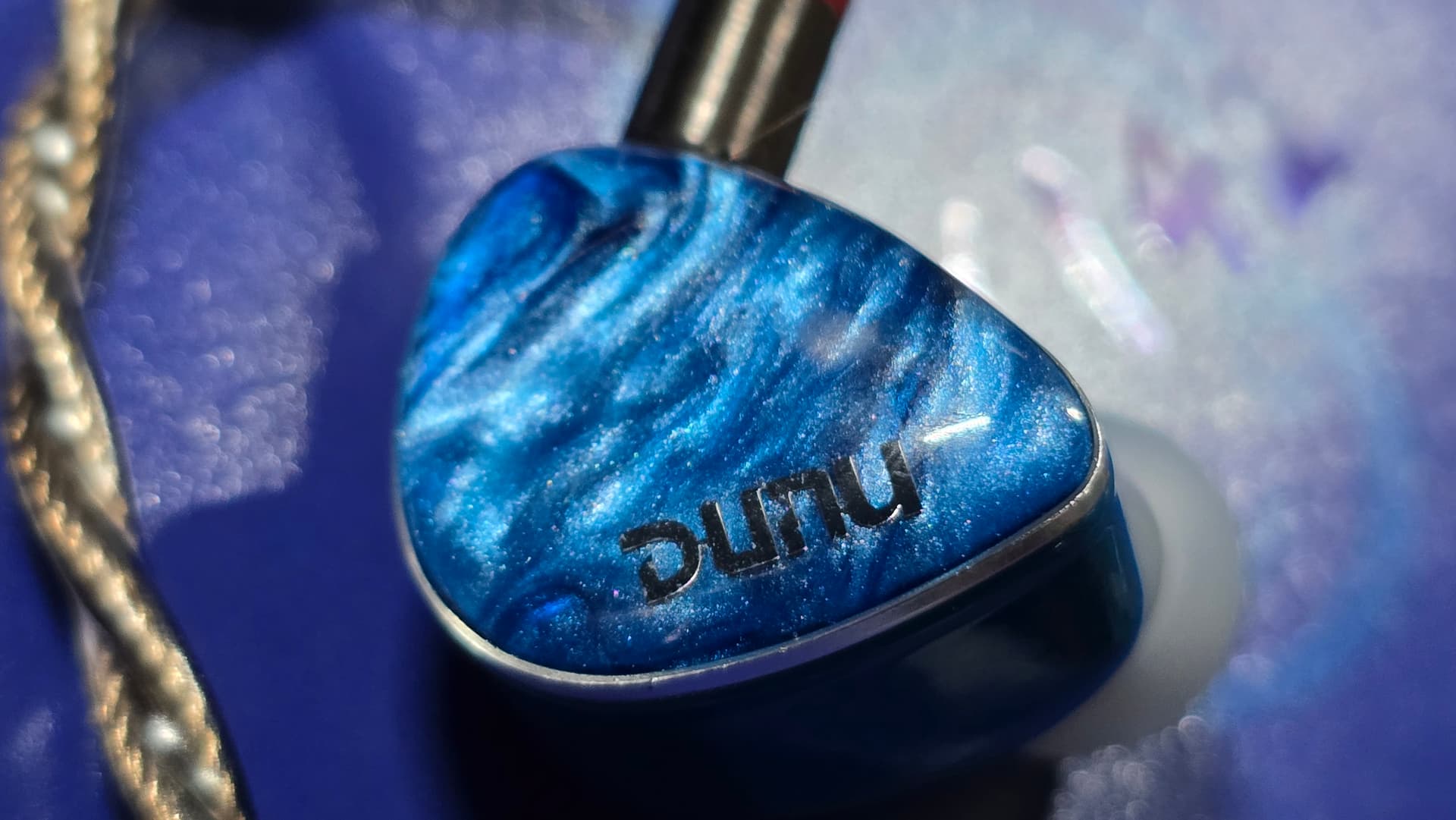
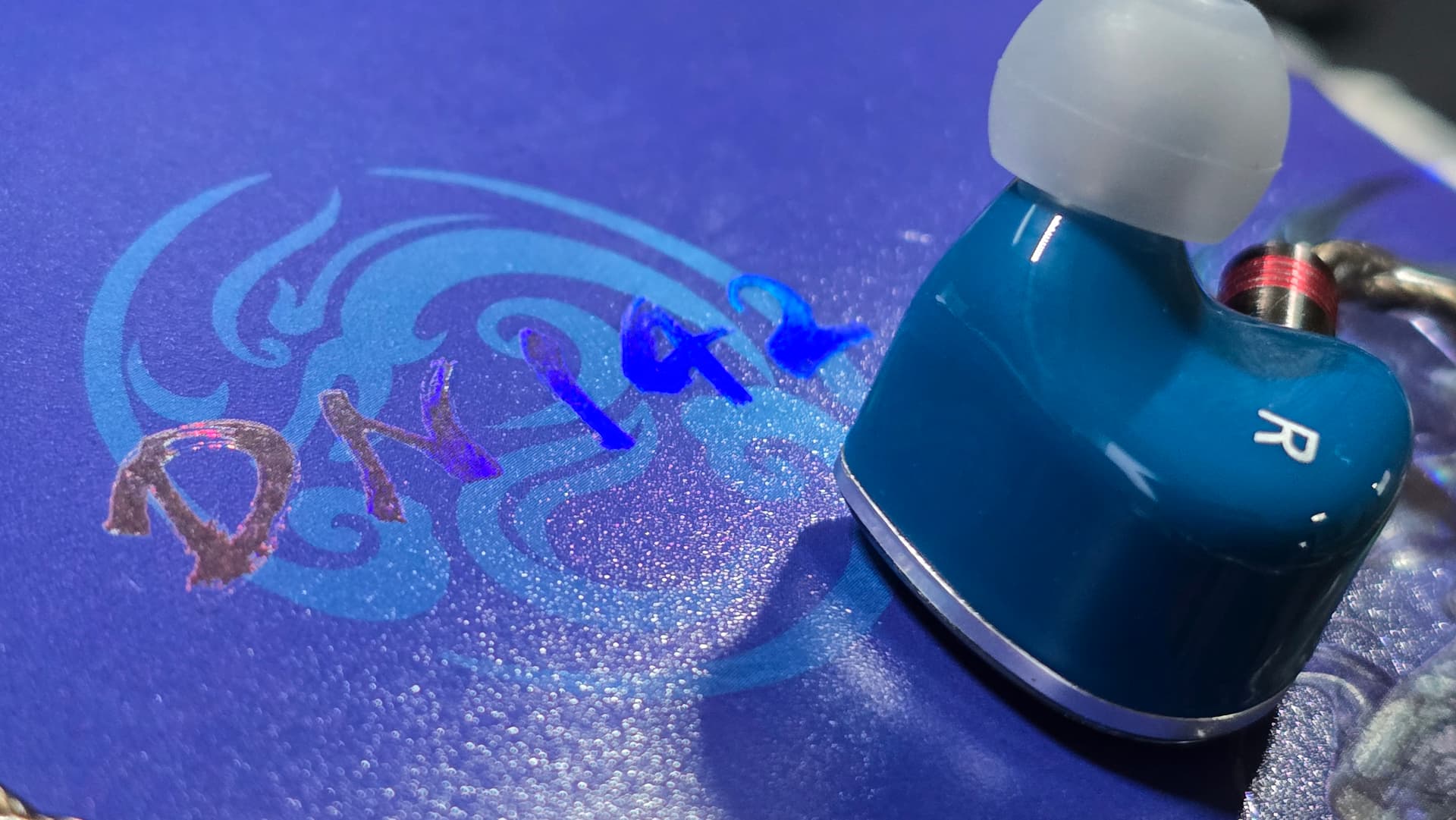
First listen to this new DUNU 124
From HiFiGo thank you to both for this wonderful opportunity to hear this IEM.
It’s stunning firstly and by far my favorite DINU I have listed to.
While the ITO was big bass bombastic this one is very well tuned for my tastes.
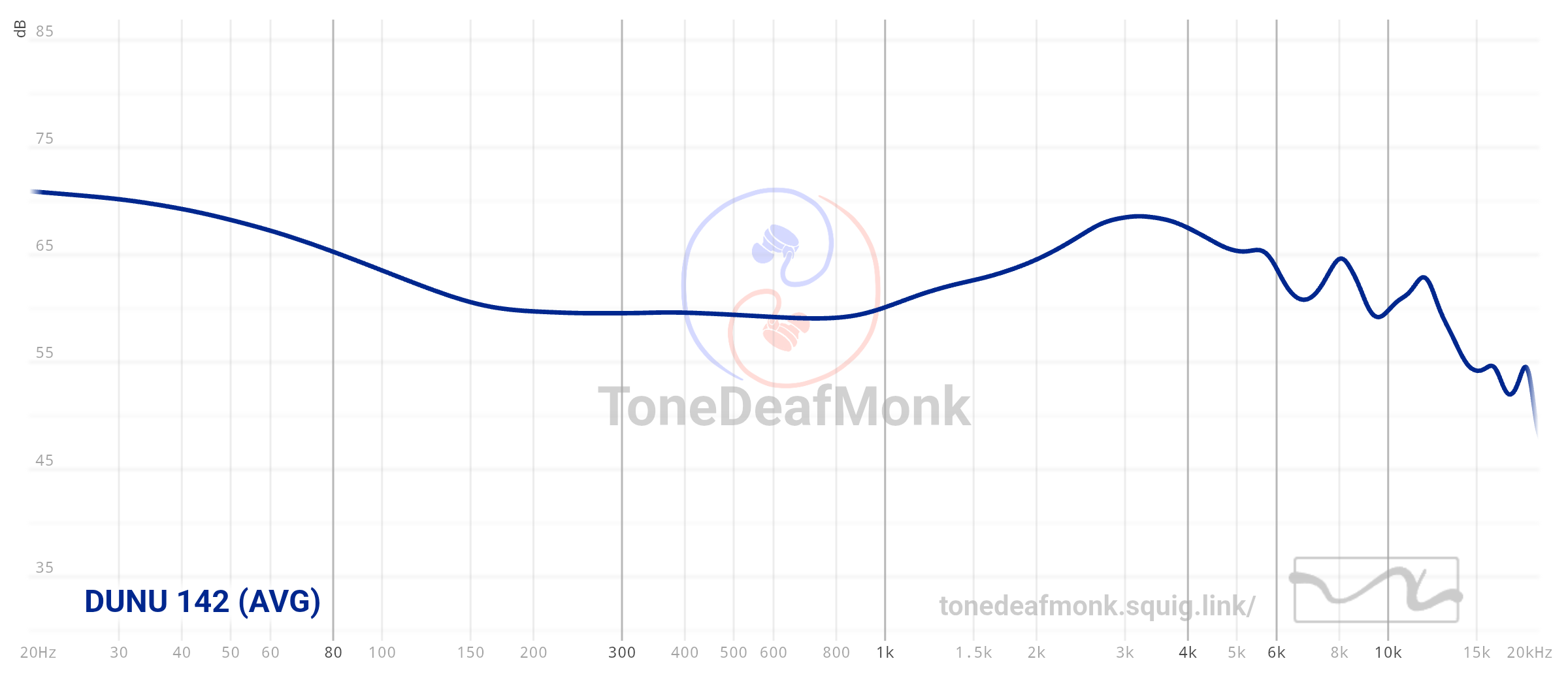
While the 242 for me was definitely more mid-centric in its presentation the 142 feels more balanced , the bass adds some really nice weight and balances off the slightly elevated upper mids , really groove to this tuning alot.
Mids stay super clean and completely uncolored this one doesn’t exsibit too much warmth while not being cold or clinical just fun and balanced.
Looking forward to getting more time on this with some different sources as well.
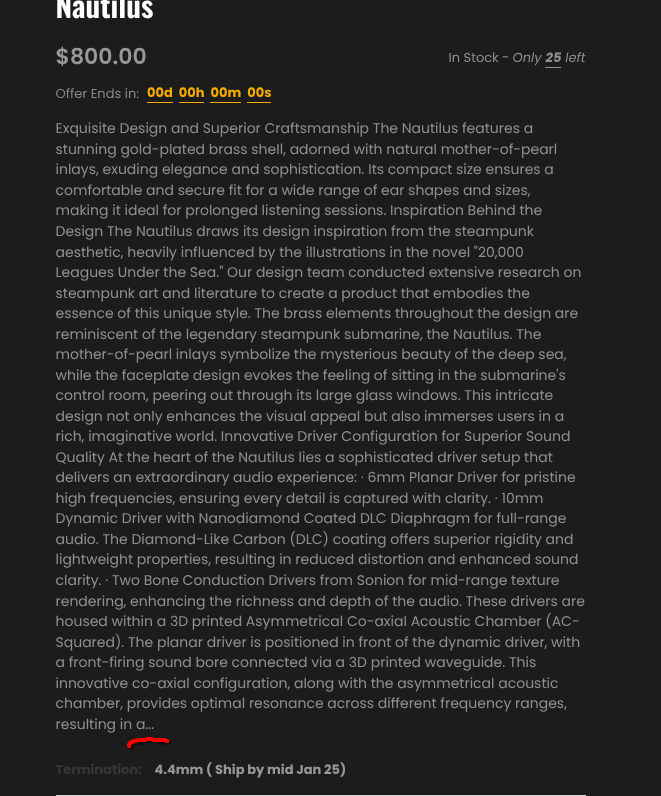
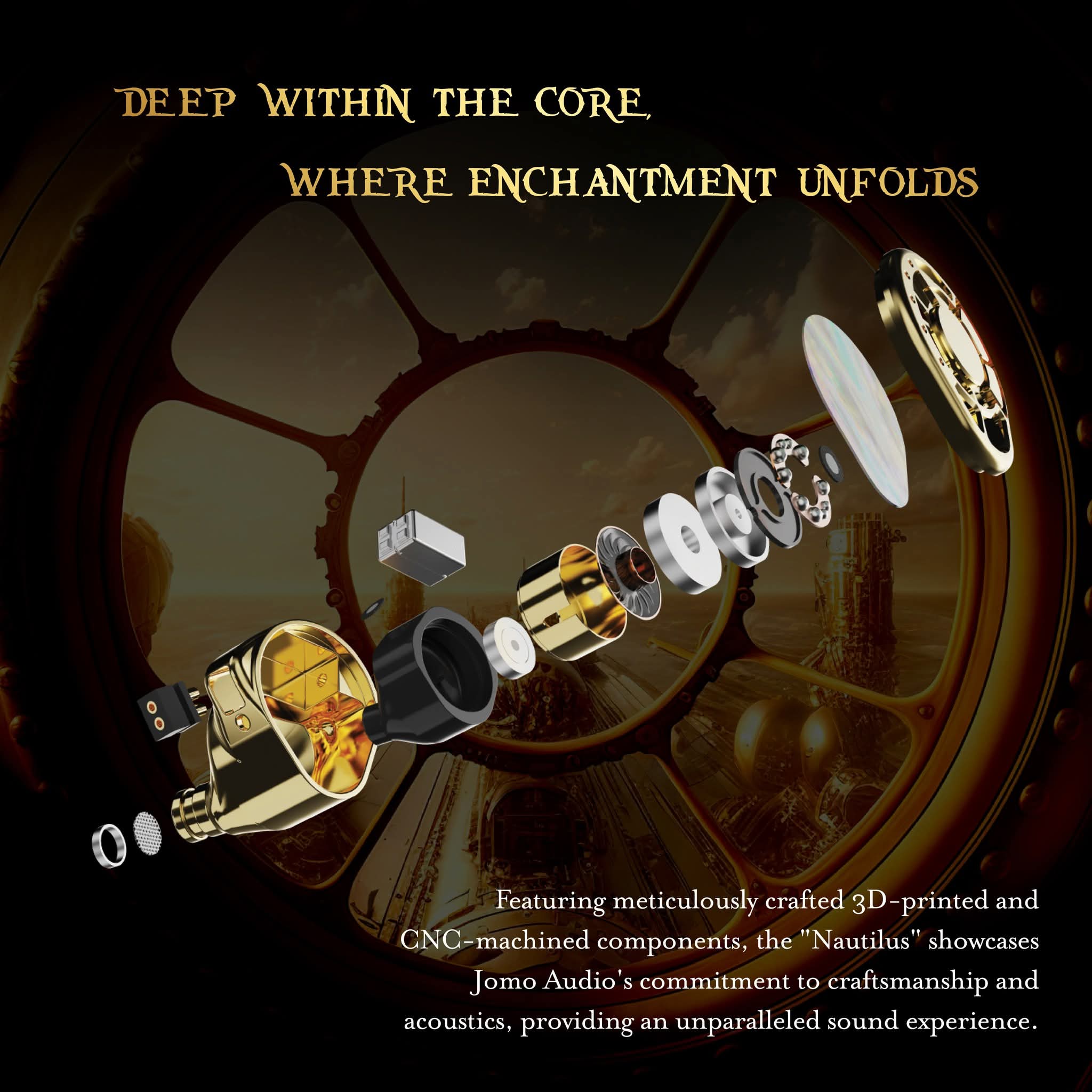
JOMO AUDIO NAUTILUS
$800.00 usd
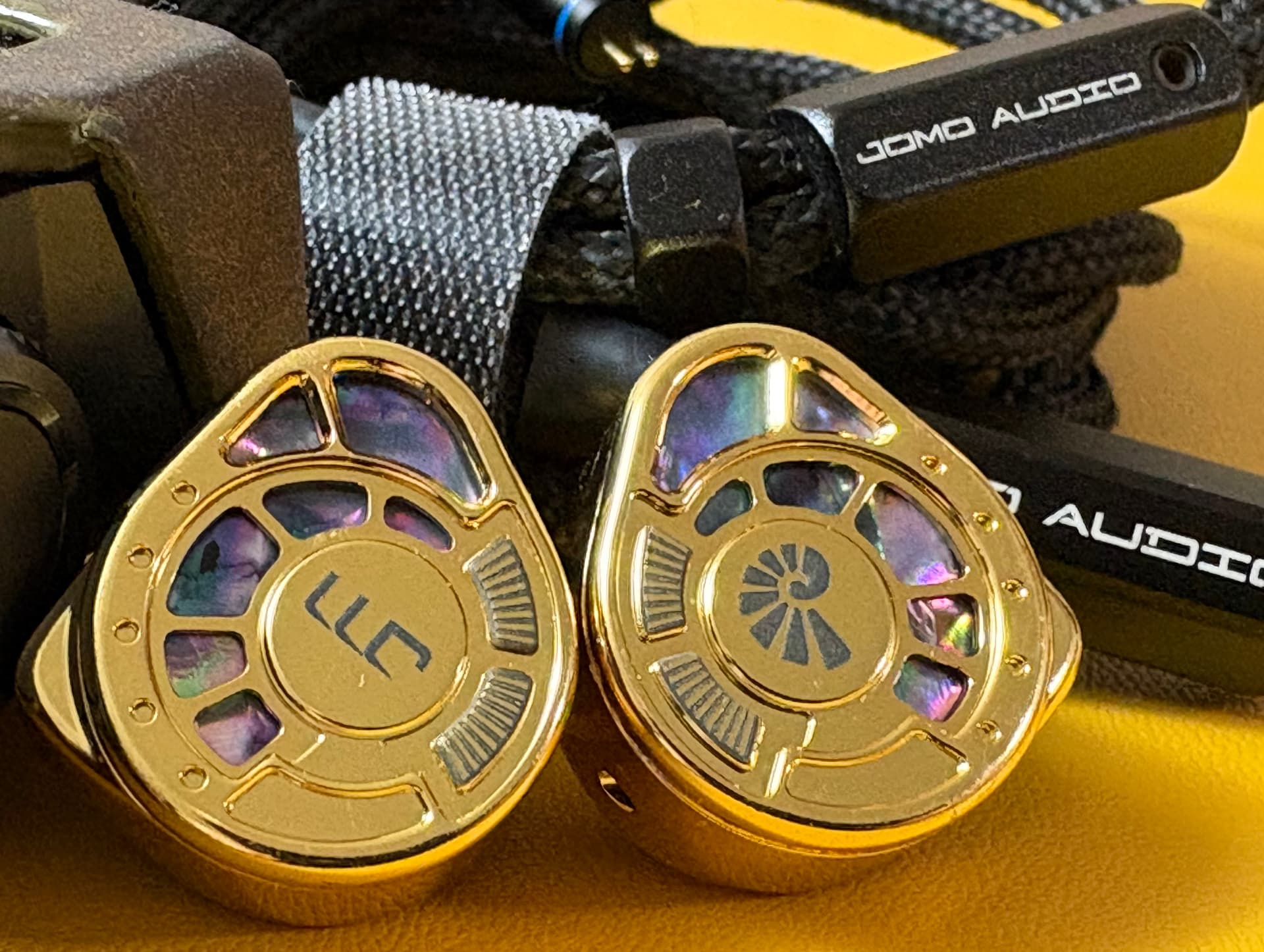
CNC Gold-plated Brass Shell with Natural Mother-of-pearl Inlay
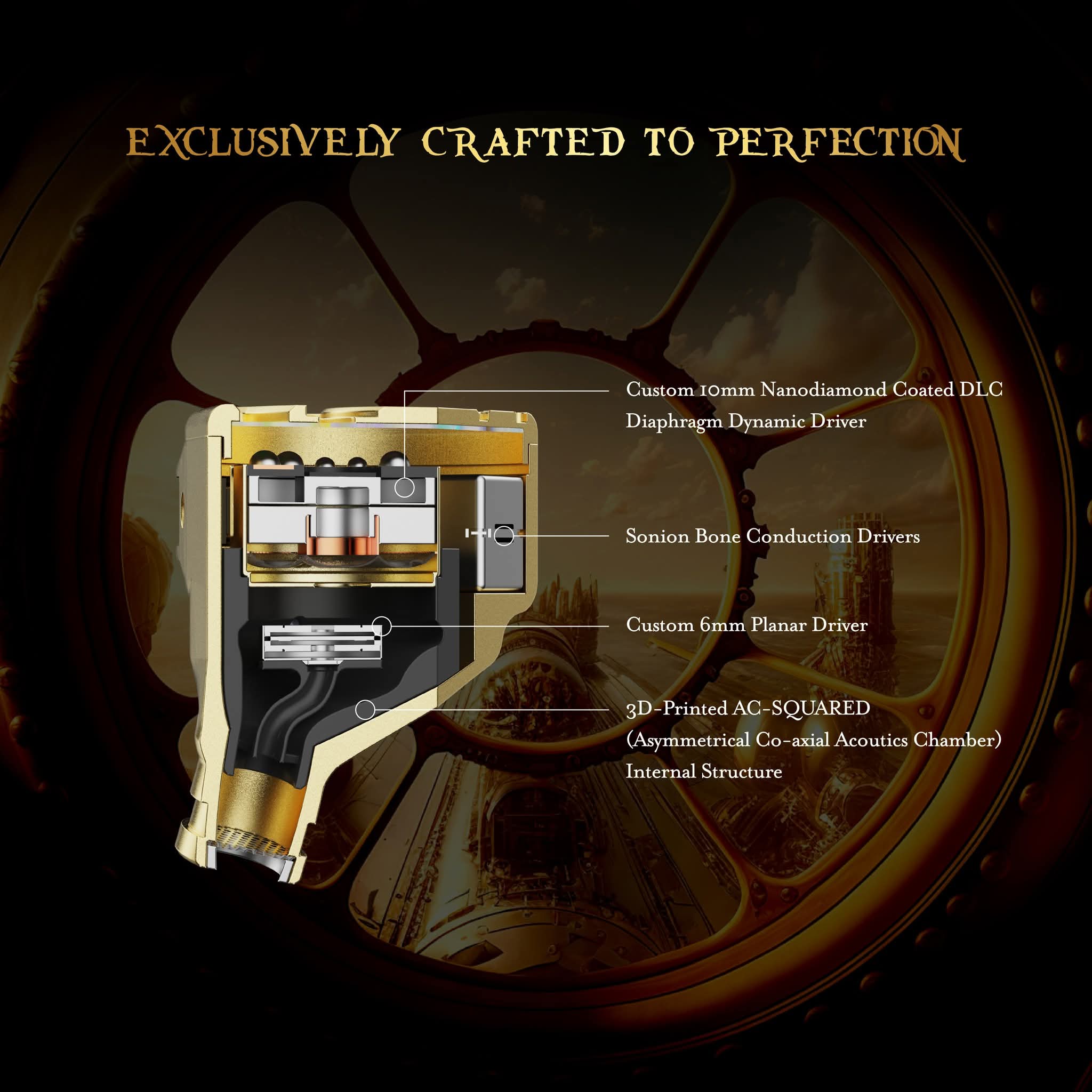
1 Custom 10mm Nanodiamond Coated DLC Diaphragm Dynamic Driver: Full Range.
1 Custom 6mm Planar Driver Unit: Pristine Highs.
2 Sonion Bone Conduction Driver Units: Mid Range Texturing.
3-Channels C.S.U. (CrossSync Uniphase) Crossover Network
3D printed AC-Squared (Asymmetrical Co-axial Acoustic Chamber) Internal Structure
Frequency Response Range: 20Hz ~ 45KHz
Impedance: 11 ohms @ 1Khz 0.5Vrms
 Preamble:
The Jomo Audio Nautilus is a Canuck Audioholics Review Group acquisition.
It is currently touring the group for review.
Tone Deaf Monk
Kingnubian
Krusty’olBastid
Packaging :
Is standard fair. The contents are in a box with ample packing material to protect everything during shipping.
Box slips into a retail presentation sleeve with some artwork and specs information on it.
*Ear pieces.
*Fabric wrapped, High Purity OCC copper cable, terminated 4.4mm.
*Carry pouch.
*3 pair silicone ear tips
*3 pair double flange silicone ear tips.
*Documentation and a wiping cloth.
Pros and Cons:
 Gold plated CNC machined brass shells feature a 3D printed internal acoustic chamber.
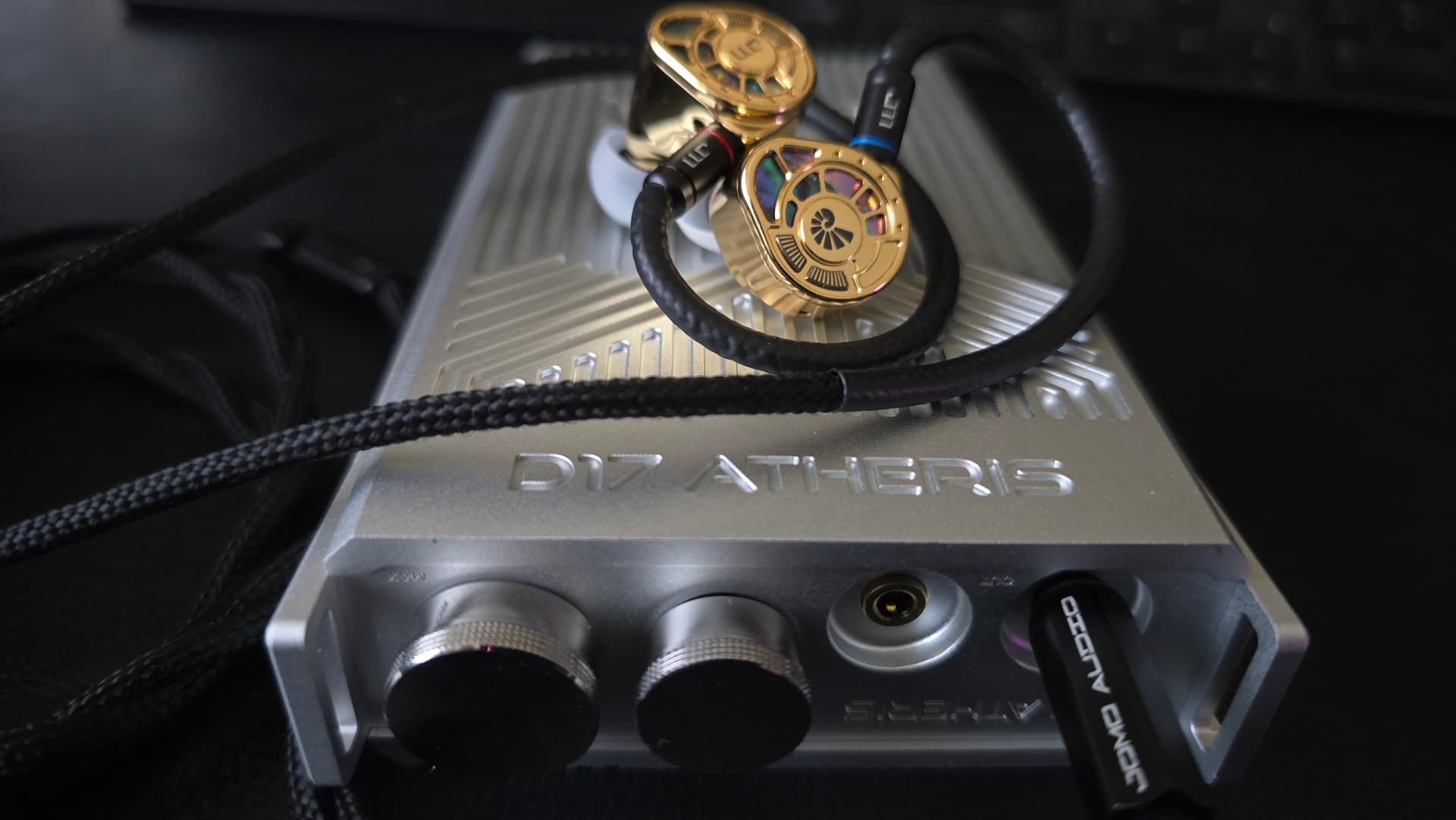
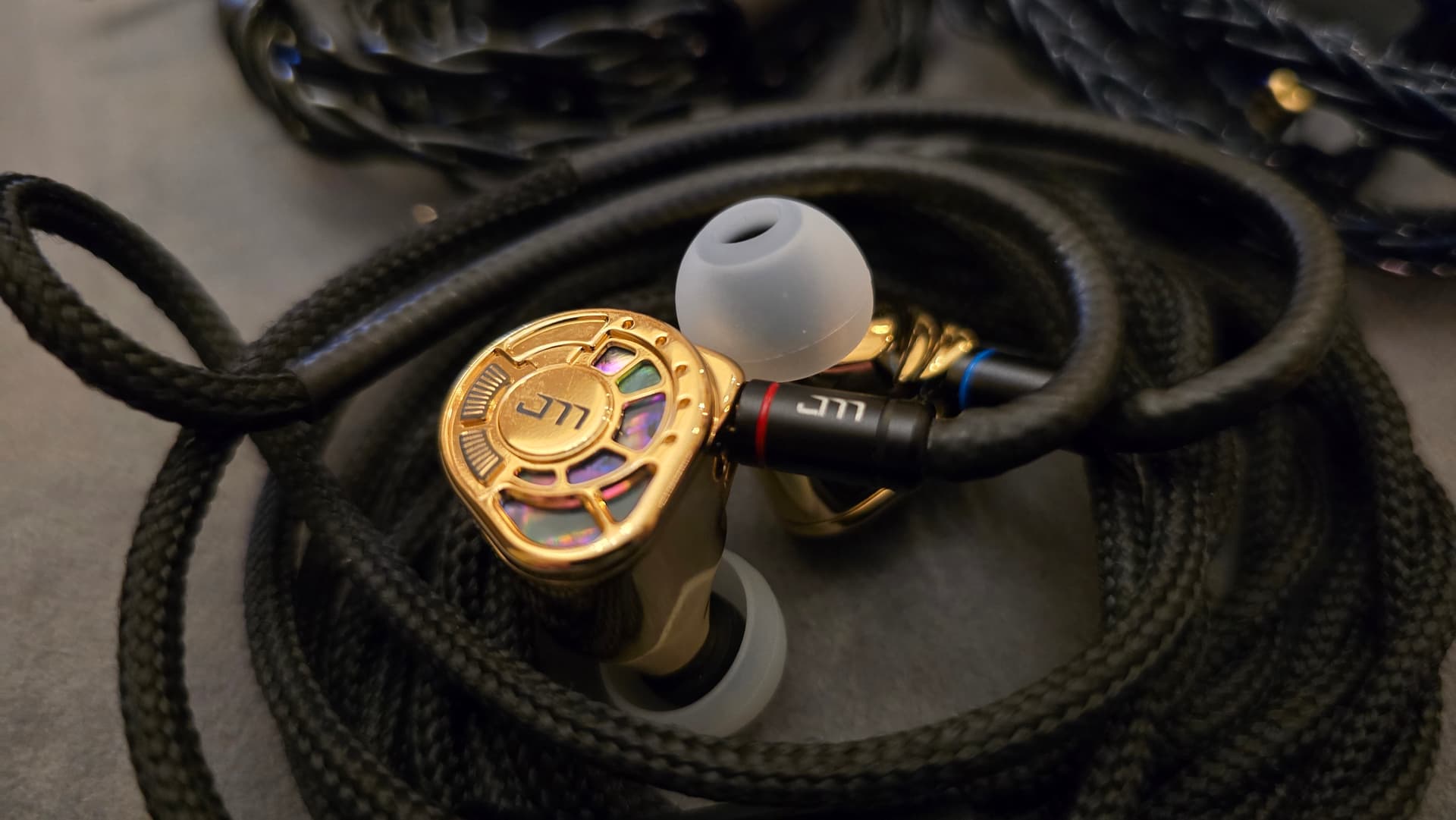
Steampunk inspired gold plated brass faceplates are adorned with natural mother-of-pearl inlays.
The mirror finish is pleasingly resistant to fingerprints, but, as the photo shows, are prone to micro scratches.
Earpieces are reasonably compact, but being brass, do have some weight to them (approx. 13g per).
They fit my ears well, are comfortable in ear for lengthy sessions despite the weight, and they anchor and seal well.
Fit and comfort, being very personal and individual, results will vary between enthusiasts.
4.4mm High purity OCC copper, fabric wrapped cable exudes quality, and pairs well with the IEM. All metal hardware, functional chin toggle.
I have seen Nautilus referred to as having a V shaped signature. I find it more balanced than that. Yes it has punchy bass, and prominent mids, but also detailed highs to round things off.
 Mids can get peaky. (Source device)
Source device fussy (my experience)
More on that below.
Sonion bone conduction drivers are not favourites of mine. Personal and subjective.
Source Devices.
I have a mids sensitivity around 3.5k, and while Nautilus does not irritate my sensitivity, on brighter/resolved sources, or mids forward sources, I find the mids can get peaky on some tracks, and, at higher volumes.
Also, bass is mid over sub, and I found to get good definition between mid and sub bass, a high resolving source device was best suited.
What defines good sound is personal and subjective so mileage here will vary. With Nautilus I found I wanted a source that had a balance between being resolving, while not being over elevated in the mids.
FiiO JM21, Hiby R8ii, and Nippo A100 not resolving enough in the bass.
Activo P1, AK SP2000T, Hiby R4, too resolving or mids forward.
VE Galvatron amp or AK HC4 dongle with iPhone, were good.
The Astell and Kern Kann Max is a resolving, but fairly neutral tuned DAP and was my preferred pairing.
Sound evaluation is done with the Kann Max.
Equipment:
 Jomo Audio Nautilus IEM, aged 100+ hours.
Astell and Kern Kann Max DAP, mid gain, 4.4 balanced out.
Stock pure copper cable, terminated 4.4mm.
Eletech Baroque wide bore ear tips.
Sound:
Bass is punchy and tight.
Mid over sub tuning delivers a strong presentation with with punchy impact that struggles a bit with sub/mid bass definition.
Recorded tracks that are sub bass prominent have decent rumble, but don’t pull really low.
Tracks that have a blend of sub and mid bass tend to lean more toward boomy/thumpy bass rather than rumbly.
This is, in part at least, why my preference is for a source device with good resolution. It helps add some extra texture, definition, and dynamic to the bass.
I listen to electronic, rap, hip hop, etc. but they are not the mainstay of my library.
Bass on the Nautilus is very good for the bulk of my listening, but those with sub bass heavy libraries may find themselves wanting.
Mids are incredible on Nautilus.
Despite having a mids sensitivity, I really like good mids. (as long as they don’t peak much around 3.5k)
Nautilus delivers in spades.
Clean clear and detailed.
Elevated and nicely forward.
Just enough bass carry forward to add some warmth without dulling detail.
Stage is open and spacious enough that vocals stand out on their own with clarity and detail. Accurate and natural.
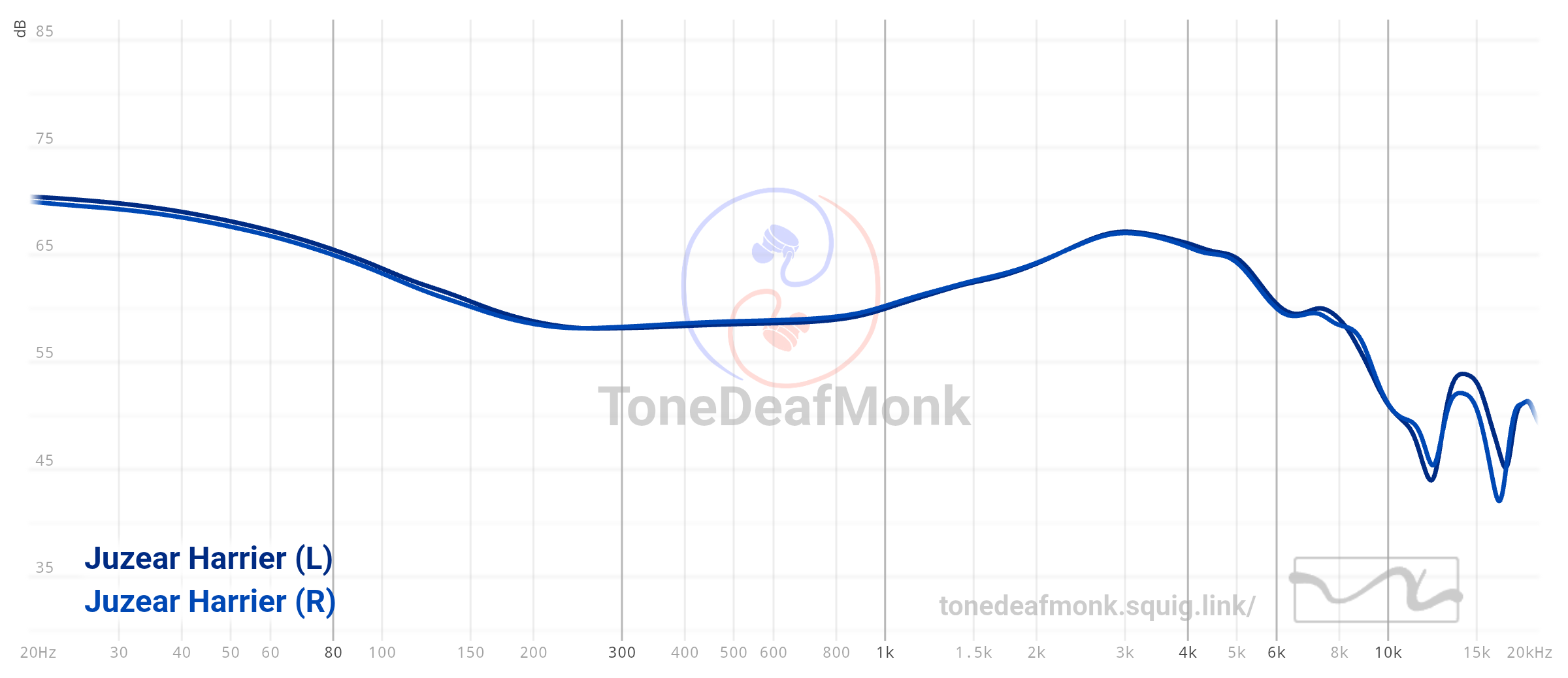
The treble and ultra highs are better represented than the FR graph indicates.
The 6mm micro planar steps up and shines nicely.
Good air and sparkle in the ultra high end. Cymbals and high hats are crisp and clear
Very good micro detail retrieval in the treble.
Violins, horns, and flutes soar, upper registers on piano are very present and precise.
Staging is very good.
Width is nicely outside the ears.
Height top to bottom also very good.
Front to rear depth has good sense of depth of stage.
The most impressive aspect of staging is how open and spacious it is. Lots of space between the notes gives accurate and precise imaging and layering. Instrument placement is precise and accurate.
Summary:
I critiqued the Nautilus pretty hard with respect to source device selection. This was an accurate recounting of my personal experience. Keep in mind though, we all hear differently, and have a variety hearing preferences.
The take away is, if you have the opportunity to listen to, or are considering purchasing the Nautilus, source device selection may factor into finding your sweet spot with this IEM.
I noted above I’m not a big fan of Sonion bone conduction drivers, this is because I cut my teeth on more “traditional” dynamic style BC drivers that are typically more noticeable in ear.
However, the mids and vocals on Nautilaus are so well done, I have to give credit where credit is due.
Providing mids support by blending seamlessly into the sound signature is commendable. 
Nautilus has great build quality, well above average cable that pairs well with the IEM.
It may not suit those who like a prominent sub bass presence, but Nautilus has punchy impactful bass, and a nice rumble on tracks that demand it.
Mids and vocals are impeccable, so most mids fans are going to be satisfied. And if you still want more, pair it with a mids forward source device.
Nautilus will likely satisfy many treble aficionados, but not to the extremes.
$800.00 usd is a significant ask.
If you are considering this IEM, MusicTeck is offering a 20% Black Friday discount at time of this posting.
My music sources:
Qobuz, and, FLAC and DSD files stored on the SD cards of my daps.
My music genre are primarily Rock, Blues, Jazz, Symphonic, Country, Rap, R&B, Pop, Electronic.
Enjoy your music.
This sure takes the cake with all the marketing jumbo and fomo tactic…
Literal word vomit to the point it gets cut off by the site lol. Was this done by LLM maybe?
I think the author just ran out of glaze and had to go and buy some more 
I work in corporate PR. This reads like the first draft of a lot of press releases that are handed to me to rewrite. 
I think Jomo also goes so far as saying Isobaric design with the DD and planar and that’s completely wrong on many levels.
Lol marketing
My review is up live:
One of my Subscribers will win a free set enter here: Thanks to DUNU & HiFiGo
Gleam has creepy written all over it.
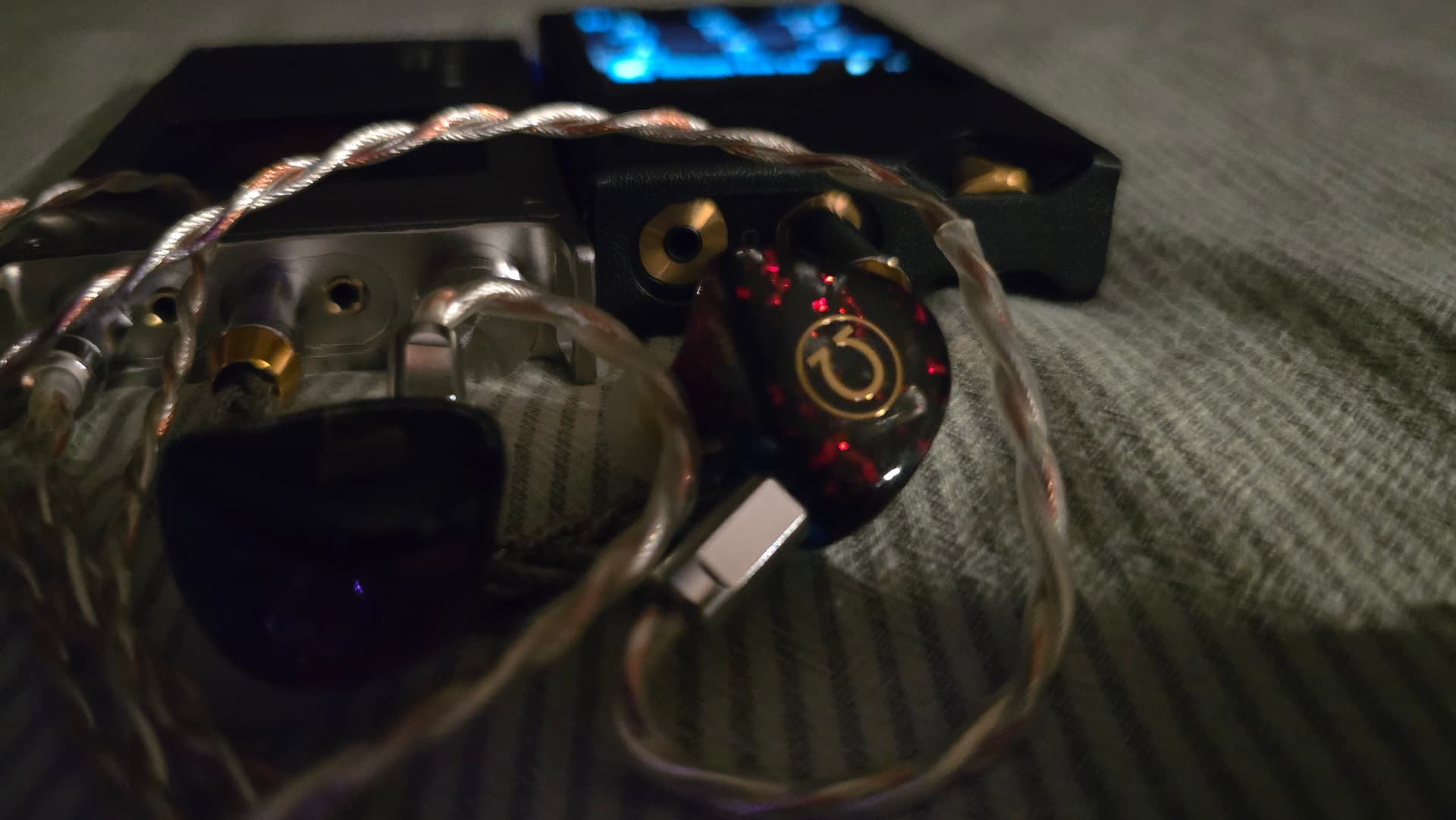
Chill out night with my #1 Alpha Omega Custom In Ear Omega and the ONIX XM5 as my source and the amazing IBasso Audio PB6 takenonh on my power requirements with some tubey goodness.
Venture Electronics/UA Vanguard Headphone
$120.00 - 148.00 usd depending on options.
*Driver Diameter: 40 mm
*Diaphragm Type: Biological Diaphragm
*Frequency Range: 20-20000Hz
*Rated Power: 500 mW
*Sensitivity: 95 dB
*Impedance: 300 Ohms
*Dual 3.5 mm connectors
Preamble:
Thanks go out to Wild Lee and Venture Electronics for the UA Vanguard review unit.
The Canuck Audioholics Review group sincerely appreciate the opportunity to hear and review the Vanguard.
Tone Deaf Monk
Kingnubian
Krusty ol’Bastid
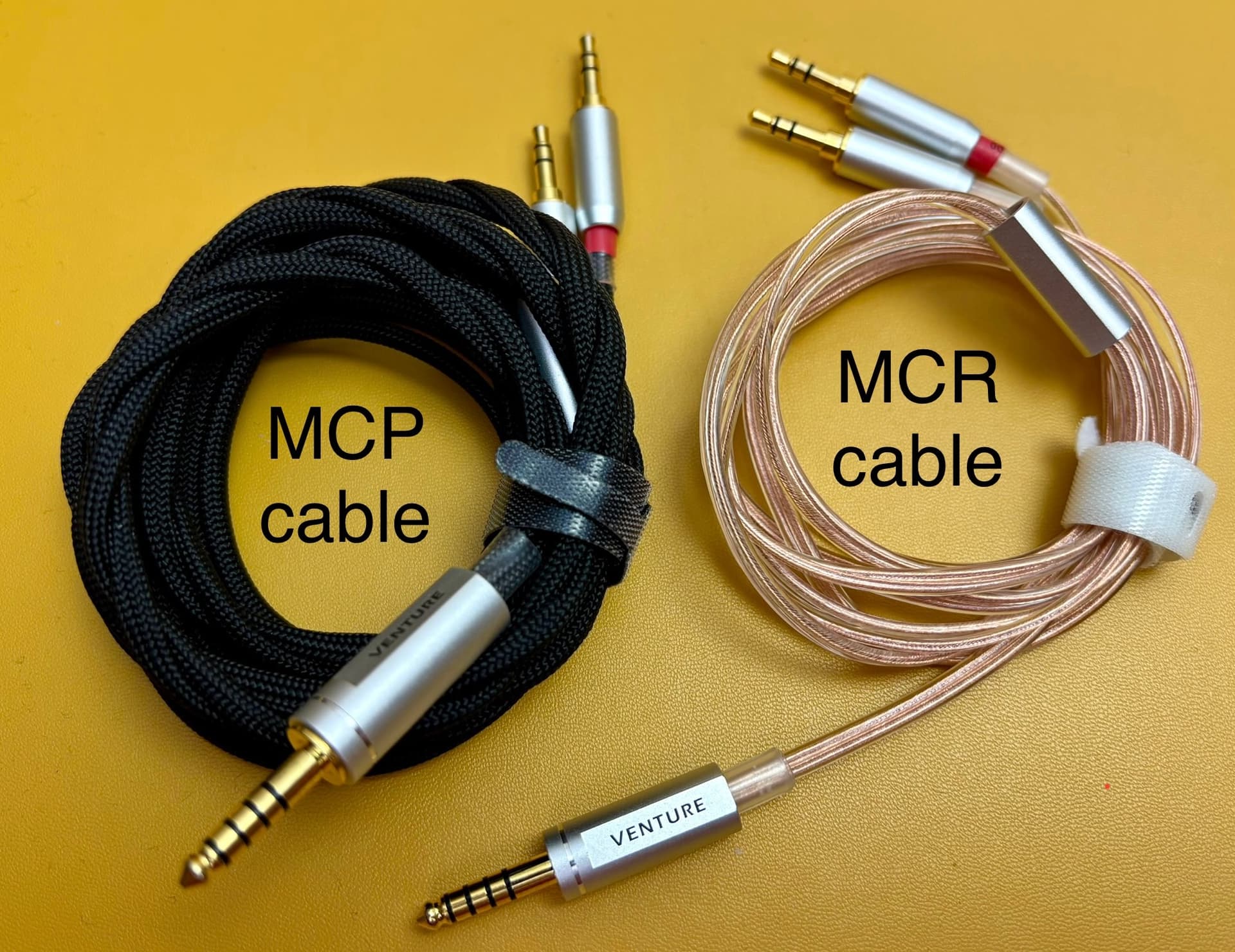
I received only the headphones and two cables. The MCR (Monk cable Retro) and MCP (Monk Cable Plus).
I can’t speak to the unboxing experience, but from what I have seen on line, it appears to be basic and cost conscious.
Pros and Cons:
Cost effective, very good sounding headphone.
Lightweight and comfortable.
 Build Quality and aesthetics.
True quality and reliability can only be confirmed over time.
I’m referring to perceived build quality, features, and aesthetics.
*Oval shaped plastic ear cups with black metal grills. There are a few minor blemishes on the trim ring around the grills.
*All metal headband and yokes.
*Headband pad is well cushioned and comfortable.
*Yokes slide in and out of headband for height adjustment, no swivels on the yokes, but enough play to allow for minimal sideways adjustment.
*Velour ear pads are comfortable and help reduce sweating.
*Clamping force is enough to provide a good seal, but not tight enough to fatigue. (on my head, personal results may vary)
*Oval ear cups/pads fit well on my ears top to bottom, but narrow enough front to back they make contact with my ears. Noticeable, but not distracting or annoying.
*The aesthetics don’t exactly exude elegance, but I feel the build is robust enough to be reliable.
High 300 Ohm impedance offers sonic advantages.
(Note: the following is cut and paste from the web)
Lower Distortion: When paired with a proper high-quality amplifier, high-impedance headphones draw less current, which results in less strain on the amplifier’s circuitry and lower levels of total harmonic distortion (THD). This provides a cleaner, more accurate sound reproduction.
Improved Driver Control (Damping Factor): A well-matched high-impedance headphone with a low-output-impedance amplifier results in a high damping factor, which gives the amplifier better control over the driver’s movement. This helps stop the diaphragm from moving unnecessarily after the signal stops (preventing “overshoot”), leading to tighter, more controlled bass and overall clarity.
Enhanced Detail and Balance: The combination of a low-mass voice coil and better amplifier control often translates to a more balanced and detailed sound across the frequency spectrum.
Increased Durability: The thinner, more numerous wire windings can sometimes make the driver electronically more robust and less susceptible to damage from accidental high-voltage input, as they require more voltage (but less current) to operate at high volumes.
High 300 Ohm impedance has some disadvantages.
(Note: the following is cut and paste from the web)
Low volume on mobile devices: High-impedance headphones need more voltage to produce sound at a certain volume. Standard portable devices often lack the necessary power to drive them sufficiently, resulting in a much quieter listening experience.
Need for a separate amplifier: To reach optimal loudness and performance, high-impedance headphones require a powerful, external headphone amplifier, adding extra cost and complexity.
Sub-optimal performance: Even if a portable device can make them loud enough, the sound quality may not be technically optimal. The source may not be able to provide the necessary voltage and current for the best technical performance and clarity.
Compatibility issues: The impedance mismatch between a high-impedance headphone and a low-impedance source can lead to poor performance, and potentially some loss in clarity or sound “bloating”.
when powered by an adequate source Vanguard is an excellent sounding headphone.
Source Devices:
I listened to Vanguard on a few different source devices. 4 Dedicated amps, and 2 DAPs.
On the dedicated amps, Vanguard sounded excellent on the Kaei Design Tap1 Pro and Venture Electronics Galvatron desktop amps.
On the component style, higher wattage headphone amps:
They sounded very good on the Cayin IHA6, mids were notably enhanced.
On the Burson GT4 (on loan to Canuck Audioholics for review) Vanguard sounds incredible.
The three DAPs I tried were the FiiO JM21 to see how a lower powered budget DAP would fare, and the iBasso DX340 and AK Kann Max to see how higher powered flagship DAPs would fare.
FiiO JM21 mid gain. Reaches adequate listening volume at around 80-85% volume. Sounds ok, very noticeable reduction in clarity and separation and in the openness and depth of stage compared to more adequate sources.
DX340 12v super gain. Sounds veryb good, but did note some occasional bloating in vocals compared to more adequate sources.
Clarity, separation and openness and depth of stage are well maintained.
Without 12v super gain, still sounds quite good, bass is less controlled and some bloat in the bass is noted.
The Astell and Kern Kann Max set to super gain drives Vanguard very well and sounds really good doing it.
Clarity, detail, open staging all in place and no bloat.
The general consensus here is that the Vanguard needs an adequate powered source to perform at the top of its game. VE suggests 1000mW.
Sound evaluation will be done on the VE Galvatron because VE has done an incredible job pairing these two, and, purchasing the two together is possible at a very reasonable price.
Equipment:
Venture Electronics UA Vanguard over ear Headphones, aged 100+ hours.
Venture Electronics Galvatron DAC/AMP set high gain, paired to AK Kann Max streaming from NAS via AK connect.
Stock Venture Electronics MCP cable (monk cable plus) terminated 4.4 balanced.
Sound:
Two words: very good.
Bass has good sub/mid bass definition.
Mid bass has decent impact, sub bass pulls reasonably low with good rumble, but on truly bass heavy tracks, trying to make the most of sub bass presence, I find I’m hearing some unnatural resonance or distortion. Like the driver is being pushed beyond its capabilities.
This is a bit of a nit pick, it is isolated to certain tracks. But for true sub bass aficionados, this is worth noting.
Mids and vocals are clear and detailed, and, present as natural and accurate.
Good macro and some micro detail retrieval.
Highs are clear and bright, good micro detail retrieval, nicely elevated, but not overly forward or in your face.
Not harsh or sibilant.
Staging is open and spacious.
Width is outside the head. Height top to bottom is good, but mostly within the head. Depth front to rear good, nice sense of depth of stage.
Imaging and layering are also good.
Summary:
Provided the Vanguard can be paired to a source device capable of driving a higher impedance headphone it is a very good sounding piece of kit.
Both cables that came with the review set pair well with the Vanguard. I had a personal preference for the Monk Cable Plus (MCP) over the Monk Cable Retro (MCR). The MCP enriches the bass without dulling the mids clarity.
I don’t see the Vanguard offered on VEclan website.
It is available on AliX, but comes in 3 different bundles.
$120.00 usd (includes shipping) will get you the Vanguard, the Devastator dongle, and MCR cable.
That same price will get you the Vanguard, and the MCP cable.
$148.00 usd (includes shipping)
Will get you the Vanguard, the Galvatron DAC/Amp, and the MCR cable.
This is the best overall value.
Galvatron is listed at $199 usd on VEclan site.
So that’s like getting 25% off the Galvatron, and they will throw in the Vanguard for free.
I haven’t listened to a ton of headphones in my time, so personal comparisons are limited.
But, on sound alone, the Vanguard easily fits as a good value in the $100ish dollar range.
My music sources:
Qobuz, and, FLAC and DSD files stored on the SD cards of my daps.
My music genre are primarily Rock, Blues, Jazz, Symphonic, Country, Rap, R&B, Pop, Electronic.
Enjoy your music.
Venture Electronics Galvatron
SPECIFICATIONS
*DAC: ES9018K2M*2
*Audio format support: 24bit 96kHz
*Input: USB / SPDIF
*Internal power supply: ‡ 15v rms
*LPF: OPA1612*5
*Weight: 240g
*Output: TPA6120*2
*Size: 76*22* 153mm
*Output:
3.5SE / 4.4TRRRS / MIC / LO3.5 / LO4.4
Preamble:
Thanks go out to Wild Lee and Venture Electronics for the Galvatron DAC/Amp review unit.
The Canuck Audioholics Review group sincerely appreciate the opportunity to hear and review the Galvatron.
Tone Deaf Monk
Kingnubian
Krusty ol’Bastid
Pros and Cons:
Low cost, simple DAC/Amp that performs and sounds good.
Retail ask is $199.00 usd, but currently offered on Alix for $128.00 usd plus shipping, but comes with Vanguard U/A headphone for that price.
Nice balanced sound signature.
Mic input for gaming.
Powered by standard usb charger.
Power pass through charges PD compatible source devices while in use.
No internal battery, keeps price down, don’t have to worry about when it dies.
But, makes it non-portable, and less transportable, since you need a power supply near by.
Simple un-complicated design.
No power switch, plug a charger into it to power up.
The only switch is high/low gain selector.
Front panel.
*3.5 and 4.4mm headphones out.
*Mic input.
*Volume wheel.
*High/Low gain toggle.
Rear panel.
*Power in. Incorrectly labelled “charge”.
*3.5 and 4.4mm line out.
*S/PDIF in.
*USBc data in.
Up to 1500mW x 1500mW @ 32ohm on 4.4 balanced out.
Only supports up to 24bit 96kHz audio.
Doesn’t decode DSD.
Summary:
This is not a review, just a shout out for a very nice DAC/Amp that performs admirably, and sounds really good.
VE is marketing it as the “King of all Gaming Sound Cards”. I don’t game so can’t comment directly, but can certainly see how it could add some serious kick to your gaming experience.
I spent most of my time with it listening to the VE Vanguard/UA headphone, which pairs very well with the Galvatron.
Enjoy your music.
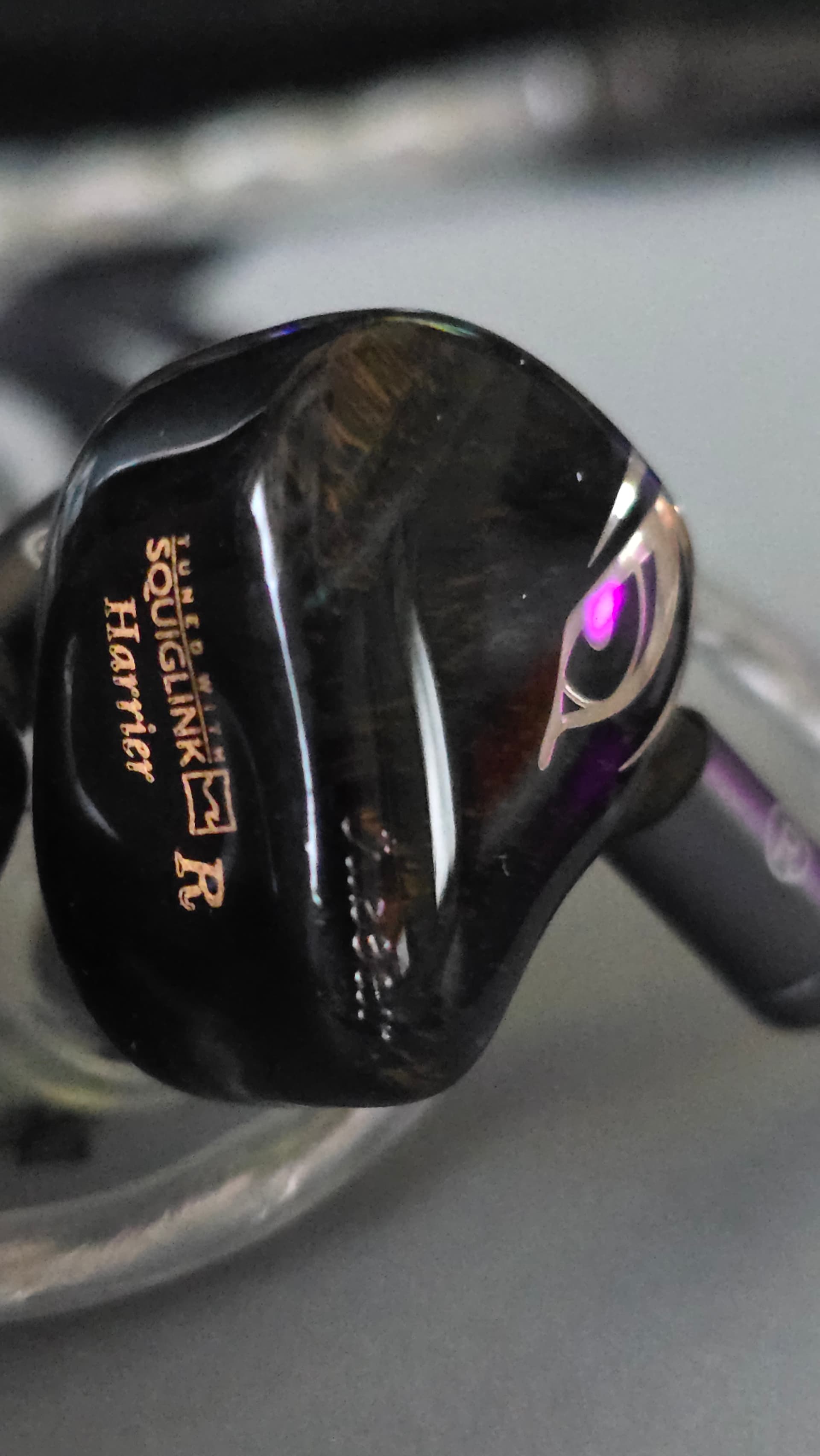
Tonight’s Listen Juzear Harrier it’s tuning is spot on for me and has some crazy good stage.
Love the micro planar implementation.
Thanks HiFiGo and Canuck Audioholics Anonymous (CAA)
Jomo Audio Nautalus was one on my radar and I came away happy for the most part. Here was my thoughts here:
Thanks to the Canuck Audioholics Anonymous (CAA) for the share.
Kaye Dee
Bennet Kelly
Tone De
af Monk
CCA Phoenix
All Metal Shell, Single Dynamic Driver
$28.00 -32.00 usd.
Driver: 10mm Dual-Magnet Dynamic Driver
Impedance: 33Ω
Sensitivity: 108dB
Frequency: 20-40000Hz
Preamble:
The CCA Phoenix is a purchased unit.
The Canuck Audioholics review team will have the opportunity to review at their discretion.
Pros and Cons:
Nice retail packaging.
Remove the outer sleeve and the box opens from the center and folds back to the sides.
A Phoenix placard greets you. Under that are the earpieces prominently displayed front and center, held securely in a foam insert.
Below the insert is a large “coin purse” style carry pouch with a nice silver plated copper cable terminated 3.5mm, and the ear tips (three pair total)
All metal, vented ear pieces exude a solid build and look good doing it.
Despite the angular edges, the ear pieces fit well and are comfortable in ear. I easily get a secure seal and anchor.
The vents do leak some sound.
The SPC cable is above average for a budget offering, nice weave, reasonably supple, metal encased plastic fittings. Connectors are color coded for left and right. 3.5mm termination.
Good bass, I’m picking up a sub over mid tilt. Lower mids and well into the mids are scooped. Good upper mids and a nice touch of treble.
Equipment:
CCA Phoenix IEM, aged 24 hours.
Hiby R4 DAP low gain, 3.5mm out.
Stock SPC cable, 3.5mm termination.
Eletech Baroque wide bore ear tips.
Sound:
Bass is nice. Sub over mid bass. Mid bass has decent impact, but is easily overridden by sub bass.
Not much definition between sub and mid bass.
Lower mids and mids sound scooped and don’t recover until well into the mid range. Not a lot of macro detail retrieval, and what’s there tends to be subdued.
Upper mids recover nicely good macro and some micro detail, and, vocals are clear and sound mostly natural.
There is some treble here. Not excessive or harsh, but with a nice touch of micro detail, sparkle and air.
Staging is just above average.
Good left to right width nicely outside the ears.
Good height top to bottom thanks to good sub bass extension and nice sparkle and air up top.
Front to rear depth is very average.
Imaging is good, but not overly precise due to the somewhat empty mids.
Summary:
There is a lot of good here, CCA has upscaled the packaging, cable, and have included a carry pouch, on a budget level IEM. On top of that, a very nice all metal shell.
The 10mm DD seems reasonably capable, but, I did notice at higher volumes it sometimes sounded a bit pushed.
I like clear and detailed mids, so the scooped mids are not to my personal preference.
However for enthusiasts who like good bass with a sub bass tilt, scooped or relaxed mids, and energetic detailed upper mids and highs, Phoenix is worthy consideration.
Build quality and included accessories alone represent good value.
My music sources:
Qobuz, and, FLAC and DSD files stored on the SD cards of my daps.
My music genre are primarily Rock, Blues, Jazz, Symphonic, Country, Rap, R&B, Pop, Electronic.
Enjoy your music.
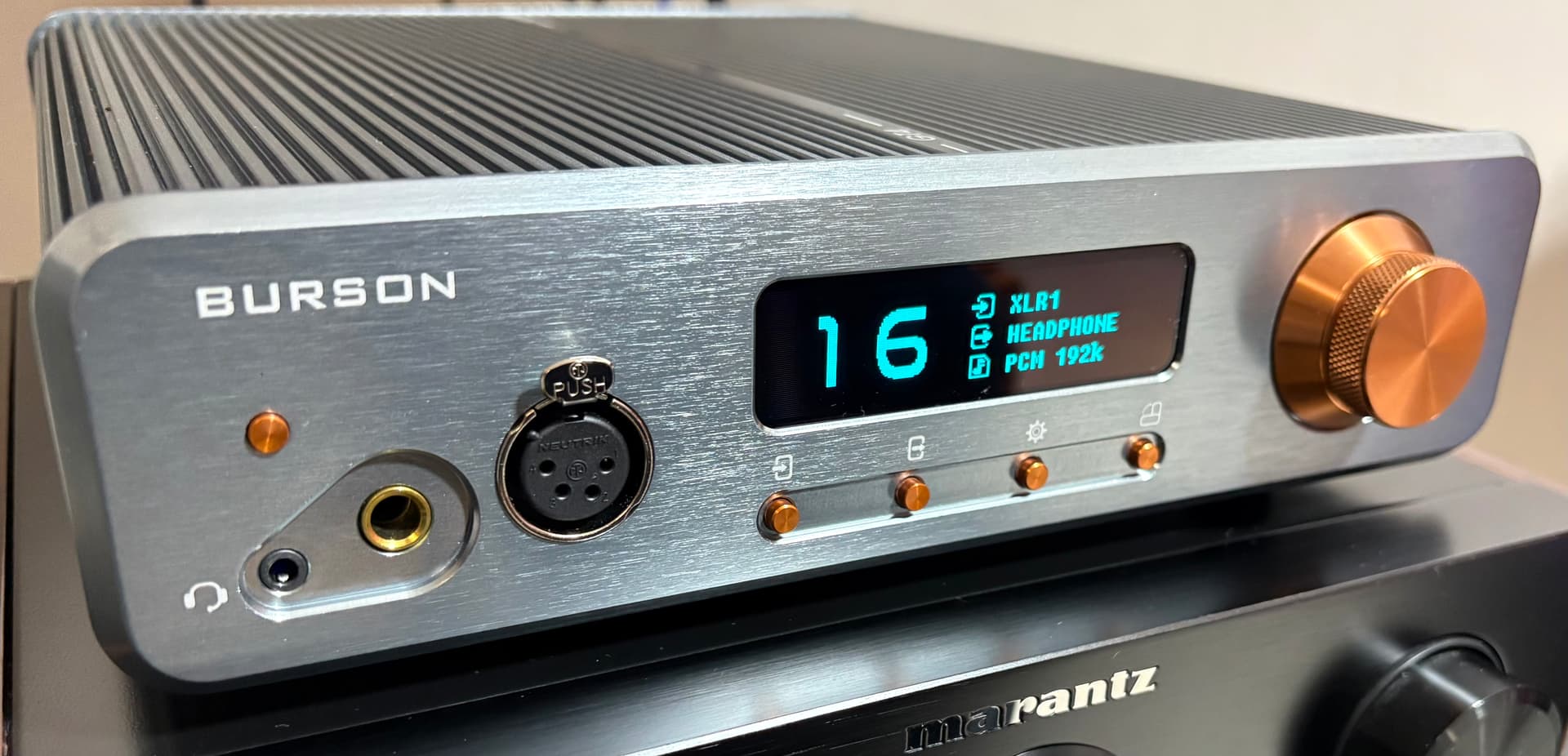
Burson Audio Conductor GT4
A Heaping Helping of Happiness!
Headphone Amplifier/DAC/Pre Amp
$2799.00 - $3799.00usd
Key Features:
• Dual ESS9038 DACs for superior sound quality.
• Unique Headphone + Subwoofer mode.
• Class-A headphone amplification.
• Balanced output for pristine audio.
• Sleek, modern design for any setup.
** Full Specs listed at the end of the review.
Preamble:
Very gracious and sincere thanks go out to Burson Audio for generously providing the Canuck Audioholics Review Group with the Burson Audio Conductor GT4 DAC/Amp to enjoy and review.
And on this piece of kit; a hard lean toward enjoy!
Tone Deaf Monk
Kingnubian
Krustyol’Bastid
Disclosure:
This is my first time reviewing a dedicated headphone DAC/Amplifier.
I do own a very nice dedicated headphone amplifier, the Cayin IHA-6, which I very much enjoy.
Limited as it may be, I do have some hands on experience to draw from, but this will be a fairly high level review.
Pros and Cons:
Clean, Quiet, Refined, Detailed, and Balanced sound.
Three, factory direct configurations of the GT4 are available.
The difference is varied combinations of OP amps, Silent power modules, and power supplies.
** Standard Package:
Conductor GT4 with V6 Vivid Opamps and Silent Power 01 Modules installed
Standard Power Supply Unit
** Deluxe Package:
Conductor GT4 with V7 Vivid Opamps and Silent Power 02 Modules installed
Burson Super Charger 5A PS Unit
** Max Package:
Conductor GT4 with V7 Vivid Opamps and Silent Power 02 Modules installed
Burson Fusion Core 24V/15A
Note: Canuck Audioholics believe the review unit is the Deluxe variation based on the included power supply.
Powerful Class A amplification.
XLR balanced 10W @ 16 ohm.
Single Ended 5W @ 16 ohm.
Intuitive menu system didn’t take me long to become familiar with it.
Flippable display orientation.
Unit can be positioned vertically on its side for space saving.
Metal cased remote is slim and solid with an unassuming classy look.
Minimal functions, but handy if your listening position is away from the amp.
Mute, Input selection, Volume up & down.
Signal beam on remote is very narrow so remote needs to be pointed specifically at the bottom right corner of the GT4 to communicate.
Interesting Headphone + Sub Woofer setting.
More on that in the summary.
Summary:
There are several functions on the GT4, some of which I wasn’t able to try, either because of time constraints, or I don’t have the components/equipment necessary to trial them.
I will provide some notes on those I did use below.
I will start with Sound, so if that is your key interest, you can skip the rest.
The low down… The Burson GT4 is the best sounding DAC/Amp device I have had the pleasure to experience to date. Period.
That doesn’t mean there aren’t competitors in class, but I have yet to hear them.
Keeping in mind this is biased toward my personal preferences for sound signature.
SOUND
Very balanced delivery. Extremely quiet background, exquisite detail, but with a warmth that offers “musical” not “clinical”
“Digital detail, Analog warmth”
Incredibly spacious and holographic staging on many IEM’s. Headphones more wide outside the head, not so much “holographic”, but still enhanced staging compared to what I’m used to.
Bass, mids, treble; none are enhanced or emphasized over another.
Unless the recorded source dictates.
The GT4 made many of my favourite ear gear sound better than I had ever experienced them in the past.
Conversely, some sounded worse than I had previously experienced. The GT4 will lay bare the shortcomings of ear gear that less capable source devices might mask.
Compared to my Cayin IHA-6 the mids on the GT4 are less forward and more relaxed. The IHA-6 has a more mids focused emphasis.
Coming from the Cayin, I initially thought the mids on the GT4 lacked some detail and clarity, but I was mistaken.
After some lengthy listening sessions I concluded all the mids clarity and detail are there, just not tuned forward.
INPUTS ANALOG
The GTR has several analog and digital input options, I connected to, and trialled USB, Bluetooth, RCA 1, and XLR 1 (there are RCA2 and XLR2 also available)
Additionally there is also choice of Toslink, and Coaxial. Neither of which I tried.
RCA and XLR analog inputs bypass the DAC section and utilize only the Amp section. As per usual.
I have a Gustard R26 R2R network streamer which I connected to both RCA1 and XLR1 connection so I could compare.
Theoretically, carrying a line level signal a short distance, these two inputs should sound the same, but I find the Balanced XLR connection provides a more open and spacious stage, which adds a sense of additional separation and clarity.
Both of these inputs on GTR4 are limited 24bit 192kHz max.
So, streaming DSD 64 or 128 files, the my Gustard R26 streamer down samples to PCM352 or PCM705 respectively, and the GT4 further down samples to PCM192.
Still sounds incredible, but, to fully utilize DSD files, using one of the digital inputs is obviously the better choice.
INPUTS DIGITAL
I used Bluetooth and USB for digital input.
USB will decode up to PCM 32bit/786K and DSD 512
Bluetooth will decode up to PCM 24bit/96. Any data sent via BT that exceeds 24/96 (including DSD) are downsampled to 24/96 max.
Bluetooth works well, and sounds great. Range is not a concern since you are wired to the amp and won’t be too far away.
Bluetooth is input only, so TWS is not an option.
USB digital is the superior connection of the four I utilized.
Not so much a performance or sound quality observation, but in decoding capability. I was able to successfully playback music tracks up to DSD512.
But not without a quirk or two with DSD.
Read on.
I used the A&K SP2000T DAP and my iPhone 16 for the USB connection. They worked seamlessly in most aspects.
The iPhone was limited to only streaming music services, while the DAP also allowed me to play stored files on the SD card, stream from my NAS using AK Connect, and utilize streaming services.
Playing DSD files from the SD card is where things got a bit quirky, some files played fine as DSD, others converted to PCM equivalent. Sound was still really good even when converted.
Conversely, streaming via WIFI from my NAS using AK Connect, all DSD files played as normal.
Not sure if this was the fault of the source device or a quirk with communicating with the GT4.
DSD 512 buffered from time to time, but that was my WIFI not keeping pace with huge files. I have experienced this in the past.
Not a huge consideration if you don’t have a large DSD collection. But thought it worth noting for those who may have.
HEADPHONE + SUB WOOFER
The GT4 is equipped with a sub out.
When I first read there was a headphone + subwoofer output I was a bit baffled, it’s a headphone/IEM amp, why a subwoofer??
Then it dawned on me.. open back headphones would allow leakage.
And… there was only one way to find out.
** NOTE: There is no LPF on the Burson GT4, so crossover frequency, required manual adjustment. Volume may need adjusting as well between different inputs, and ear gear.
I swapped the sub off my stereo and onto the GT4, slapped on a pair of 600 ohm Beyerdynamic DT 990 open back headphones and started experimenting.
I was more impressed than I thought I would be.
The DT990 are entry level studio monitors. So detail and clarity are the focus, not heavy in the bass.
There was enough ambient intrusion to add a nice, and realistic sub bass boost. Additionally, I was sitting only a few feet from the sub and was getting a physical rumble as well.
On “run of the mill” tracks it was a nice add, but, on bass focused electronic tracks it was pretty amazing.
Not sure if this would be suitable for gaming (not a gamer) the open back headphones and sub rumble would likely interfere with the mic. But thinking it would add a new dimension to getting a grenade dropped in your foxhole.
OTHER INSIGHTS:
The Class A amplifier gets hot. The top of the unit gets very warm to the touch. There are cooling fans, the left and right sides, where the vents are located, can get uncomfortable to the touch.
GT4 can stand upright to save desk/rack space, and Burson states the unit runs cooler when vertical.
A stand would be required to provide stability, and to keep the vent from being blocked.
The Display is rotatable to accommodate.
Burson carries stands made specifically to fit the Conductor series.
FINAL THOUGHTS
Audio enthusiasts are a diverse and varied group of individuals, so I’m well aware some would not be as enthralled with this headphone DAC/Amp as I am. But, honestly, this is the best sound I have heard out of my ear gear to date.
Old favourite ear gears have received a breath of new life, and I couldn’t be happier.
Starting at $2800 usd and topping out at $3800 usd is a substantial investment, but, considering the Hiby RS8ii and A&K SP4000 DAPs tap in at around the $4000 usd mark, the Burson GT4 is not unreasonably priced for high end audio kit.
For discerning audiophiles who seek a high end audio experience, could see this type of headphone DAC/Amp as a good fit for their needs, and are willing to wade in this end of the pool.
The Burson GT4 is very worthy of a look. IMHO.
The Burson Conductor GT4 is officially on my “hopefully someday” list.
SPECIFICATIONS
Input Impedance: 40 KΩ
Frequency Response: ± 1dB 0 – 58Khz
THD: <0.0015%
DAC
Channel Separation: 143dB @ 1KHz | 136dB @ 20KHz
THD+N: 0.0005% @ 1KHz, 0dBFS
COAX / Toslink / SPDIF: up to 24bit / 192K
Output Impedance
Amp: 0.5Ω
Pre Out: 1Ω
DAC Out: 25Ω
Inputs
(x2) XLR
(x2) RCA
USB
Optical TOSLINK
Bluetooth 5.0 (24-bit/96kHz aptX HD and LDAC codecs)
Mic
Outputs
XLR
RCA Preamp | RCA Line out
DAC Out
Subwoofer Preamp
XLR Headphone
6.3mm Headphone
3.5mm Headphone/Mic
Impedance (Headphone Jack) | Power (XLR / SE) | SNR | Separation
16Ω | 10W/5W | 96dB | 99%
32Ω | 5W/2.5W | 98dB | 99%
100Ω | 3W/1.5W | 95dB | 99%
150Ω | 2W/1W | 96dB | 99%
300Ω | 1W/500mW | 96dB | 99.5%
Weight: 11 lbs
Dimensions: 10” x 10.6” x 2.75”
XMOS USB
OS: Windows, Mac OSX, iOS*, Android (OTG support)
PCM Support: PCM ≤ 768kHz @ 16, 24 or 32bits
Native DSD: Native DSD 64/128/256/512
DSD over PCM: DoP64/DoP128/DoP256/DoP512
My music sources:
Qobuz, and, FLAC and DSD files stored on the SD cards of my daps.
My music genre are primarily Rock, Blues, Jazz, Symphonic, Country, Rap, R&B, Pop, Electronic.
Enjoy your music.