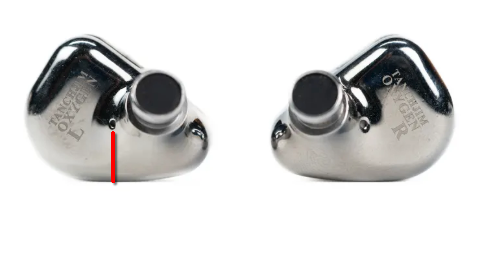
there is a vent on it though, an “inner” vent which is what helps the most at least for me. Never had any pressure/suction with this one at all iirc.
I was referring to the Orchestra 2 being discussed…
Got it. O2 Is usually what we call the Oxygen though.
2 Likes
My bad. Will try and correct. Thanks for the heads up
2 Likes
Work continues on the DX340 optimization. Now the complete install is simply running a single bat or command file. It does all the rooting, installs and downloads for you.
Tek is super passionate about the 340 and the work to optimize. I’ve had the pleasure of working with him to test the various versions/tweaks and make suggestions for quality of life improvements.
Give it a whirl. It’s no risk, no work and can all be undone by simply uninstalling Magisk. No data loss, no preferences lost…
1 Like
Fiio Retro Nano - One Device To Rule Them All
Pros:
- Compact & Portable
- Beautiful Design
- Excellent Sonic Performance
- Good Power Output
- Very good bluetooth implementation
- Removable battery
- Full parametric EQ Support
- Effective Heat Management
- Excellent battery life
- Excellent value
Cons:
- Cumbersome UI
- Not the best build quality
- Slow charging

Specs
- Display: 0.96-inch 80×160 color IPS
- Shell material: Plastic
- Dimensions: Appx. 55.1 × 37.5 × 13.7 mm
- Weight: 28.3 g (including battery)
- DAC: Dual CS43131
- Bluetooth version: 5.1
- Bluetooth codecs: AAC / SBC / aptX / aptX LL / aptX Adaptive / aptX HD / LDAC
- Sampling Rates: Up to 16bit 96kHz PCM (bluetooth)
- Output Power: Output power 1: L+R ≥ 100 mW + 100 mW (32Ω single-ended, THD+N < 1%) Output power 2: L+R ≥ 220 mW + 220 mW (32Ω balanced, THD+N < 1%)
- Battery: 10440 batteries, 3.7V rechargeable lithium battery
- In-line controls: Supports microphone, volume adjustment, and play/pause controls (CTIA protocol)
- Price: 50$
- SNR: ≥ 128 dB (A-weighted)
- Noise floor: PO < 1 µV (A-weighted) BAL < 1 µV (A-weighted)
- Output impedance: < 0.3Ω (32Ω load)
- THD+N: < 0.0018% (1 kHz / -4 dB @ 32Ω)
Before starting the review, I want to thank fiio for sending the retro nano in for a review.
Accessories
The accessories package is very good for the price. Things provided in the box are 1. The device 2. Plastic battery holder 3. Usb type c cable 4. Lanyard and 5. Skin for the device.
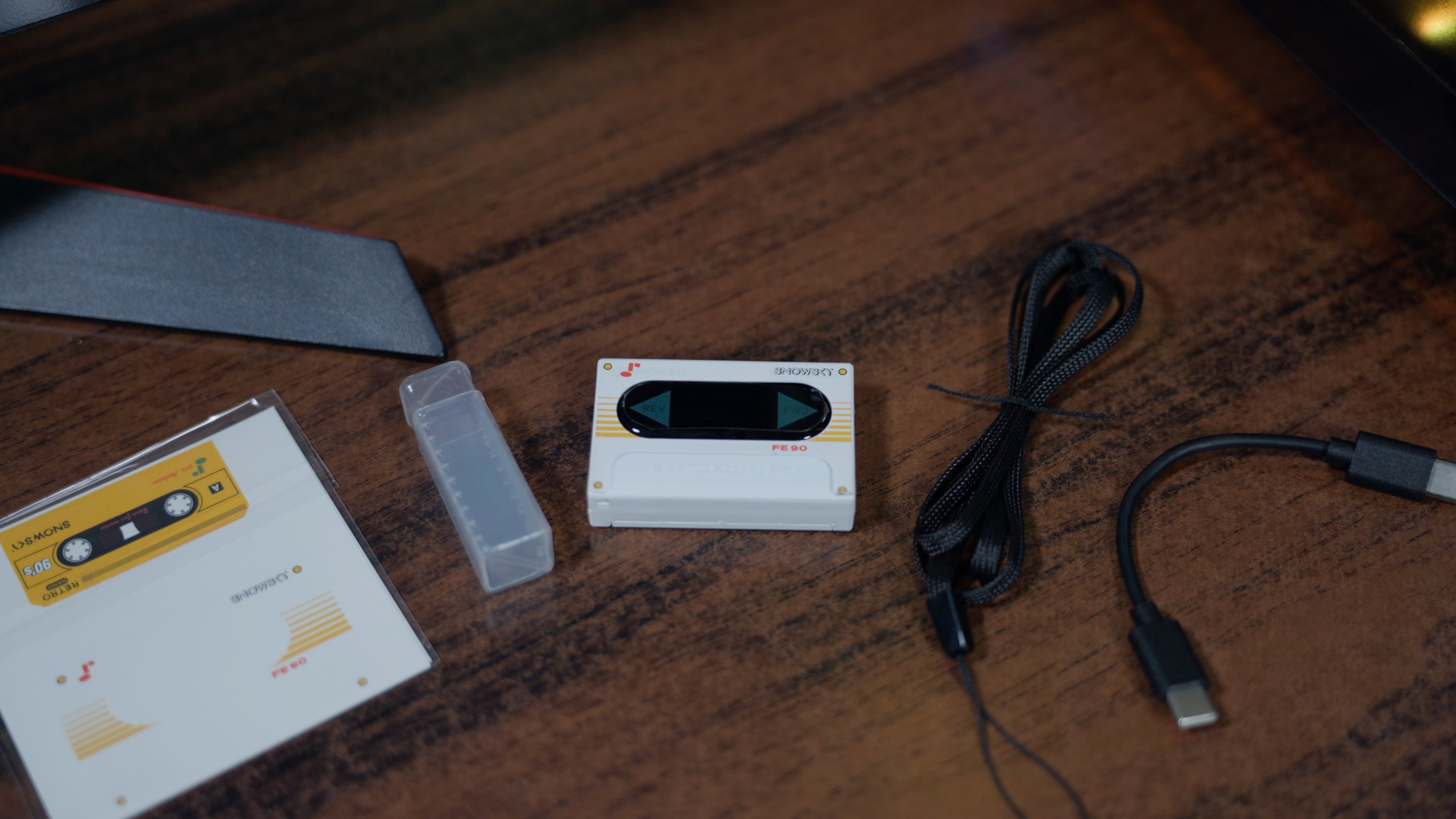
The USB cable provided is pretty basic. It gets a job done. The interesting Inclusion is the addition of vinyl skin for the device. I think this is a very good addition, as it protects the device from scratches and makes it look even better.
Design and build
The design of the Retro Nano is playful and neo-retro, and I really love it. It’s lightweight and easy to carry around daily.
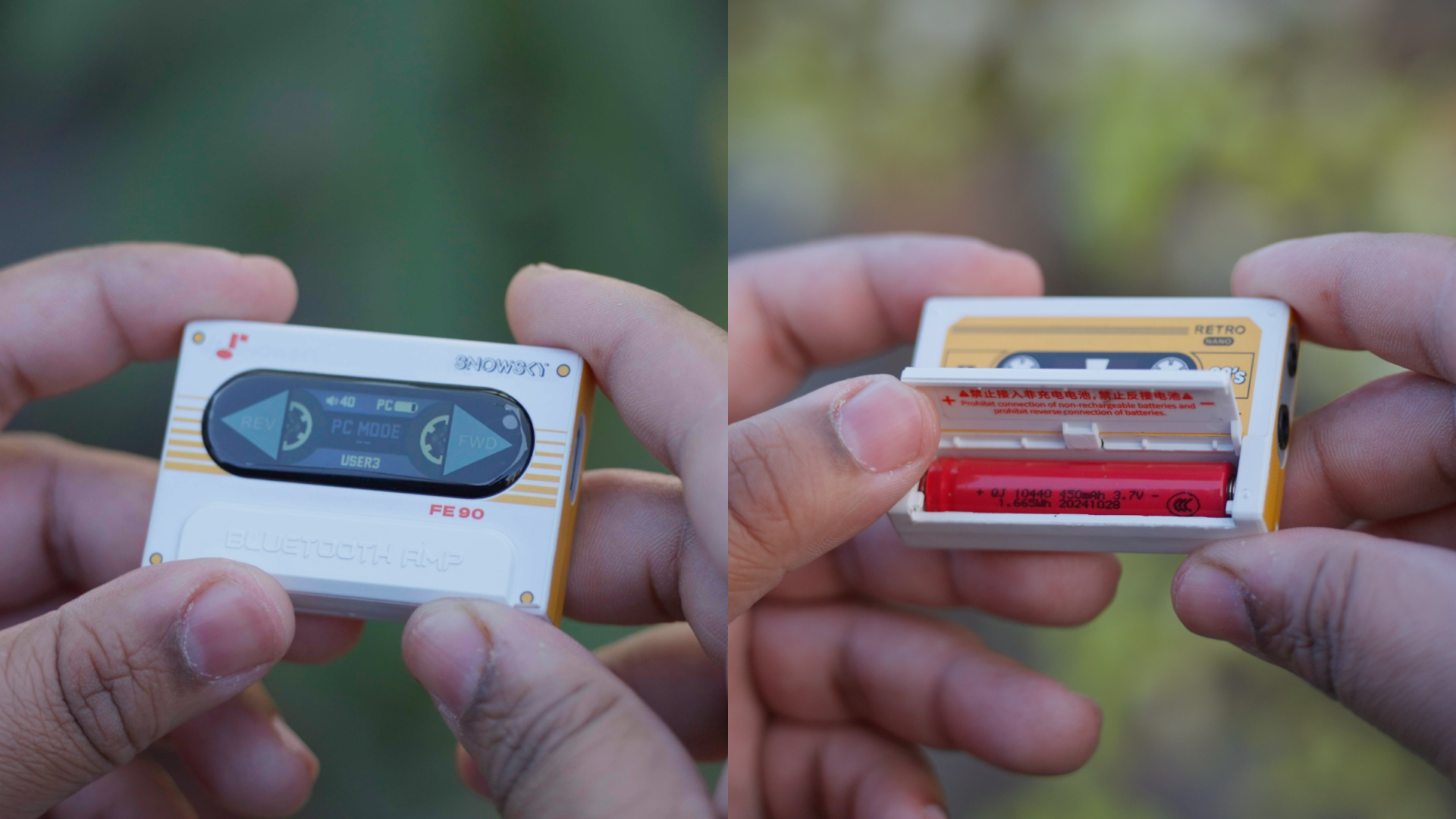
The build quality is decent. The construction is fully plastic, which keeps it light, but it can feel cheap at times. The plastic used here isn’t as good in quality as what’s used in the Echo Mini. That said, the build still feels purposeful, and plastic is naturally shatter and dent resistant. One more thing I don’t like as much is the battery door on the back; it feels a bit flimsy, so do handle it with care.
Device’s User Interface
Retro Nano’s UI offers a lot of settings, so it can feel like a bit much at first. But after some time, you do get used to it. On top, you have all the buttons through which you control the device. Each button functions differently according to the menu selected.
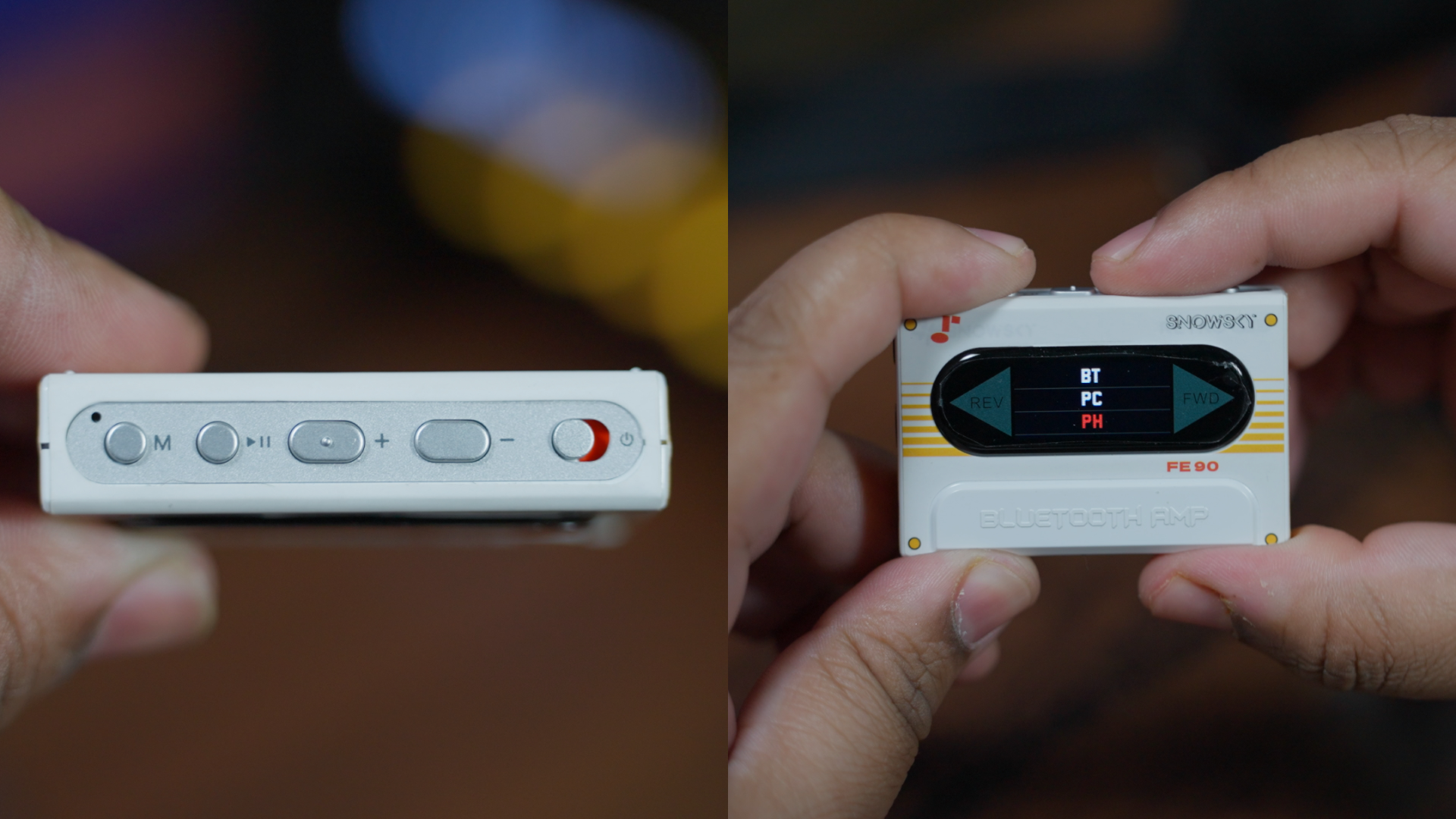
The display offered is very legible and provides good brightness. You can access all the basic DAC settings directly from the device. You can short-press the menu button to change the theme, and when you hold the menu button, you enter the full menu system. In the menu, you can change basic settings like charge protection, gain, EQ, screen brightness, power-saving settings, language, DRE, and you can reset the device as well.
The device has three functional modes:
BT Mode (Bluetooth Mode) – You can use Bluetooth in this mode to connect the Retro Nano to a source like a smartphone, laptop, or PC. In this mode, the Retro Nano uses its own battery.
PC Mode – In PC mode, you connect the Retro Nano to a source using the USB cable. Bluetooth is turned off, and the device is powered by the source. The internal battery will also be charged if needed.
PH Mode (Phone Mode) – In this mode, just like PC mode, you connect the Retro Nano to your source via USB cable. The difference here is that the Retro Nano is powered by its internal battery, so it won’t drain your source device’s battery.
Fiio App
If you want more control and more advanced settings, you can access them via the fiio app. Through the app, you can access and change all the device settings and configure EQ as well. I’m using the latest version of the app, and the recent update has changed the UI; it looks cleaner and more professional now, but it has made the app slower too. The subpages take a bit longer to load, which makes the whole experience feel sluggish. I think this can be fixed with another update, but till then, it gets the job done.
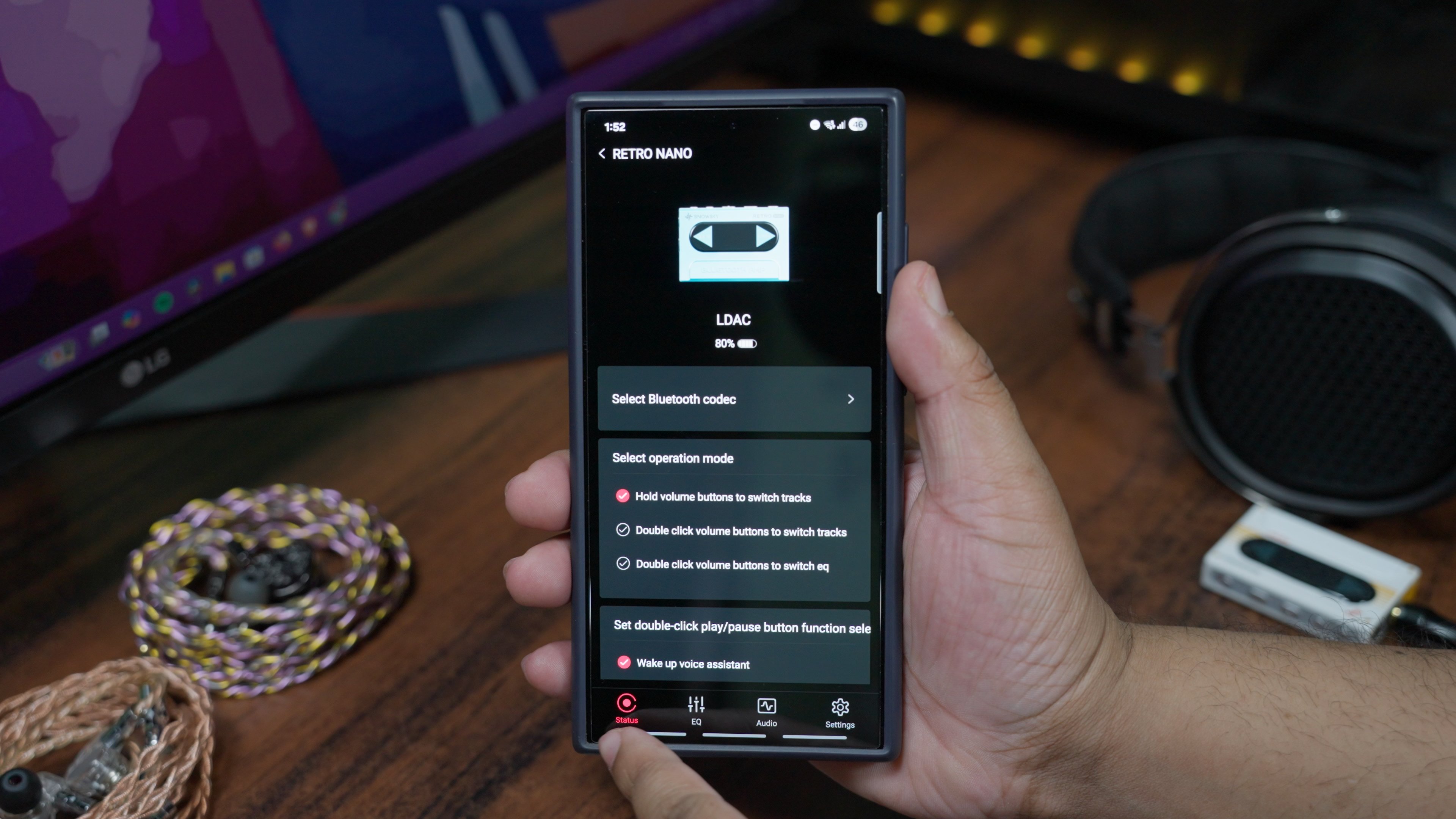
The coolest thing about the retro nano and the FiiO app is the support for full parametric EQ, allowing you to fine tune the sound exactly to your needs and taste. It’s one of the few devices in this price range that offers proper EQ support. Huge kudos to FiiO for that.
Battery Life, Charging and Heat Management
The battery life of the Retro Nano is very good. In Bluetooth mode using LDAC and running relatively efficient IEMs, I got around 6.5 to 7 hours of battery life. In Phone mode, I got about 8 to 8.5 hours. Now, these numbers can fluctuate depending on the load. If you plug in heavy, hard-to-drive headphones, the battery life will go down.
Since this uses a replaceable 10440 battery, you can always carry a spare fully charged cell. When the first battery dies, you can just swap in the fresh one. That’s the beauty of a replaceable battery and something you don’t see often these days.
Heat management is handled well too. The device never overheats, whether you’re charging it or just listening to music.
The only minor downside is the charging time. Using a Samsung 25W charger, it takes about 1.5 hours to fully charge. If you’re using a slower charger, expect it to take even longer.
Bluetooth Performance
The Bluetooth performance of the Retro Nano is very good. It supports all the major codecs like AAC and SBC, along with hi-res codecs like LDAC and a variety of aptX options.
The range is also very good in SBC mode. I can keep my phone on a desk and roam around my house without any cutouts. LDAC performance is solid as well. I didn’t face any glitches or dropouts, and the range was decent too, although not quite as strong as the lower-bandwidth SBC codec.
Gears Used For Testing and Drivability
Iems - Thieaudio hype 10, Elysian Pilgrim, tanchjim bunny, Tangzu Zetian Wu Heday.
Headphones - Fiio FT1 Pro
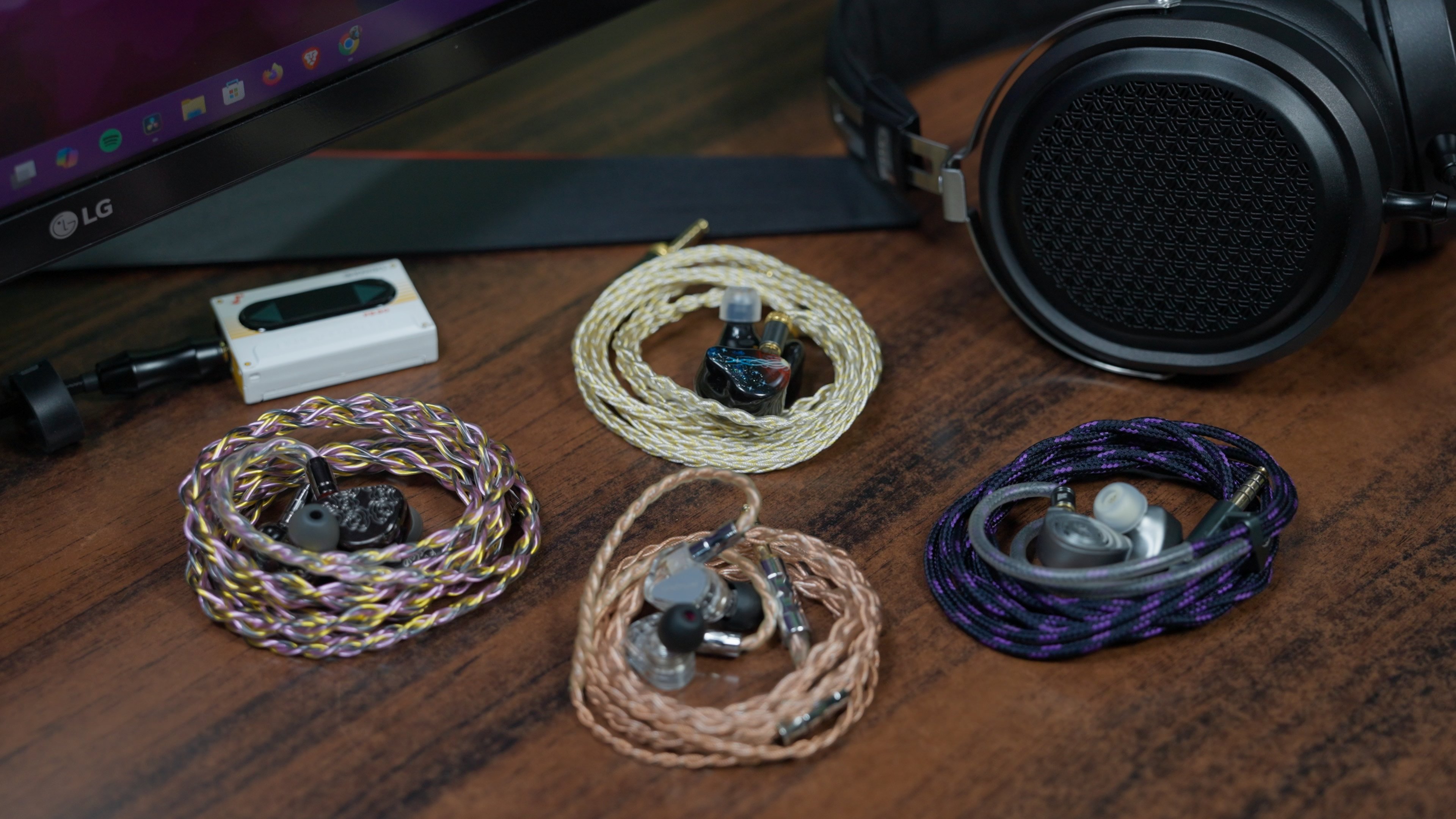
The retro nano has ample power to drive all the IEMs I have, and it handled the FiiO FT1 Pro excellently. I am really impressed with the driving power of it.
Sound
The sonic performance of the retro nano is excellent. The overall signature leans mostly neutral with a touch of warmth in the lower mids. It sounds very natural, with no hint of digitalness or artificiality.
The bass is clean and uncoloured. The Melody handles deep sub-bass notes very well, offering good texture and rumble. Mid-bass thump is presented with solid impact and authority. Overall, the bass performance has great dynamics and weight, especially for this price point.
The mids are slightly coloured with a hint of warmth in the lower mids, giving vocals and instruments in this region a nice sense of heft and body. I actually like this coloration because it prevents the mids from sounding lean or dry, yet it’s subtle enough that the Melody still pairs well with warm IEMs. The upper mids are presented faithfully, without any harshness or forwardness. Overall, the mids sound natural and realistic.
Treble is also well executed. It’s smooth yet well articulated, with a good amount of bite. The Melody represents this region accurately without boosting it or making the sound metallic and artificial just to fake extra detail. Treble extension into the air region is excellent; I didn’t notice any roll-off, and this extension gives the Melody a nice sense of space and openness.
Detail retrieval and technical performance are very good for the price, and I would say they punch slightly above their weight. Macro-detail and dynamics are handled well, with a satisfying sense of punch, while micro-detail retrieval is also very solid. The staging has good width and depth, not huge, but appropriate for the price. Imaging and layering within that stage are handled impressively well.
Comparison (Retro Nano vs Echo Mino vs Melody)
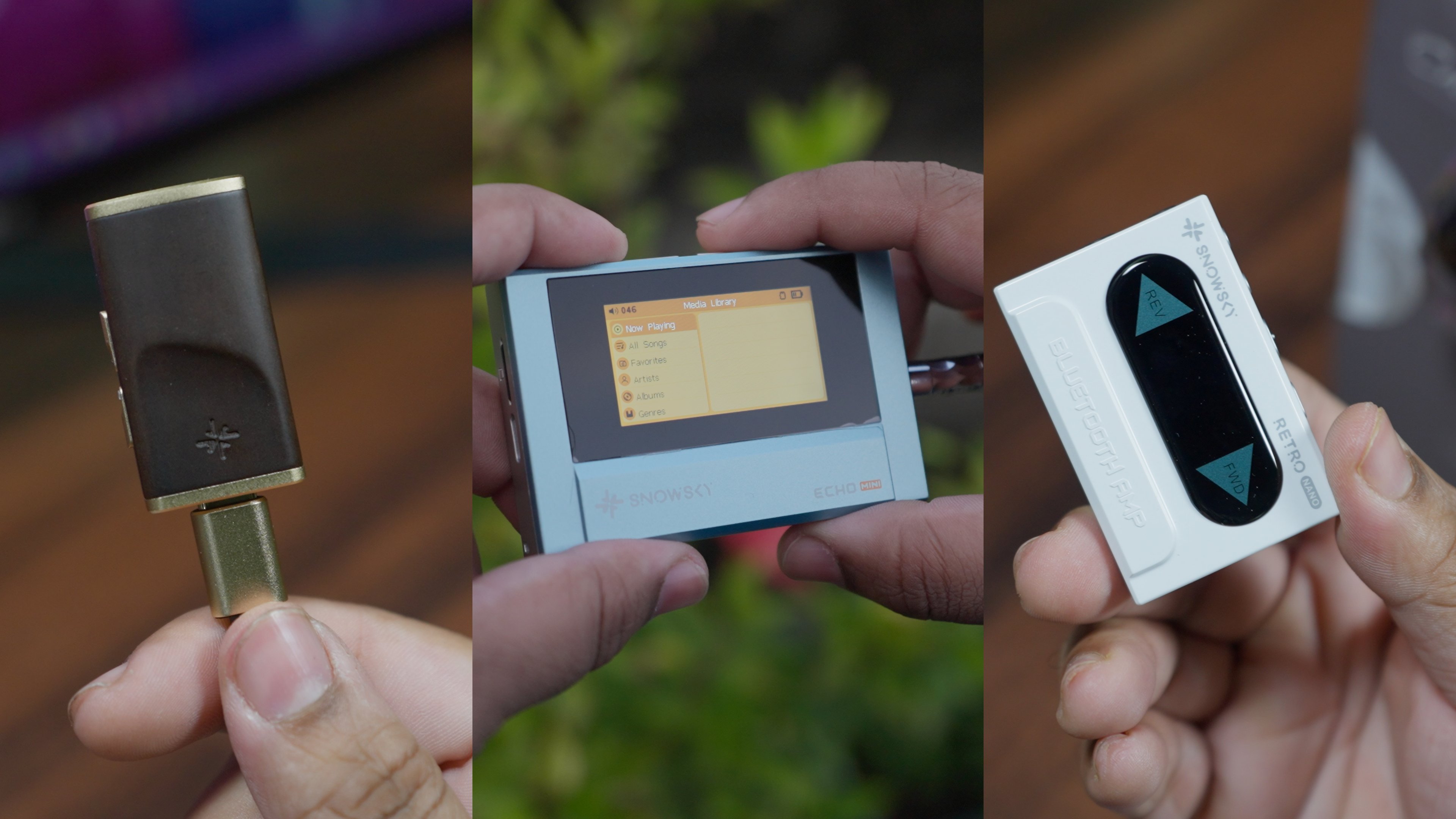
Now, before moving to the conclusion, let’s do a small comparison between the Snowsky Melody, Echo Mini, and Retro Nano. All three fall into a similar price category and share some overlapping features, while also offering their own unique extras.
To make your decision easier, if you simply want a portable and compact dongle DAC, and you don’t care about additional features like Bluetooth, a display, or standalone music playback, then the Snowsky Melody is the one to go for. It covers all the essential features, which are accessible through the app, and it also offers EQ support.
If you prefer something with a removable battery and Bluetooth functionality, then take a look at the Retro Nano. In terms of sound, both the Retro Nano and the Melody are very similar. The power output is also quite close, although the Melody delivers slightly more power overall.
Lastly, if you’re looking for a small portable music player that can play music on its own and also function as a USB dongle DAC, then the Echo Mini is worth considering. Sonically, the Echo Mini comes across as more neutral compared to the other two, leaning slightly cleaner and more linear in its presentation.
Conclusion
I’m really impressed by the value Fiio has provided with the Retro Nano. It’s such a feature and value packed device. A Bluetooth dongle DAC done this well in this price range is very hard to find.
It’s handy, easy to carry, has ample power to drive easier headphones, sounds excellent, and comes with full parametric EQ capability. On top of that, it gives you the flexibility to switch between Bluetooth and wired modes, and the removable battery is another big value add. It helps keep the device from going into a landfill and keeps it operational for much
longer.

Of course, there are flaws. The build doesn’t feel particularly premium, and the UI takes some time to get used to. However, these are minor issues that you can look past, considering how much value this product offers. I can confidently recommend this device to anyone looking for a budget-friendly, all-in-one portable dongle DAC. Overall, it gets a huge thumbs up from my end.
3 Likes
This new planar is different , throw out everything you thought you knew and give this one a listen, a serious listen.

5 Likes
It is with great sadness that we announce the passing of our good friend Kaye Dee (KrustyOlBastd).
Kevin was an ardent lover of music, a knowledgeable Audiophile and most importantly a cherished friend. As a member of the Canuck Audio Audioholics Anonymous Review Group, he openly and enthusiastically shared his love of music with us and the audio community at large.
His memory is not one to be forgotten, but one to be celebrated. In one of his last messages, he urged us to continue to enjoy the music. We will do more than that and persist in honouring his memory.
Rest in Peace Kay Dee (Kevin Davies). A true friend.


11 Likes
Oh man I’m so sorry to hear this  RIP Kevin
We will bro 
4 Likes
So sorry to hear about this, RIP Kevin and condolences to his family!
3 Likes
This is a bummer. Sincere condolences to his family, friends and audio family here and elsewhere.
2 Likes
My condolences! Truly sad news. Warm thoughts that both you that where his friends and to his family!
2 Likes

I am saddened to hear of his passing.
2 Likes


Kiwi Ears Cadenza 2 – Good All-rounder

Preamble:
Kiwi ears strikes again. This time with a more “budget” offering than the last model, the Orchestra 2, that I reviewed most recently. The $45 Cadenza 2 would have us believe, looking at its name alone, that it is the second iteration of the well-received Cadenza from a few years ago. After listening to the C2 I’m not sure if that comparison holds any water. For the better, that is.
As with the original Cadenza, the Cadenza 2 (C2), sports a single 10mm dynamic driver. Different from the OG Cadenza is the shift from a Beryllium driver to a Titanium one in the C2. The C2 is also easy to drive and doesn’t seem too fussy about what is powering it, but I recommend a warmer source for best synergy.
Regarding tuning, the C2 offers a mild V-shape with good frequency balance overall. Listeners can use the C2 for any musical genre, as it is quite versatile.
Specs:
Drivers: 1 10mm Titanium dynamic driver
Sensitivity: 106dB SPL/mW
Recommend music type: Pop, vocal
Impedance: 18 Ω
Frequency response: 20-29000Hz
Monitor plug:3.5mm connector
Earphone end plug: 2Pin(0.78Pin)
Cable: SCC
Build & Fit:
1. Attractive, simple design. Nicely appointed aluminium front plate and resin shell.
2. The build quality is very good.
3. Great comfort and an easy fit because of its ergonomic shape and moderate size.
4. The included 3,5mm cable is basic at best, as are the included tips.


SOURCES:
1. XDuoo XA-02
2. EPZ TP-35
3. Celest CD-2
4. Burson Conductor GT4
SOUND:
Bass:
1. The bass has good extension.
2. Sub-bass has a clean texture, with good speed and detail.
3. Mid-bass is punchy with good detail and texture.
4. The sub-bass is very present when called for in the music without embellishments.
5. The bass stays in its place, not bleeding into the lower midrange.
6. The bass has good control and poise, even on busier tracks.
Midrange:
1. Great clarity with an open sound. Vocal clarity is admirable.
2. Detail retrieval is macro over micro with some micro-details present.
3. The vocals are natural and positioned in the middle of the mix.
4. Balanced midrange presentation, with no harshness.
5. Good timbre and texture with a rich sound. Dynamics are notable.
6. Pinna gain is controlled without harshness.
7. Note-weight and density are good if slightly lean.
8. Layering and separation are very good.
9. Transients exhibit a rapid attack with natural decay.
10. Overall, the midrange sonics are pleasing.
Treble:
1. The treble has adequate extension.
2. Smooth treble presentation with acceptable sparkle and air.
3. Detail retrieval is decent.
4. Complementary to the rest of the frequency range.
5. Treble has enough energy to keep the sound open without being overbearing.
At first, I did not find the Cadenza 2 very impressive when I listened to it. Not that it sounded bad, just that nothing really jumped out. After moving away from it and coming back to spend some extended quality time, I now better understand and appreciate what it brings to the table.
This isn’t an IEM with a sound that jumps out. It does, though, offer a natural, balanced presentation that does really well for long listening sessions to any genre I used it to listen to.
Each part of the frequency range complements the other, and I believe that’s where the C2 really excels. This is not all that common in the $50 price range.

IMAGING & SOUNDSTAGE:
1. A moderately sized, balanced soundstage.
2. Instrument placement is stable within that soundstage.
3. Well-balanced between dimensions, adding to the natural technicalities.
4. Instrument spacing is fairly easy to discern.
5. Layering and instrument separation are notable within that soundstage.
6. Not overly expansive, but in a good way, as the C2 avoids sounding unnatural.
Versus:
Cadenza OG:
It’s been a while since I’ve listened to the original Cadenza and audio memory is fickle, so this comparison is not maybe the best. The C2 as a more refined OG. The original sounded good but a little unrefined as you moved up the frequency range.
While the OG had a more ballsy sound, the C2 tones that down and replaces it with a steadier hand which makes the C2 even more versatile.

CONCLUSION:
The Kiwi Ears Cadenza 2 really grew on me. It is a very capable all-rounder with a cohesive sound that lends itself to longer listening sessions. It’s not a sound that jumps out, but one that may take time to fully appreciate.
Looking at the Cadenza 2 through the lens as a successor to the original Cadenza, I’d say that Kiwi Ears have done well to take their time here. We have a comparably more refined and balanced sound, being now more resolving and cleaner in its sonics.
1 Like
One Dot Helios D100 – Musicality Wrapped In Fine Clothes

Preamble:
This is my first exposure to One Dot Audio (Shenzhen One Dot Audio Technology Co., Ltd.). Based in Shenzhen, One Dot Audio, also known as ODA, produces a full lineup of in-ear monitors and cables. ODA seems to have flown under the radar outside of Asia. This is a shame, as the Helios D100 is a fantastic IEM which I am certain will have a much broader appeal.
The $284 Helios D100 in for review occupies the middle of their product range, at least regarding pricing. Co-developed by ODA and TGS, the Helios is a single dynamic driver-based IEM housed in a gorgeous wood shell. According to ODA’s website, the D100 is suitable for pop and vocal music. As we’ll see from this review, that is not actually true, and the D100 sounds great with all genres when driven properly; that is.
The D100 with its quoted 112DB dB of sensitivity and 16ohm impedance is easy to drive by most sources but scales notably with a better frontend. Sonically, it brings a meaty yet vibrant musicality to the table. I would call the general sound presentation as more of a W shape than a V shape.
Specs:
Drivers: 1 10mm dynamic driver
Sensitivity: 112dB SPL/mW
Recommend music type: Pop, vocal
Impedance: 16 Ω
Frequency response: 20-20000Hz
Noise isolation: 26dB
Earphone type: In-ear
Monitor plug:4.4mm connector
Earphone end plug: 2Pin(0.78Pin)
Cable: 4-strand Silver-plated copper
Build & Fit:
- Gorgeous design that the camera does not do justice to.
- The build quality is exemplary. The finish on the wooden shells is beautiful.
- Great comfort and an easy fit because of its ergonomic shape and moderate size.
- The included 4.4mm balanced cable has good haptics, but is not modular.


SOURCES:
XDuoo XA-02
- EPZ TP-35
- Celest CD-2
- Burson Conductor GT4
SOUND:
Bass:
- The bass digs deep with good authority.
- Sub-bass has a dense yet clean texture, with good speed and detail.
- Mid-bass is punchy with good detail and texture.
- The sub-bass is very present when called for in the music without embellishments.
- The bass stays in its place, not bleeding into the lower midrange.
- The bass has an organic quality which lends itself to any genre.
Midrange:
- Great clarity with an open sound. Slightly mid-forward.
- Detail retrieval is notable, both micro and macro.
- The vocals are natural and positioned more forward. Notable vocal clarity.
- Balanced yet lush midrange presentation, but no harshness when driven by a capable source.
- Good timbre and texture with a rich sound. Dynamics are notable.
- Pinna gain is without harshness when driven by a capable source.
- Note-weight and density are notable.
- Layering and separation are very good.
- Transients exhibit a rapid attack with natural decay.
- Overall, the midrange sonics are fantastic.
- Overall, the D100 exhibits a natural and organic midrange.
Treble:
-
The treble has great extension. Slight upward treble Tilt.
-
Neutral yet smooth treble with notable sparkle and air.
-
Detail retrieval is very good without being sharp.
-
Nicely balanced with the rest of the frequency range.
-
The treble relays harmonics well with clearly audible decay.
-
Treble has enough energy to keep the sound open without being overbearing.
The ODA Helios D100 is a joy to listen to, with one caveat. When not driven by a better source, the sound, while still impressive, does not achieve the level of natural refinement heard on a better source, even sounding somewhat overly forward. A quality source will reward the listener with a natural and organic listening experience when paired with the D100.
The D100 is proof positive that a single DD-based IEM can offer a complete sound that can easily compete with other multi-driver bases products. In many regards, the Helios D100 reminds me of my beloved Timsok TS316. An IEM where driver counts/tech rightfully take a backseat to the sound.

IMAGING & SOUNDSTAGE:
- A moderately sized, balanced soundstage.
- Instrument placement is stable within that soundstage.
- Well-balanced between dimensions, adding to the natural technicalities.
- Instrument spacing is easy to discern.
- Layering and instrument separation are notable within that soundstage.
- A soundstage tuned more for natural sizing than for being exaggerated or imbalanced. The D100 while not offering the most expansive soundstage, never sounds closed in or constrained.
Versus:
Timsok TS316:
Both are excellent-sounding single DD-based earphones with many similarities and a few distinct differences. The TS316 is more balanced overall with less of a comparable upward treble tilt.
While the D100 has arguably superior micro-detail retrieval, neither suffers in that metric. The TS316 delivers slightly less bass prominence and a smoother treble.
Vocals are more forward with the D100 with excellent clarity, while comparably more recessed on the TS316 with almost equivalent clarity.
Both IEMs, in my humble opinion, lead the way for those who prefer a single dynamic driver. They are stellar examples of the quality, cohesive sound that single DD driver-based earphones can achieve.

CONCLUSION:
One Dot Audio, where have you been? The Helios D100 made it so easy to just chill and listen to music. It offers a cohesive and lively sound with an organic delivery. It did well with every music genre I threw at it, remaining poised.
The Helios D100 is easy to drive but definitely scales with better hardware. Take that into consideration, and I can see that many listeners will be more than happy with this IEM.

2 Likes
Ordered today. Liked your review and I like a different take on tuning
2 Likes
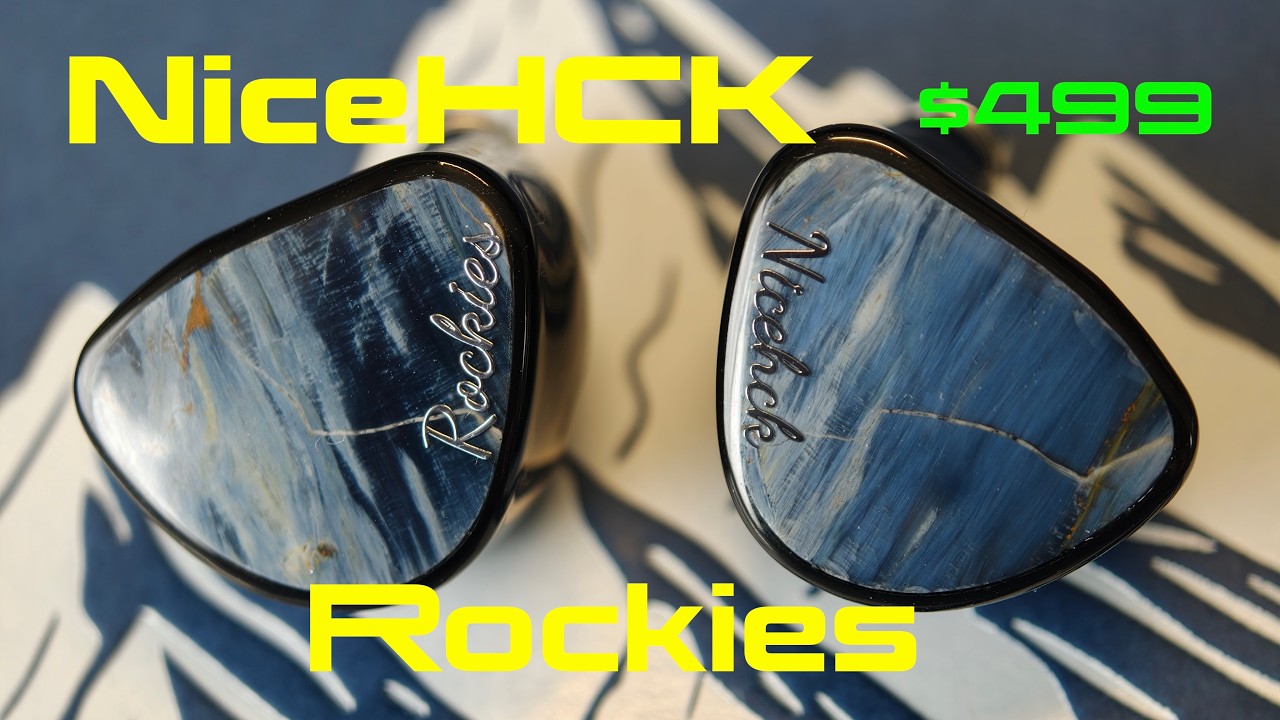
Lots of Hype on this one , and it’s good but is there better for the same or less?
4 Likes

5 Likes