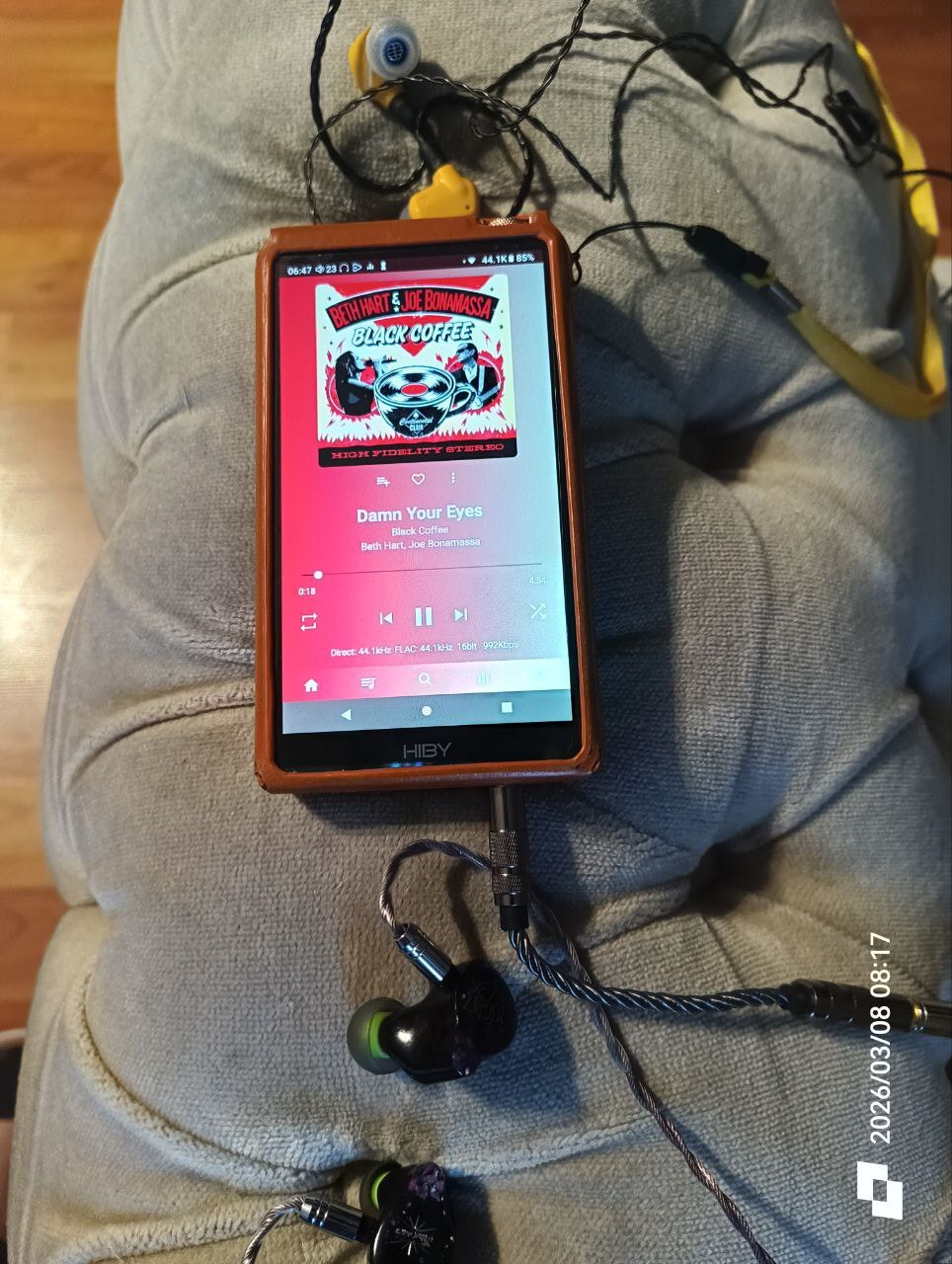
Comparison Review: Campfire Audio Honeydew vs Kiwi Ears x HBB Punch
In this comparison I’ll be looking at Campfire Honeydew (which I’ll refer to as Honeydew) and Kiwi Ears x HBB Punch (simply Punch).
The Honeydew is a single dynamic-driver IEMs, while the Punch is a hybrid design, which inevitably brings different characteristics - typically greater musical cohesion from a single dynamic driver versus greater technical performance from a hybrid setup. But more on that later.
Source and Setup
All listening was done using the HiBy RS6 digital audio player with Darwin enabled, along with the DRX10K Dynamics plugin created by respected Joe_Blogg, the member of our Bass-Head Club at Telegram.
Personally, I don’t enjoy listening to overly flat or sterile sound, so these two features are almost essential for my listening setup.
Normally I listen using the balanced output, but in the case of the Honeydew I couldn’t find a Litz cable terminated in 4.4 mm, and all the balanced cables I currently own actually sound worse than the stock Litz cable. Because of that, both IEMs were tested using a single-ended connection.
One practical note:
The Punch requires about 11 additional volume steps compared to the Honeydew, which naturally has some impact on battery life when using portable sources.
First Impressions
The difference between these two IEMs becomes apparent within the first few seconds.
The Punch sounds darker, while the Rosa comes across as more transparent and more natural.
For reference, here is the frequency response comparison I measured:
https://bassyalexander.squig.link/?share=Alexander_Target,CampFire_Audio_Honeydew,KiwiEars_HBB_Punch
The Punch is technically a more complex design, incorporating EST drivers and a crossover. For listeners who prefer a technical and analytical presentation, it’s definitely a compelling option.
Treble
Surprisingly, the treble decay on the Rosa is actually easier to perceive, even though it has less treble quantity overall compared to the Punch.
In theory the Punch should have the advantage here, but Campfire Audio did an excellent job with the Honeydew tuning.
Neither IEM exhibits sibilance, which is always a welcome trait.
On the Honeydew, the treble is smooth, soft, and completely non-aggressive.
On the Punch, the treble feels more controlled and “tidied up,” but also somewhat restrained.
Of course, physics still applies: the Rosa has less air and slightly fewer micro-details, which is expected given that the Punch uses EST drivers.
Simply put, EST drivers naturally bring extra air and detail retrieval to the table.
Midrange
Because the mid-bass on the Honeydew bleeds to midrange, the midrange is still dense and full-bodied. And thus, it can occasionally sound slightly muddy.
However, that same mid-bass presence also gives male vocals a rich, powerful character.
So, in this case it’s not entirely clear what’s objectively better:
the cleaner separation of frequencies, or the lush, weighty vocal presentation.
For true bassheads (the Honeydew is clearly designed with them in mind) this isn’t really a drawback. In fact, the strong mid-bass works especially well for outdoor listening, where a bit of extra low-end energy can help compensate for environmental noise.
The Punch presents the mids more clearly, but again this largely comes down to personal preference.
This difference also affects guitar reproduction. On the Honeydew, guitars have a noticeably sharper bite, which I personally consider a plus.
The mids on the Honeydew are slightly more distant and recessed compared to the Punch. However, they never feel overly forward or shouty. As a result, the soundstage can feel deeper on the Honeydew.
That said, this is perfectly natural given its more pronounced V-shaped tuning.
In terms of instrument separation and layering, the Punch does have an advantage. But we should remember that the Honeydew relies on a single dynamic driver, which typically prioritizes coherence and musicality over technical separation.
And indeed, the Honeydew clearly excels in musical cohesion and overall musicality.
Acoustic instruments (especially acoustic guitar and piano) sound excellent on the Honeydew.
Overall, the midrange on the Punch feels somewhat drier, while the Honeydew delivers a richer and more organic presentation.
Bass
Now we arrive at the lows, which are really the defining feature of both the Honeydew and the Punch.
Sub-Bass
Both IEMs deliver very deep sub-bass. If anything, the Punch might dig slightly deeper, which also aligns with the frequency response measurements I took for both pairs.
This difference is easiest to notice during track intros, when only a few instruments are playing. Once the full band or arrangement comes in, it becomes much harder to distinguish.
The Punch seems to also have slightly more kick, mainly because its bass is faster, better controlled, and more tightly focused.
Mid-Bass
Moving up into the mid-bass, this is where the Honeydew really starts to shine.
If the kick drum on the Punch hits you in the chest, on the Honeydew it goes straight to your lower back, if you’ll excuse the expression.
With EDM tracks, there’s even a certain danger that your head might detach from your body while you’re nodding along to the rhythm.
And that’s not even mentioning your feet starting to move on their own. As soon as the kick drum and bass guitar enter the mix, the urge to move becomes hard to resist.
Personally, I believe the foundation of almost genre of music (with the possible exception of classical) is built in the low frequencies. Many of you have probably noticed how dramatically the character of a song can change depending on how the bass was mixed during recording.
One clear advantage of the Punch (and I suspect many listeners who have heard both IEMs would agree) is that its mid-bass never bleeds into the midrange.
Overall, the low frequencies on the Punch sound more balanced.
However, this raises an interesting question:
does that balance come at the expense of the sheer wall of bass power?
That’s something each listener will have to decide for themselves.
It’s also worth noting that the bass on the Honeydew has a distinctly “tube-like” warmth, which makes old-school rock sound especially enjoyable.
On the other hand, the Punch clearly offers better layering and structure in the low end.
But as always, different listeners will prefer different presentations.
Conclusions
Time to wrap things up.
These are, of course, just my personal impressions.
Honeydew is an IEM designed for true bassheads.
Punch is for listeners who enjoy powerful bass but with a more audiophile-oriented presentation.
In terms of price-to-sound-quality ratio for bassheads, the Honeydew clearly wins.
Its advantage becomes even more apparent when listening outdoors, where the strong bass response helps maintain the musical foundation despite environmental noise.
If anyone has questions or suggestions for other comparisons between the IEMs in my collection, feel free to send me a private message.
You can also check which earphones I currently have available for review in my Squig.ling thread, the link is provided at the beginning of the review.
Thanks for reading.
P.S.
I almost forgot an important point about the Honeydew.
Listening with the stock ear tips can be quite difficult because of driver flex and vacuum pressure.
I strongly recommend switching to Sancai Wide Bore tips.
They completely eliminate the driver flex (almost like magic) and also add a bit more control to the bass response.