DUNU PRS 5
A more musical PRS 6
✧ ════ •IN-DEPTH REVIEW• ════ ✧

「SOUND-SIGNATURE」
It goes for a warm-neutral signature that is quite versatile and easy to listen. It is tuned with a slight low-end tilt that gives its bassline a cozy feel. The mid-range has an organic warmth touch that sounds more euphonic than analytical. The treble has a fair level of brightness to not sound dark and dull.
「BASS /LOW-END」
► My first impression was; Such a warm, bassy set! There is a significant bass boost across the low range. The bassline gives off this warm, enveloping presence that tends to wrap around the listeners like a blanket rather than isolating the bass elements in the background. Bass notes tend to linger a little bit longer, giving this notion of a slow-ish, organic bloom.
► The sub-bass is not about leaving a powerful, resonating sub-line. It is more about that strong sustain presence to fill the soundscape to create a more expansive low-end foundation. The rumbling, booming and tremoring effect will emphasize on atmospheric flow over air vibration and textural feel. I’ve noticed on warmer pairing; it has the potential to get borderline muddy and smeary.
► The mid/upper bass still sounds relatively rich and full-bodied. The attack amplitude seems a tad wider and faster versus its subline, but it still exhibits this soft, rounded-edge bass attacks.
► Kick-drums give off a decent tactile boom with a slight wooliness behind the thud.
► Drum-strike slams wider and tighter leaving a believable impact.
► Bass line guitar sounds very prominent. The hums and drones sound deep with well sustained-tone and rhythmic flow.
► Bass drops have good clarity though it is not the most distinct with its rise and fall. Meanwhile, ghetto bass seems to have a flatter rebound rate.
► Bass control is not the tightest, but it avoids from sounding overly muddy or bloaty.
" In short, the bass performance is more of a quantitative than qualitative bassline. It focuses more on providing low-end warmth and presence than high-definition bass layer and attack."
↓
「MID-RANGE /VOCAL」
► The mid-range is best describe being warm, smooth and pleasant. The vocalist often feels like they’re standing right in front you, stepping out in front of the background instrumentations. It will sound less frontal on a hall-like environment. The voice is well spread across the stage to create a more immersive experience. The separation between the bass and treble instruments may not have the clearest of cut but they are well spaced out between each other.
► Of course, in trade for pure musical experience, the analytical aspect of it will be compromised a little. It seems to prioritize a natural tone over ultra-sharp definition. It doesn’t try to highlight every nuance on the surface texture on vocals or the delicate on instrumental plays. However, I wouldn’t go as far as to say it sounded “low-res” or muffled for that matter. It is still fairly detailed by today’s standard. It is just less resolving versus its peers.
► The tonal balance allows its mid-range to have a core characteristic of a smooth, rich and dense timbre. Vocal and instruments that reside within this range, never sound thin or hollow. On surface level, they may not have the strongest definition, but in terms of depth, they have solid fundamental body and note-weight with rich overtones that makes them sound organic.
► MALE/LOW-PITCHED: Listening male vocals is such a treat. It is warm, lush with pleasant tonality. From bass to baritone to tenor, the voice is well-weighted with velvety texture. The chest voice can sound deep and resonating when it needs to. While the head-voice can soar high emotionally without crossing the line of fatiguing territory. Their vocal dynamic is well expressed for most part. It gives off an intimate and immersive feel that is often enhanced by the reverb/harmonic overtones. Such traits make them sound organic with a welcoming nostalgic feel.
► FEMALE/HIGH-PITCHED: They follow the same suit. Not matter what range the voice is at (contralto or soprano), they are just sweet and pleasant to listen. Despite, its warmer tonality, they don’t sound overly thick or husky with its complexions. The low to middle voice range sounds nigh excellent. However, as the voice tries to reach for the apex, some part of the high-pitch release and airy nature is toned down a little. Hence, it doesn’t sound as liberating or ethereal like a full-blown female vocal specialist set would do. As a result, the upper mid-range will never get fatiguing. They will never sound like they’re screaming or shouting at you directly. To my ears, the vocal dynamics and control is well-judged. I don’t find it to be all that lacking. If anything, they come across sounding natural and soothing.
► Quite frankly, I can’t think of any negative traits other than nit-picks. There is no harshness, hotness or any tonal flaw that could be a major deal breaker as far as my assessment goes.
► Acoustic guitar or pluck instrument is less about the plinking of strings; it is more about hearing the warmth and subtle resonance of the hollow wooden body.
► Violin and cello strums have a warmer playstyle. Bow strike will sound less aggressive with a hint of sweet sheen as it progresses higher in the notes.
► Piano on the hand tends to have a softer, rounded tap. It focuses more on the sustain and reverb of note-hits.
“Overall, the mid-range is just simply it easy to listen. The vocals and instruments may not give you a strong sense contrast but, most likely you’ll ended just listening to it for hours appreciating its smooth musical flow.”
↓
「TREBLE / HIGHS」
► The warm hues coming from the lows combined with a rather neutral-dark treble response, makes the upper frequencies sounds rather inoffensive. Air-extension is seemingly rolled-off which limits the sense of openness and clarity.
► At normal listening volume, it is free from sharp peaks, harshness and sibilance. It sounds very soft and liquid-smooth that feels relaxing to listen. There is no metallic-timbre coming from the micro-planar which I appreciate. It is quite forgiving on bad recording as it tends to iron out those imperfections.
► Treble definition isn’t the best in the game. But I don’t find the highs to be heavily veiled or masked. Those essential treble elements still managed to pull through naturally in the background. Though the transient is softened, the attack doesn’t sound too blunted or lacking the minimal bite. The high notes decays naturally, avoiding any sort of dryness issue with decent note-weight.
► There is a certain pleasantness to the way the hi-hat “chicks”. It pitched at the right amplitude with no fuzziness when constantly being hit.
► I feel the same with cymbal plays as well. When it crashes, the initial splash is rounded off while still preserved its sizzle. The clanging effect has a nice flowy quality that blends smoothness and crispiness.
► Drum-snare have good depth. The “pops” and “cracks” doesn’t sound spikey with a noticeable hollow resonance of the wooden/metal shell.
► Electric guitar sounds engaging without overly bright overdrive solos. It has the right warmth to sooth the guitar sheen while giving it enough grunt.
► Glockenspiel just sounds natural. The bell-like dings are well depicted.
► When it comes to synthesizer or electronic zing,ring,buzz and etc, is where I wish it’s got abit more bite and crunch to sound more substantial.
► It is quite safe for treble sensitive folks. I could still handle it at my loudest volume for a short blast. It is not the most suitable for monitoring purposes due to its rather warm and dark nature.
“Overall, it delivers the highs in a smooth, pleasant manner. There is adequate sense of clarity to cover the high spectrum by only just. Treble-heads will have to look elsewhere.”
↓
✧ ════ • TECHNICAL PERFORMANCE & OTHERS ASPECT • ════ ✧
The STAGE has good dimensions. Though, everything will sound closer to you, it’s the horizontal width is quite wide with adequate sense of headroom and perceived depth.
IMAGING performance is solid. Spatial cues have high accuracy with decent level of sharpness with its image projections.
INSTRUMENT SEPARATION is well sorted. Vocal and instruments were given enough space between each to prevent from sounding too cramp or congest.
DETAILING-HANDLING may not be its forte. It has stronger sense of macro than micro. But it didn’t sound particularly “low res” for the tier it competes.
As for the DYNAMIC-RANGE, the loud and soft elements have decent contrast. It has good balance of micro and macro-dynamics to keep listeners engage with the music.
TONE & TIMBRE? The warm and smooth nature is felt across the spectrum. It sounds rather organic and easy to listen. I do wish some part of the attack definition could better. But overall, it provides a solid fundamental body and density with natural decays. I never find it to sound artificial or digital.
DRIVER? It runs on five DUNU’s custom drivers. Those drivers did a decent job to achieve its goal. The crossovers are well implemented to channel a harmonious sound. Timbre contrast is very minimal.
SYNERGY? Based on my experience, it is less picky than the PRS 6 when it comes to pairing. It can scale better with higher volume/amplification rate. But I find it best to plug it to a neutral or brighter DAC/AMP just to dial its technical prowess a notch.
PRICE? As I am writing, there is no official pricing for the PRS 5 but I was told that it will cost less than $200. When considering its overall sonic performance plus DUNU premium packaging and accessories, the asking is quite reasonable. I don’t feel like they’re asking too much.
↓
✧ ════ •BUILD/ PACKAGING/COMFORT• ════ ✧
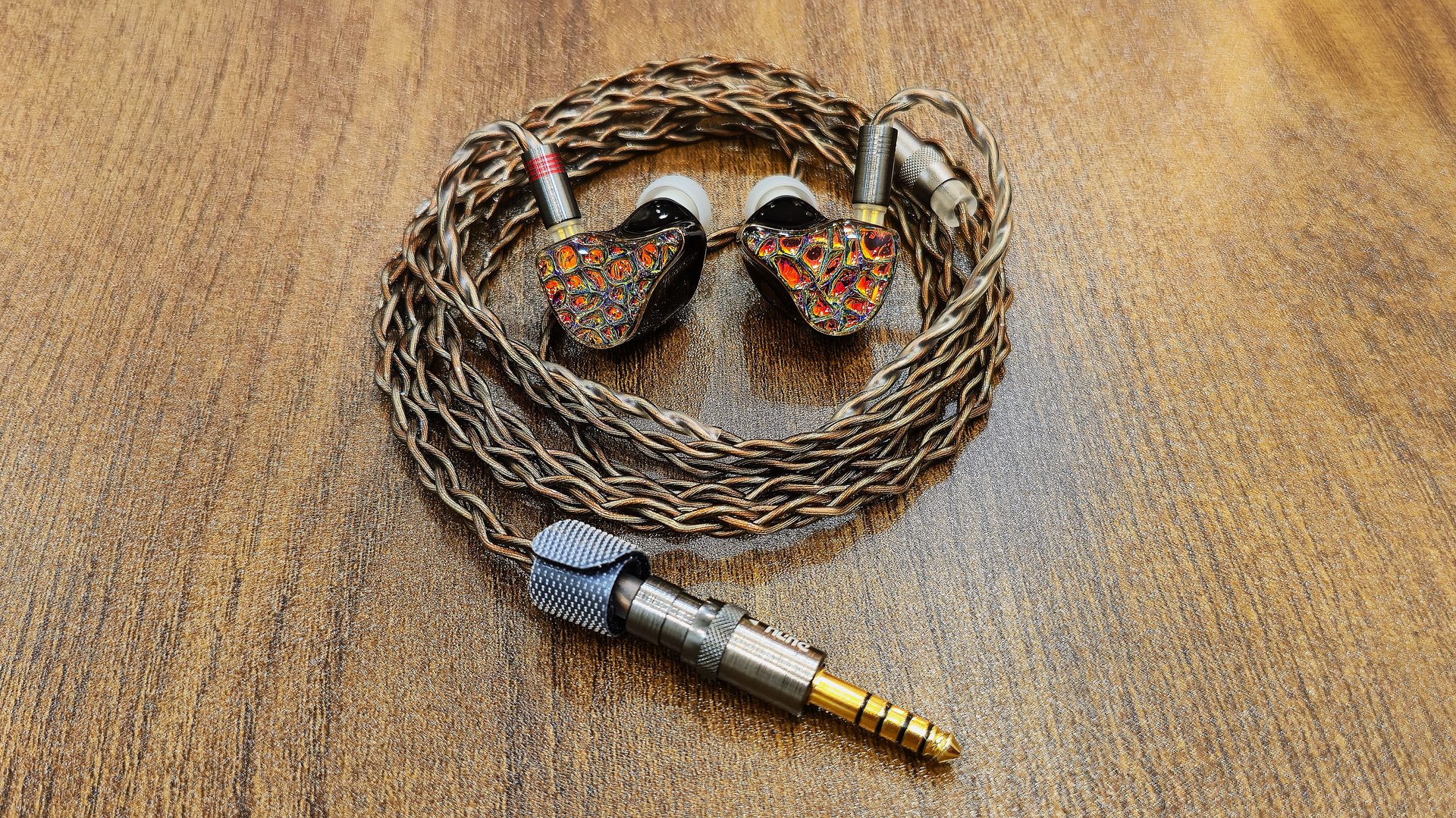
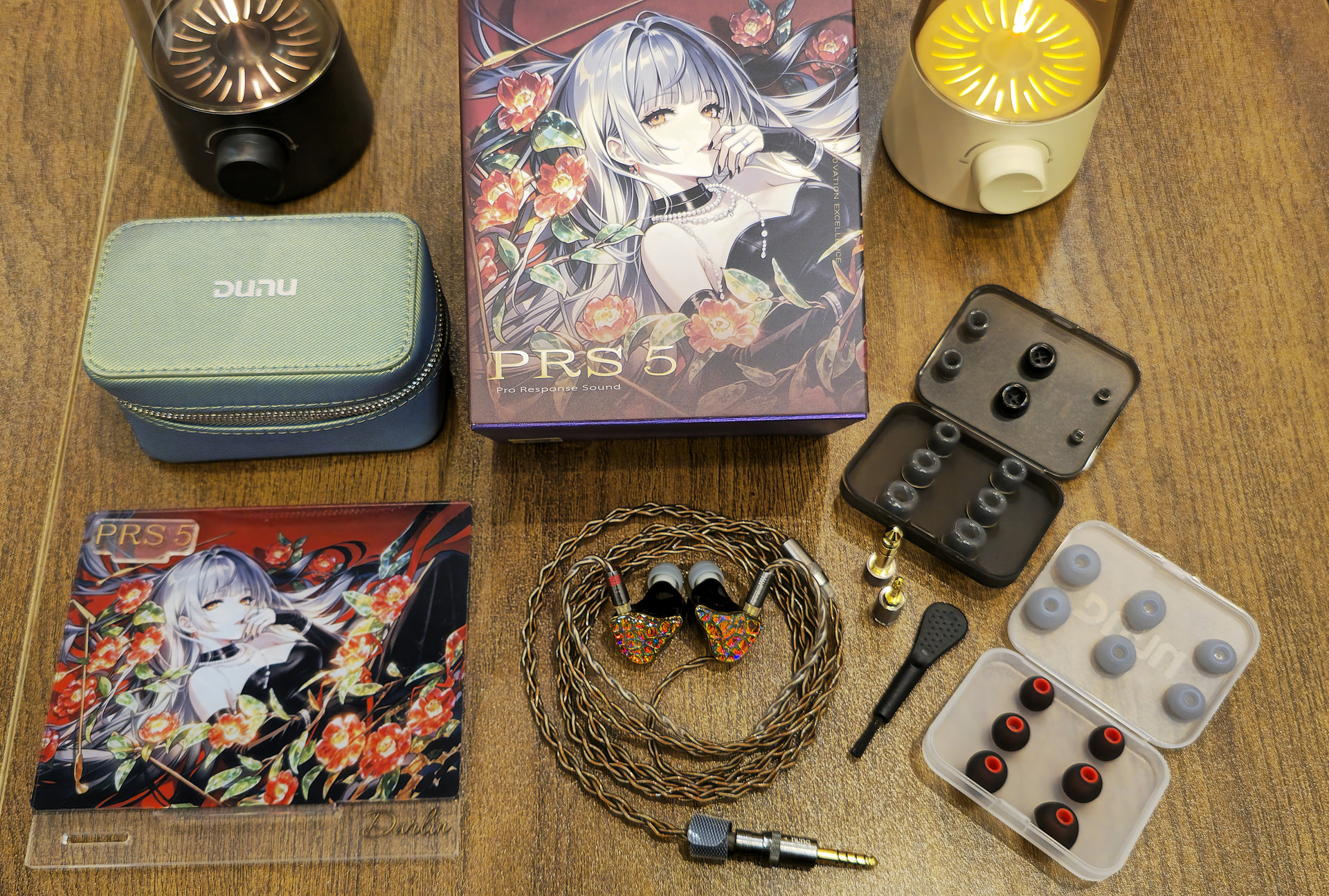
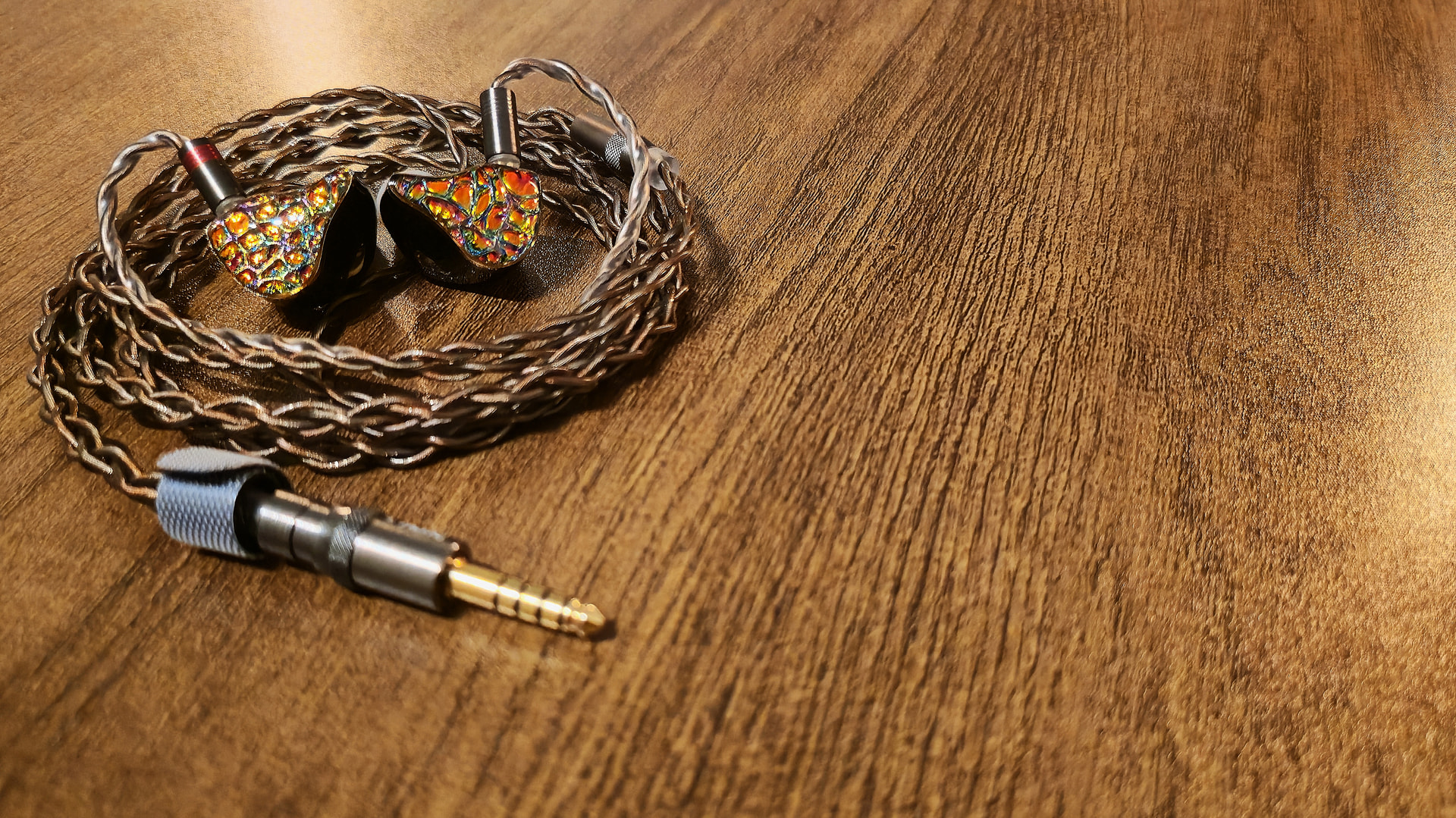
DUNU packaging and accessories has always been one their strength. And it is no exception with the PRS5. The PRS5 has a shell that is on the medium-large side. It sits in my small ears more comfortably than the PRS6 ever did. The only let down is the faceplate design. It doesn’t look as elegant nor as classy as the ones on the PRS6. It reminds me of cancer cell under microscopic view. Personally, I am not fan of it. Regardless, it is well vented with no driver flex or pressure build-up issue.
The stock cable is just decent. It is not a premium as the PRS6’s. It is thinner, stiffer and prone to memory. It tends to tangle as you wrap and unwrap it. Thankfully, it still uses a swappable termination plug (3.5/4.4MM). The casing and the stock ear-tips are identical to the PRS6. It also came with a waifu acrylic-stand.
↓
HEAD-2-HEAD
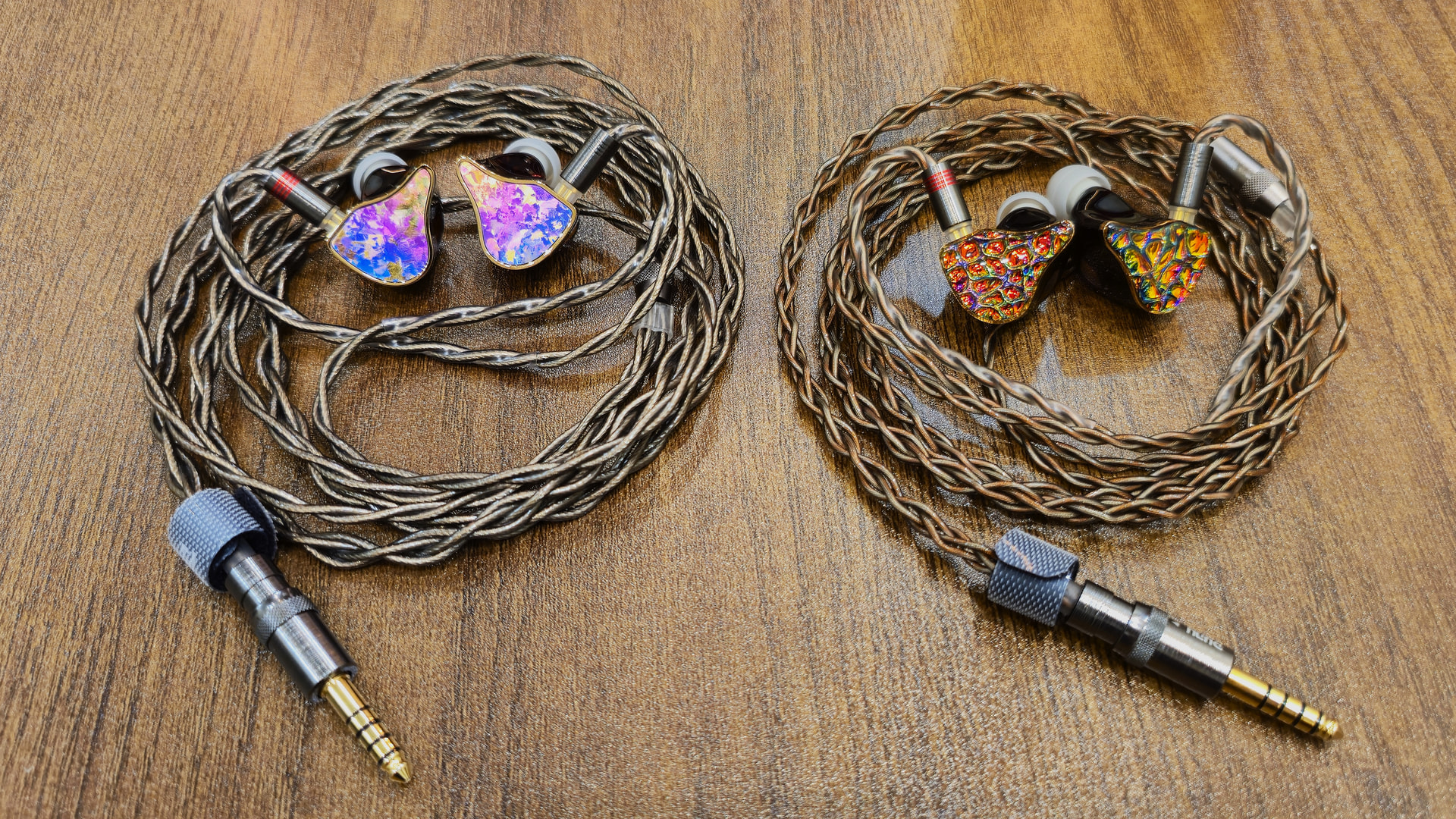
DUNU PRS6 vs DUNU PRS5
Both runs on 4.4MM BAL stock cable and Azla Sednaearfit Light (MS)
↓
< BASS >
▲ Right of the bat, the bass boost on the PRS5 sounds significantly stronger. The bassline is warmer, thicker, denser and slower in nature.
▲ On the PRS5, the sub-bass seems to have a longer sustain level. It lingers a little longer before it fades. It allows those rumbling, booming and tremor effect to sounds more atmospheric. However, the PRS6 seems to offer a deeper extension. The attack amplitude revs higher, giving subline elements a more rhythmic feel. As a result, bass-drop will have better contrast with its ups and downs.
▲ As we transition onto the mid/upper-bass section, such demeanour is carried over here as well. The PRS5 will offers a thicker, fuller bass note while the PRS6 will have a snappier bass attack.
▲ Kick-drums will pack a bigger, slower punch on the PRS5. While the PRS6 hits deeper and sharper. The same true can said with its drum-strike. Bass line guitar on the PRS6 sounds higher-pitched, with the PRS5, it sounds mellower, more enveloping and better with its sustained-tone.
▲ Surprisingly, the PRS6 offers bouncier ghetto bass replay. And most of the time, it sounds tighter and better controlled.
▲ In short, the PRS5 is more about having a warmer, slower, atmospheric bassline. The PRS6 will not have same level of warmth and density but the attack definition just offers a little bit more attack dimension overall.
↓
< MIDS >
▲ The PRS6 is the more mid-centric set of the two. The vocals and instrument have better clarity and transparency overall. It sounds less coloured and truer to life.
▲ Male vocals on the PRS5 performs more consistently with its note-weight. Thanks to its warmer and fuller lower spectrum. Having said that, the PRS6 allows male vocalist to sound more dynamic. The natural rise and fall to the voice make its more emotionally connected. And in terms of vocal weight and density, it is not that lacking either.
▲ Female vocal is tonally sweeter on the PRS5. The vocal sustains a little bit longer allowing it to bloom. However, the PRS6 is better at capturing the delicate breathiness or airiness to the voice. At higher pitched the vocal sounds tad clearer and slightly more engaging to listen.
▲ Guitar plucks have more tangible bite with the PRS6. the twang just sounds clearer to my ears. On the PRS5, it focuses more the warmth and reverb of it.
▲ Piano plays sounds more realistic on the PRS6, every tap carries a more distinct physical hit. On the PRS5, it does come across sounding softer.
▲ Again, the violin and cello sound a tad sharper and more expressive with the PRS6.
▲ Overall, the PRS6 easily win this. It sounds more focus, more dynamic and in many areas sounds truer to life. The PRS5 does sounds thicker and warmer which make its a more coloured sound and easy to listen.
↓
< TREBLE >
▲ The PRS5 treble is noticeably darker. The upper registry has a warmer and smoother tone to it. This is where you felt the absence of the MEMS driver. The PRS6 has slightly brighter and sharper upper treble definition.
▲ Hi-Hats on the PRS6 does sounds more prominent and slightly higher-pitched in comparison. Oddly enough, the PRS5 “chicks” more pleasantly. The attack though is softer, sounds less peaky and decays more naturally.
▲ I get the same impressions with cymbal plays as well. The PRS6 will have a more distinct initial attack. Whereas the PRS5 sounds more pleasing with heftier note-weight and decays more gracefully.
▲ Drum-snare on the PRS6 sounds snappier and faster with its “pops” and “cracks”. The PRS5 just sounds thicker, slower and less spikey.
▲ On rock & metal genres, the E-guitar on the PRS5 does sounds more melodious. It sounds abit more progressive and better with its sustained pull.
▲ The mallet strike on the glockenspiel sounds sturdier and tighter on the PRS6. The PRS5 will have softer hits but it reverberates longer when it “ding”.
▲ Electronics (zing,ring,ding,buzz etc.), those elements will have a crunchier bite on the PRS6 which gives its PRS6 an upper hand when it comes to modern genres that rely on synthesizers.
▲ The PRS5 will be better for loud volume listener or treble sensitive folks. Meanwhile, the PRS6 is better for monitoring purpose.
▲ The PRS6 is for those who chase high-end clarity and precise decay. The PRS5 is for those who likes a smoother, more laid-back and organic presentation.
↓
< TECHNICALITIES & OTHER ASPECTS>
The STAGE on the PRS5 has better dimensions. It is slightly wider, noticeably taller too. The front-to-back layering offers more depth. The PRS6 sounds abit more 2D-ish in comparison.
The IMAGING on the PRS5 is more accurate. The vocal and instrumental placement are more correctly placed within the sound-field. However, the PRS6 can project a sharper image.
INSTRUMENTAL SEPARATION? The gap between vocals and instruments on the PRS5 is more spacious thanks to its stage dimensions. On the PRS6, everything seems to sit closer to each other despite having a clearer cut between bubble of sound.
In terms of MICRO-DETAIL, the PRS6 takes it. But MACRO-wise, the PRS5 handles them abit better overall.
DYNAMICALLY, the PRS6 is the more aggressive set when it comes to its attack. The loud and soft elements will have a better contrast. The subtle tone-shift or the tonal variation will be much better depicted with the PRS6. Whereas the PRS5 will take a more balance approach.
TONE & TIMBRE is a toss between the two. Tuning wise, the PRS5 does sounds abit more organic. It has better balance between attack, decay and sustain. Meanwhile, the PRS6 does sounds less coloured and tend to focus more on transient attack.
BUILD AND PACKAGING? Accessories wise, they’re nigh identical (Casing & Eartips). The PRS5 is thicker in size, but surprisingly more comfortable to wear. It will fit deeper ear-canal better. However, the PRS6 faceplate is just simply gorgeous. The faceplate on the PRS5 looks rather cancerous to me. Both will have a swappable plug termination (3.5/4.4MM). However, the stock cable on the PRS5 is thinner and more prone to memory. It doesn’t feel as premium as the PRS6.
PRICE? The PRS5 is set to be cheaper than PRS6 for less than $200 (No official announcement as of now). Depending on your tuning preference, your price value preposition can shift easily between the two. But from a physical standpoint, that gorgeous looking aesthetic including a more premium stock cable (like DN242/142), I honestly don’t mind paying the extra 50-60 bucks for the PRS6.
↓
" The PRS6 is what I’d picked If I were to prioritized vocal authenticity and treble clarity. And that beautiful faceplate could be one of the reason why you want to grab it over the other. The PRS5 would be a better choice for all walks of genres. It sounds warmer yet still engaging and well-balanced. And yes, it is cheaper too. Though aesthetically, it may not be for everybody XD."
↓
→ CONCLUSION ←
The PRS5 has more likeable tuning especially when you’re listen to broad genres. Though its detail-handling is slightly inferior to the PRS6, it sounds more versatile.
For less than 200 bucks, you should shortlist the PRS5. Especially when you’re looking for a smooth, warm and fatigue free experience. It’s got s decent technical performance to run through everything. And that DUNU accessories with bonus waifu acrylic stand is a nice additional touch. I just wish, it’s got PRS6’s faceplate on it.
↓
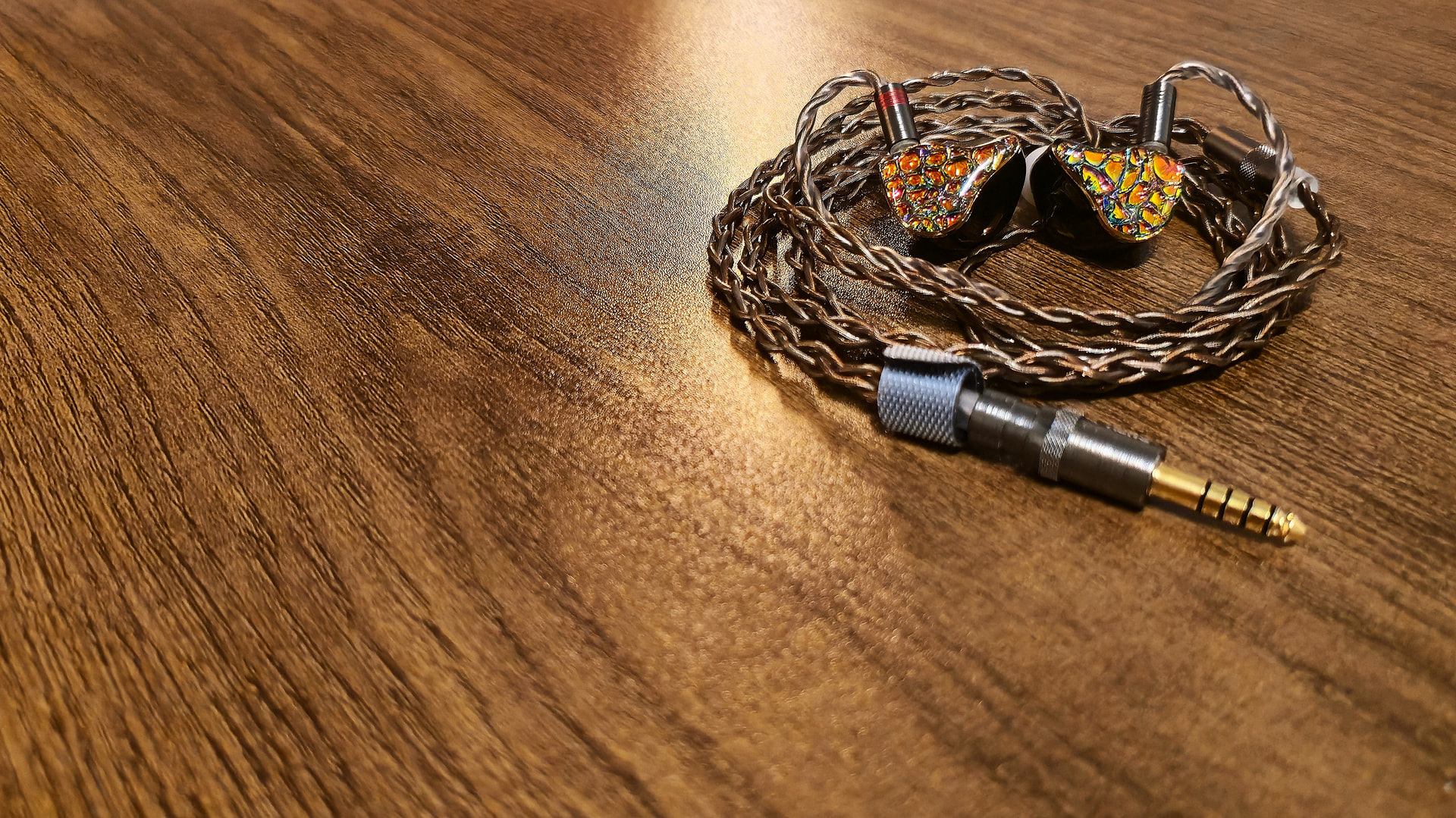
DUNU PRS 5
PRICE : PERFORMANCE [<$200] : ★★★★ (8.0/10)
BUILD & PACKAGING [BASED ON PRICE]: ★★★★★ (10/10)
COMFORT : ★★★★⯪ (9.0/10)
PERSONAL ENJOYMENT (BIASED) : ★★★⯪ (7.0/10)
OVERALL : ★★★★ ( 8.5/10)
1-2 ★ - Appalling! please avoid this
3-4 ★★ Subpar offering, there are better options out there!
5-6 ★★★ Decent with some caveats! Not a bad pick! (CONSIDER)
7-8 ★★★★ Not perfect but solid choice! This should be in your shortlist. A nice addition to your collection. (SHORTLIST) (RECOMMENDED)
9-10 ★★★★★ One the best in class! You should go right ahead & buy one! A must have! (BLIND WORTHY)
↓
< MY DISCORD SERVER MEMBERS AND MY BROTHERS TAKES>
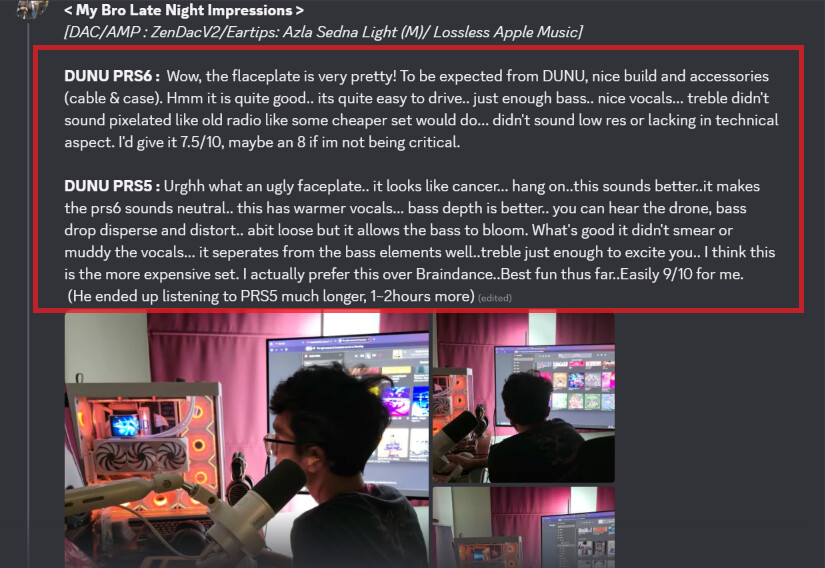

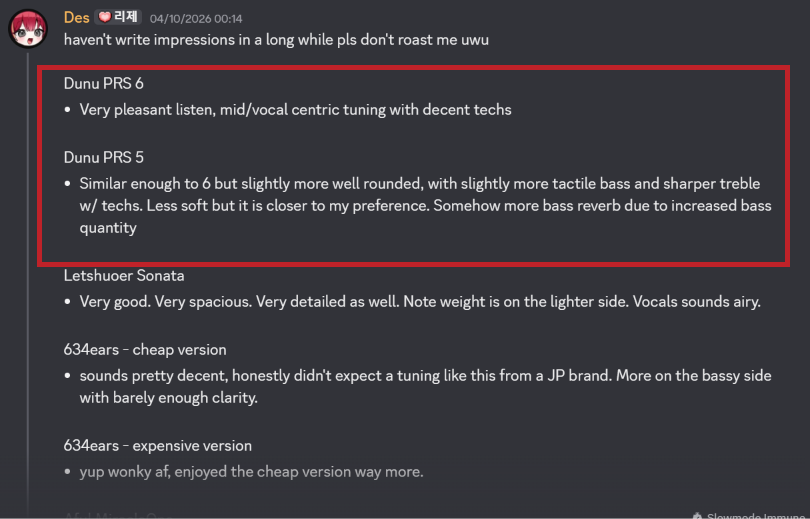
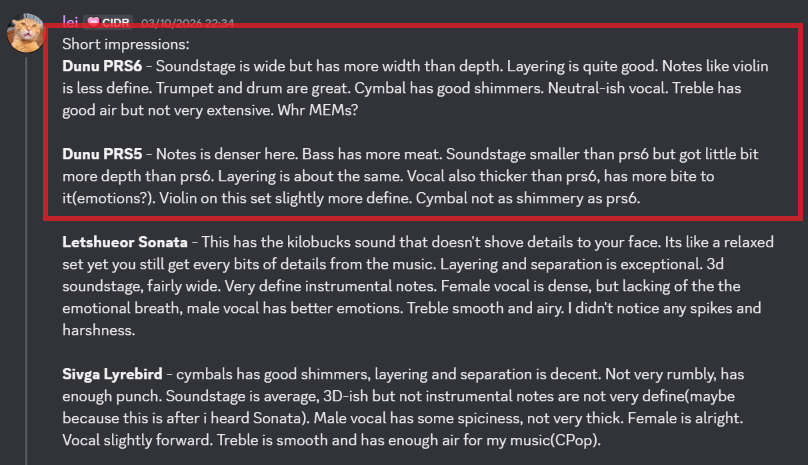
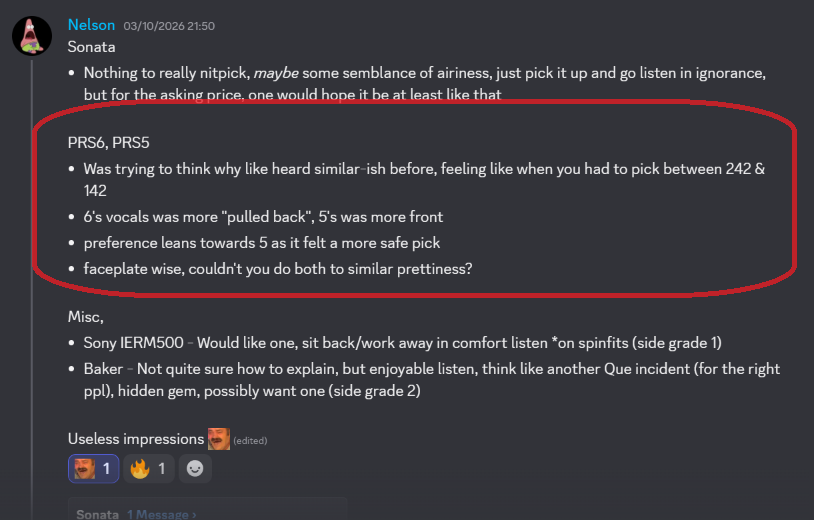
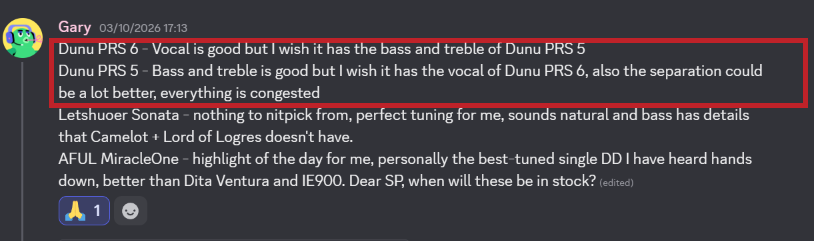
Pros:
**- Warm, enveloping low-end.
- Rich and lush mid-range/vocal.
- Inoffensive, natural highs.
- Decent detail-handling.
- Well dimensioned stage.
- Medium-large resin shell with comfy fit.
- Solid packaging & accessories.
- A better all-rounder than PRS 6.**
Cons:
- Not the most resolving in its price-point.
↓
Driver Configuration: 1DD + 3BA + 1 Micro Planar.
MSRP: < $200
↓
DISCLAIMER
~ This unit is sent by DUNU for a review.
~ Assessment took after 5-7 days of running process.
~ Running on stock 4.4MM BAL & Azla Sednaearfit Light (MS).
↓
Shoutout to DUNU for making this possible!
↓
Thanks for Reading! ╮(╯▽╰)╭