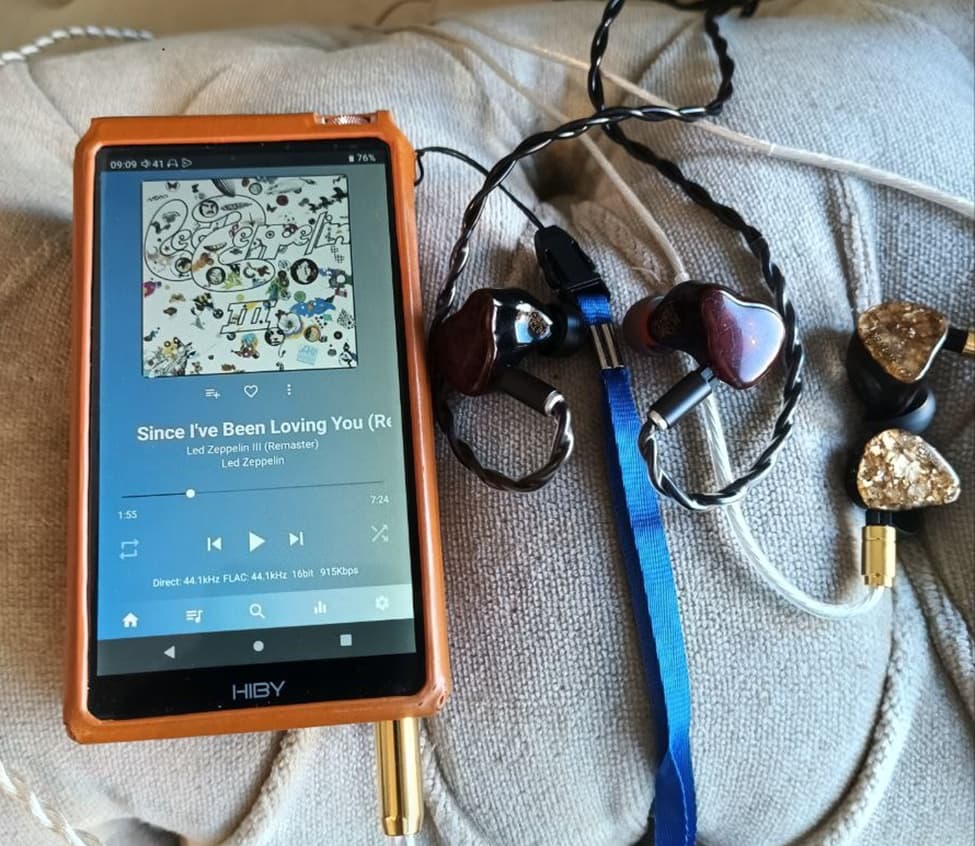
A comparison of the well-known brand at Bass-Heads United We Stand thread the TSMR Armor (USD289, purchased from Penon store) vs the Punch Audio Martilo (USD329 – price as of October 2025 on AliExpress). For convenience and brevity, we will refer to them as the Armor and the Martilo.
The Martilo has now increased in price by 50 dollars. Apparently, people have started to appreciate these IEMs, and sales have risen. Previously, they cost the same as the Armor does now. Perhaps the same fate awaits these IEMs (Armor) as well.
A few words about the components used to “cook up” these bass-head IEMs. Yes, indeed - bass-head. They are clearly designed for listening in different conditions, but in any case, both will likely appeal to lovers of powerful low frequencies which do not bleed into other frequencies but only create the foundation of the music, serving as an excellent base on which the entire structure of a quality house is built.
The Martilo’s sensitivity is 100 dB and impedance is ~9 Ω. The Armor has a sensitivity of 103 dB and an impedance of 11 Ω. The declared frequency response for the Armor is 10Hz – 45kHz, and for the Martilo it’s 10 Hz – 22 kHz.
The Armor seems to be born for listening to jazz-rock and the genres alike. The first time I listen to them, I got so hooked that I couldn’t stop for over 4 hours. I don’t know how they achieve this, but I don’t have any other earphones where I’ve experienced such an effect for jazz rock. Old-school rock also sounds excellent. The Martilo, on the other hand, is very great for EDM music, as well as pop and R&B.
Both pairs of earphones are hybrids, though the Armor is sometimes classified as a tribrid. It consists of two dynamic drivers, two balanced armature drivers from the well-known (in narrow circles) American company Knowles, and one EST (electrostatic) driver with tuning switches. The Martilo also includes two dynamic drivers and two balanced armature drivers from Knowles. The high frequencies in the Armor are handled by the electrostatic driver, while in the Martilo it’s a planar driver. And this is noticeable immediately. But more on that a bit later.
The fit of Armor suits me better, as they are smaller in size. Due to their considerable size, the Martilo may not fit properly in every ear. The Armor can’t be called tiny either, but they are still compact. Out of my entire extensive collection of in-ear monitors, the Armor, which aren’t particularly distinctive in terms of color, are somehow especially beautiful to me. You don’t even want to let them out of your hands. As it turned out, my Armor are not quite ordinary IEMs. After 9 years of the HiFi hobby, I have accumulated exactly ONE HUNDRED IEMs to date. A milestone indeed… Well may be a little bit more but that’s the I amount of frequency response graphs I have at squig.link.
Gear used for analysis and comparison:
Hiby RS6 player without any enhancers/tuning on the balanced output (4.4mm). Well, except for Darwin Ultra, of course. Without it, the sound is bland to me. For testing the high requencies/midrange/soundstage/air, the track “Since I’ve Been Loving You” by Led Zeppelin was used, and for the low frequencies, the song “Honey Bee” by Blake Shelton (hello country lovers). By the way, I also recommend evaluating low frequencies on country songs. In most tracks, the low end is recorded very neutrally. Well, for my taste. There’s not as much as in EDM, and not as little as in most rock recordings, i.e., just right. They don’t steal the show but still maintain a worthy place in the compositions. At least in terms of quantity.
Now the comparison itself.
High frequencies are the most noticeable difference between these two. As mentioned earlier, the Martilo uses a planar driver, which isn’t very favored in audiophile circles, whereas the EST is rated higher, but in this case, the highs on the Martilo are tuned better, well, at least to my ears. I mean that the high frequencies clearly draw more attention to themselves on the Martilo than on the Armor. I don’t know if this was done intentionally or just happened during driver tuning. The high frequencies are more pronounced on the Martilo. They have a longer decay and overall sound less dark than on the Armor. Also, the frequency response curves differ significantly in the upper range. I will post links to the frequency response graphs for the Armor and Martilo at the end of the comparison. The Armor is clearly made for those who are high-frequency-phobic. Still, the electrostatic driver adds detail and clarity. However, the planar driver in the Martilo adds more air to the overall sound. So here, it’s a matter of personal preference.
Now let’s talk about the midrange.
The Armor has very good detail, but the naturalness of the timbre is still better on the Martilo, especially noticeable. It also has very a good instruments separation. On the Martilo, the vocal is slightly closer than on the Armor, which can be an advantage for some users and a disadvantage for others. This happens because the upper part of the midrange between 2 and 4 kilohertz has a peak, especially noticeable on female vocals. Guitars on the Martilo are also quite biting and very well textured. Despite a substantial bass shelf (more on that below), there is no feeling of the midrange being suffocated, and they sound surprisingly clean and balanced. But actually, the lower range of the mid frequencies is suppressed in favor of the Bass. Well, at least with the tuning 1-0-0. This leads to a lack of body and richness in male vocals. The midrange on the Armor sounds natural and soft. Unlike the Martilo, male vocals with the Armor sound quite full-bodied. Moreover, the frequency switches on the Armor can significantly alter the overall sound signature. Using the switches, you can enhance the midrange, thereby bringing them forward or, conversely, pull them back. Oh, these switches are a great thing. I can say without a doubt that using these three switches, you get three earphones that sound completely different. It’s at least three in one.
Finally, we’ve reached the most important component of these two pairs of earphones. We’re talking, of course, about the low frequencies.
Let’s start with the Martilo.
Very deep sub-bass. The bass shelf is “only” 14 decibels (compared to Fatfreq Scarlet), but nevertheless, it’s enough to get rumbling, thunderous and room-shaking low end. They start from 20 hertz, so the depth and impact of the lows are felt instantly. The two dynamic drivers coupled with the armatures create a layered and deep sub-bass, as well as impact for the mid-bass, which is still somewhat restrained compared to the sub to avoid masking the midrange. The low frequencies are very well controlled and have good speed, which are the most important characteristics of lows. At least for me personally. The sub-bass doesn’t even come close to booming, and the decay on the lows is good and natural. The mid-bass punch is quite solid, but I find it slightly lacking the punch. *Especially for outdoor use. We’ll talk about this in the conclusion part. I’d like more of that tactile “thump”. I’m missing those ear-drum massaging rubber balls. And it lacks some tightness too.
But the Armor has all of that. If not in excess, then quite enough to satisfy 90% bass-head’s demands. I’m talking about the mid-bass. As for the sub-bass, the Armor also goes deep, although not as much as the Martilo. The punch is more emphasized in the Armor, especially if you set the switches to the 1-0-0 position. Drum hits are dynamic, deep, and meaty. The bass is very well textured and crisp, and the separation between the kick drum, toms, and bass guitar is very well differentiated. There’s no muddiness in the lows whatsoever, which I consider a huge achievement.
The soundstage on both IEMs is quite realistic. That is, there’s a distinct feeling of being in a concert hall where musicians are playing “live.” It is slightly wider on the Armor, but identical in depth to the Martilo.
Conclusion.
Although the Armor and Martilo are both bass-head IEMs, they sound different. For lovers of strong, punchy mid-bass, the Armor is preferable. For admirers of rumbling sub-bass, the Martilo will be to their taste. Universal recommendation: if you’re choosing between these two IEMs, listen and compare them with your own ears. My opinion, of course, is personal and subjective, but both pairs of these IEMs highly deserve a purchase by bass-heads. And not only for bass-heads, in the case of the Armor, where you can use the tuning switches to reduce the lows by about 70%, while keeping excellent mids and highs.
P.S.
*About the punch when listening to IEMs outdoors.
On all my in-ear monitors, the sub-bass is catastrophically reduced when listening outdoors, no matter what IEM tips I use. That is, if at home I hear a roar that almost feels like a vibration in my chest, outdoors it turns into, at best, rumbles, not the thunder itself. However, the mid-bass is not overpowered by anything. Therefore, for outdoor listening, mid-bass is my priority. Between these two, I’d unquestionably choose Armor for the outside use.
For questions and discussions about these and many other earphones, you are kindly invited to the Bass-Head Club on Telegram.
Apologies for the large volume of information. I just wanted to cover the topic more thoroughly.