That is one sick pic.
2 Likes
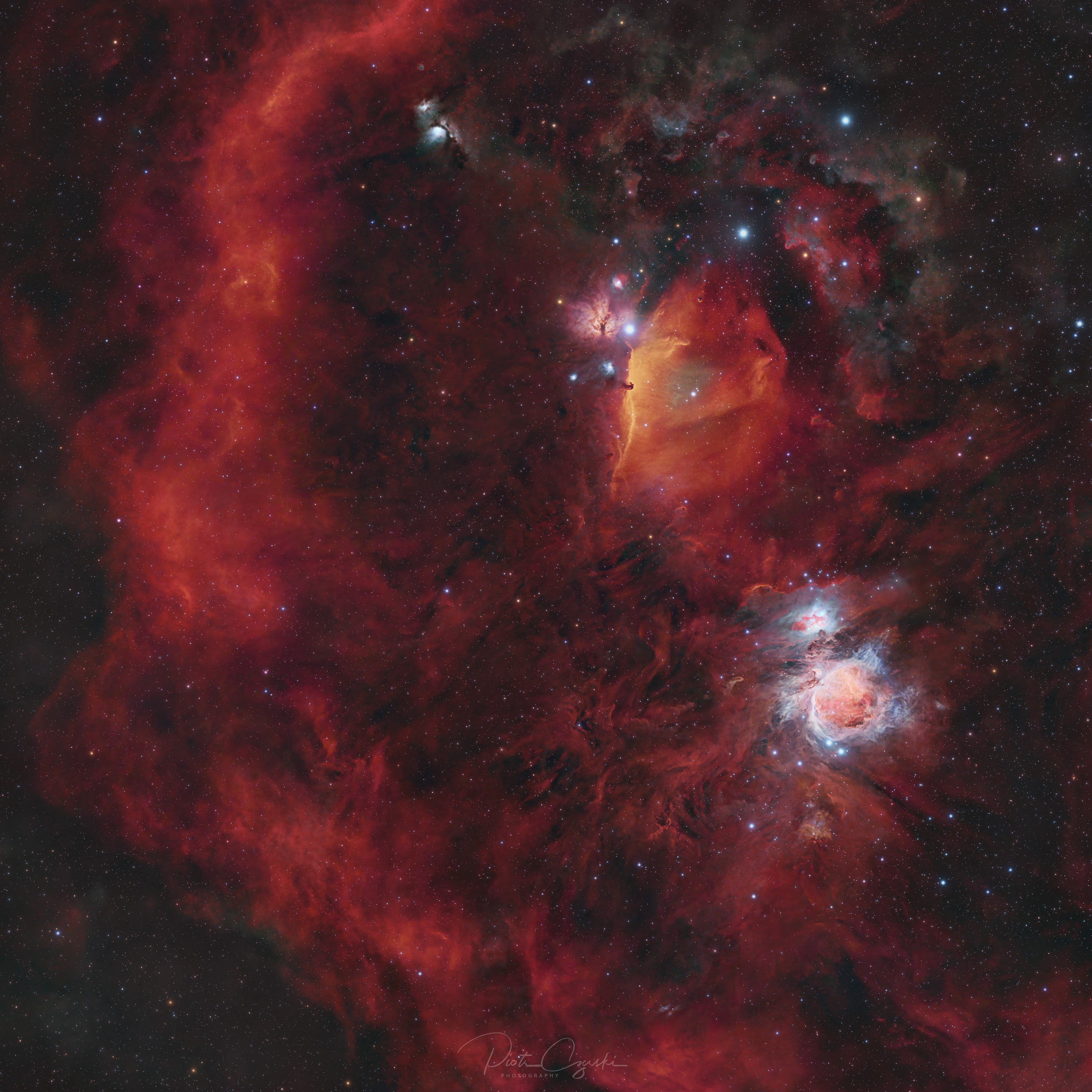
Image Credit & Copyright: Piotr Czerski
Explanation: Cradled in red-glowing hydrogen gas, stars are being born in Orion. These stellar nurseries lie at the edge of the giant Orion molecular cloud complex, some 1,500 light-years away. This detailed view spans about 12 degrees across the center of the well-known constellation, with the Great Orion Nebula, the closest large star-forming region, visible toward the lower right. The deep mosaic also includes, near the top center, the Flame Nebulaand the Horsehead Nebula. Image data acquired with a hydrogen-alpha filter adds other remarkable features to this wide-angle cosmic vista: pervasive tendrils of energized atomic hydrogen gas and portions of the surrounding Barnard’s Loop. While the Orion Nebula and many stars in Orion are easy to see with the unaided eye, emission from the extensive interstellar gas is faint and much harder to record, even in telescopic views of the nebula-rich complex.
3 Likes
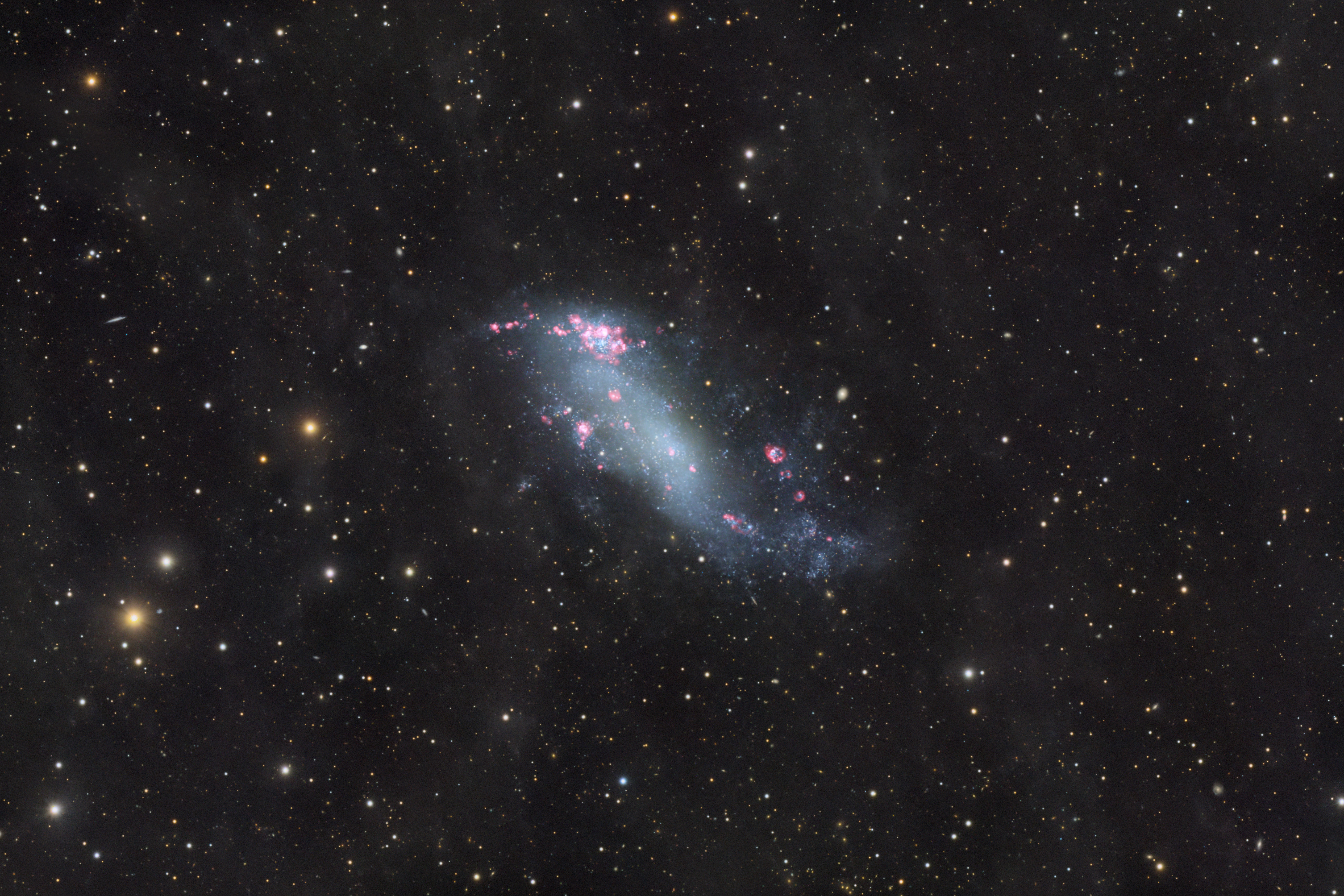
Image Credit & Copyright: Dane Vetter
Explanation: Grand spiral galaxies often seem to get all the glory, flaunting their young, bright, blue star clusters in beautiful, symmetric spiral arms. But small, irregular galaxies form stars too. In fact, dwarf galaxy IC 2574 shows clear evidence of intense star forming activity in its telltale reddish regions of glowing hydrogen gas. Just as in spiral galaxies, the turbulent star-forming regions in IC 2574 are churned bystellar winds and supernova explosions spewing material into the galaxy’s interstellar medium and triggering further star formation. A mere 12 million light-years distant, IC 2574 is part of the M81 group of galaxies, seen toward the northern constellation Ursa Major. Also known as Coddington’s Nebula, the faint but intriguing island universe is about 50,000 light-years across, discovered by American astronomer Edwin Coddington in 1898.
1 Like
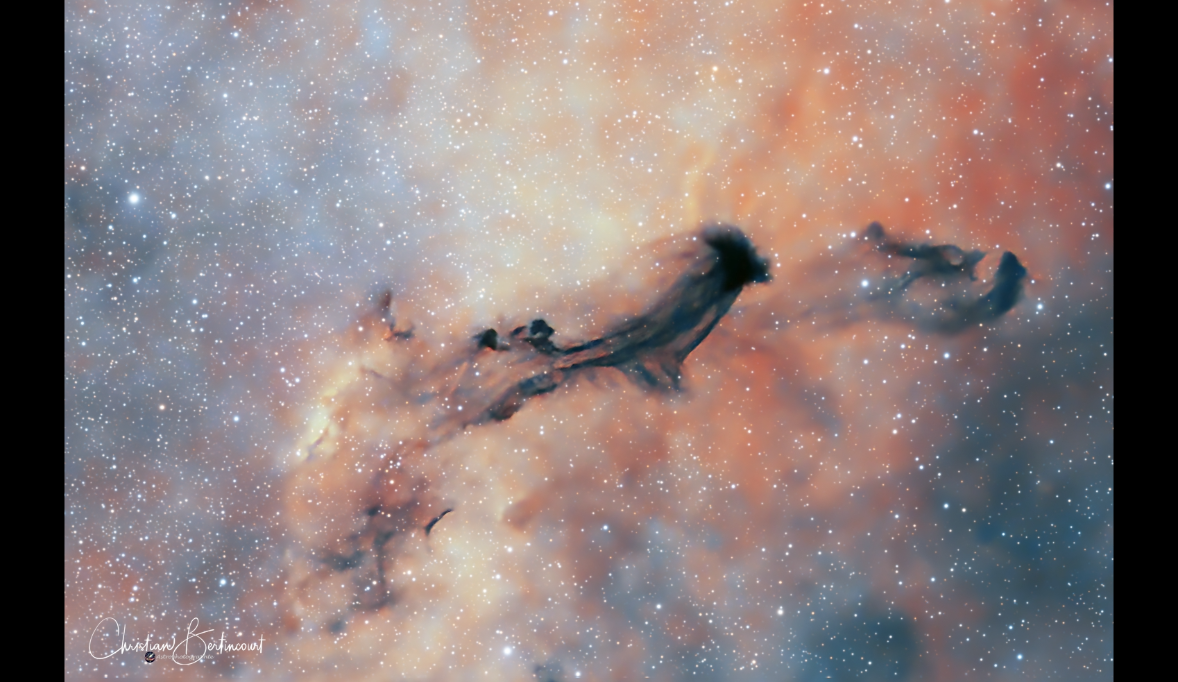
Image Credit & Copyright: Christian Bertincourt; Text: Keighley Rockcliffe (NASA GSFC, UMBC CSST, CRESST II)
Explanation: "A ghost in the Milky Way…” says Christian Bertincourt, the astrophotographer behind this striking image of Barnard 93 (B93). The 93rd entry in Barnard’s Catalogue of Dark Nebulae, B93 lies within the Small Sagittarius Star Cloud (Messier 24), where its darkness stands in stark contrast to bright stars and gas in the background. In some ways, B93 is really like a ghost, because it contains gas and dust that was dispersed by the deaths of stars, like supernovas. B93 appears as a dark void not because it is empty, but because its dust blocks the light emitted by more distant stars and glowing gas. Like other dark nebulas, some gas from B93, if dense and massive enough, will eventually gravitationally condense to form new stars. If so, then once these stars ignite, B93 will transform from a dark ghost into a brilliant cradle of newborn stars.
2 Likes
Anyone else making plans for the total eclipse in August? I’m going to Portugal. I was planning on Reykjavik initially because that’s the moment of maximum eclipse but it’ll probably be cloudy.
1 Like
Normally I’m on top of those kinds of things but this one slipped past me. I’d love to go travel and catch it.
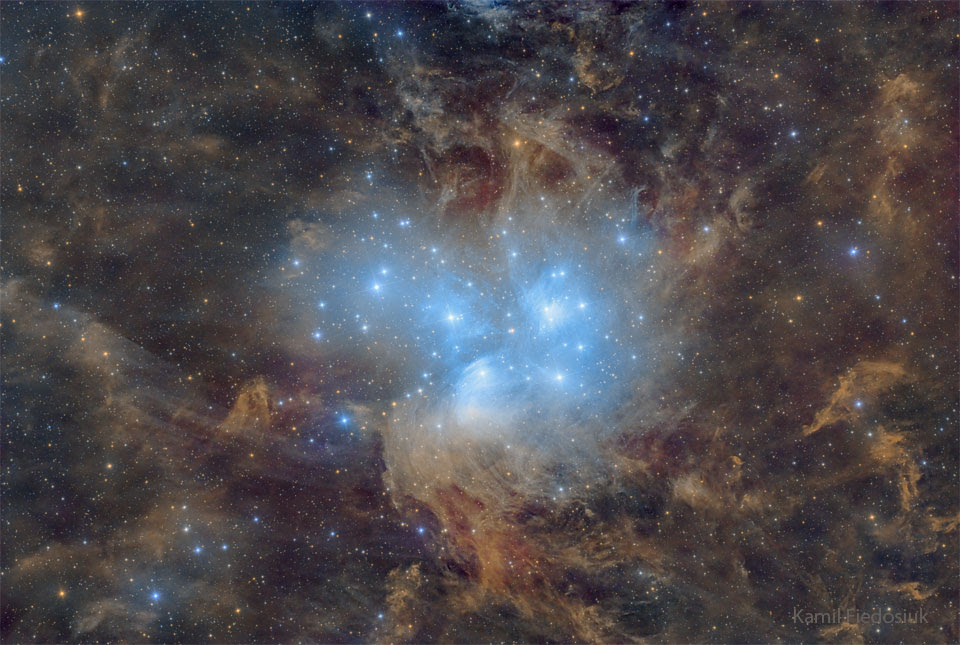
Image Credit & Copyright: Kamil Fiedosiuk
Explanation: Have you ever seen the Pleiades star cluster? Even if you have, you probably have never seen it as large and clear as this. Perhaps the most famous star cluster on the sky, the bright stars of the Pleiades can be seen with the unaided eye even from the depths of a light-polluted city. With a long exposure from a dark location, though, the dust cloud surrounding the Pleiades star cluster becomes very evident. The featured 18-hour exposure, taken from Bory Tucholskie, Poland covers a sky area several times the size of the full moon. Also known as the Seven Sisters andM45, the Pleiades lies about 400 light yearsaway toward the constellation of the Bull (Taurus). A common legend with a modern twist is that one of the brighter stars faded since the cluster was named, leaving only six of the sister stars visible to the unaided eye. The actual number of Pleiades stars visible, however, may be more or less than seven, depending on the darkness of the surrounding sky and the clarity of the observer’s eyesight.
1 Like
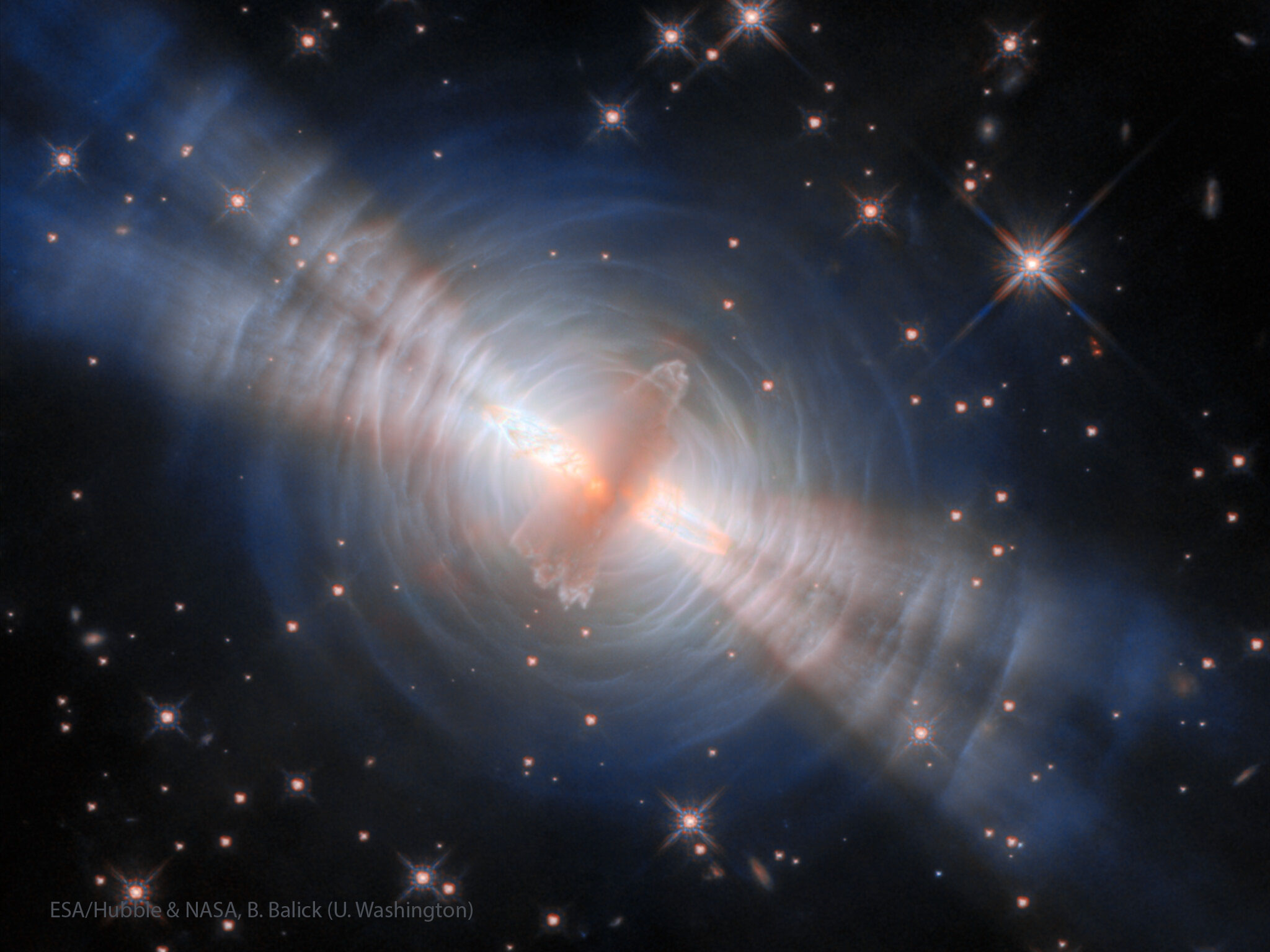
Image Credit & Copyright: ESA/Hubble & NASA, B. Balick (U. Washington)
Explanation: Ever wonder what it would look like to crack open the Sun? The Egg Nebula, a dying Sun-like star, can unscramble this question. Pictured is a combination of several visible and infrared images of the nebula (also known as RAFGL 2688 or CRL 2688) taken with the Hubble Space Telescope. The star has shed its outer layers, and a bright, hot core (or “yolk”) now illuminates the milky “egg white” shells of gas and dust surrounding the center. The central lobes and rings are structures of gas and dust recently ejected into space, with the dust being dense enough to block our view of the stellar core. Light beams emanate from that blocked core, escaping through holes carved in the older ejected material by newer, faster jets expelled from the star’s poles. Astronomers are still trying to figure out what causes the disks, lobes, and jets during this short (only a few thousand years!) phase of the star’s evolution, making this an egg-cellent image to study!
3 Likes

Image Credit & Copyright: Katelyn Beecroft
Explanation: Normally faint and elusive, the Jellyfish Nebula is caught in this alluring telescopic field of view. Floating in the interstellar sea, the nebula is anchored right and left by two bright stars, Mu and Eta Geminorum, at the foot of the celestial twins. The Jellyfish Nebula itself is right of center, seen as a brighter arcing ridge of emission with dangling tentacles. In fact, this cosmic jellyfish is part of bubble-shaped supernova remnant IC 443, the expanding debris cloud from a massive star that exploded. Light from the explosion first reached planet Earth over 30,000 years ago. Like its cousin in astrophysical waters the Crab Nebula supernova remnant, the Jellyfish Nebula is known to harbor a neutron star, the ultradense remnant of the collapsed stellar core. An emission nebula cataloged as Sharpless 249 fills the field at the upper left. The Jellyfish Nebula is about 5,000 light-years away. At that distance, this image would be about 300 light-years across.
2 Likes
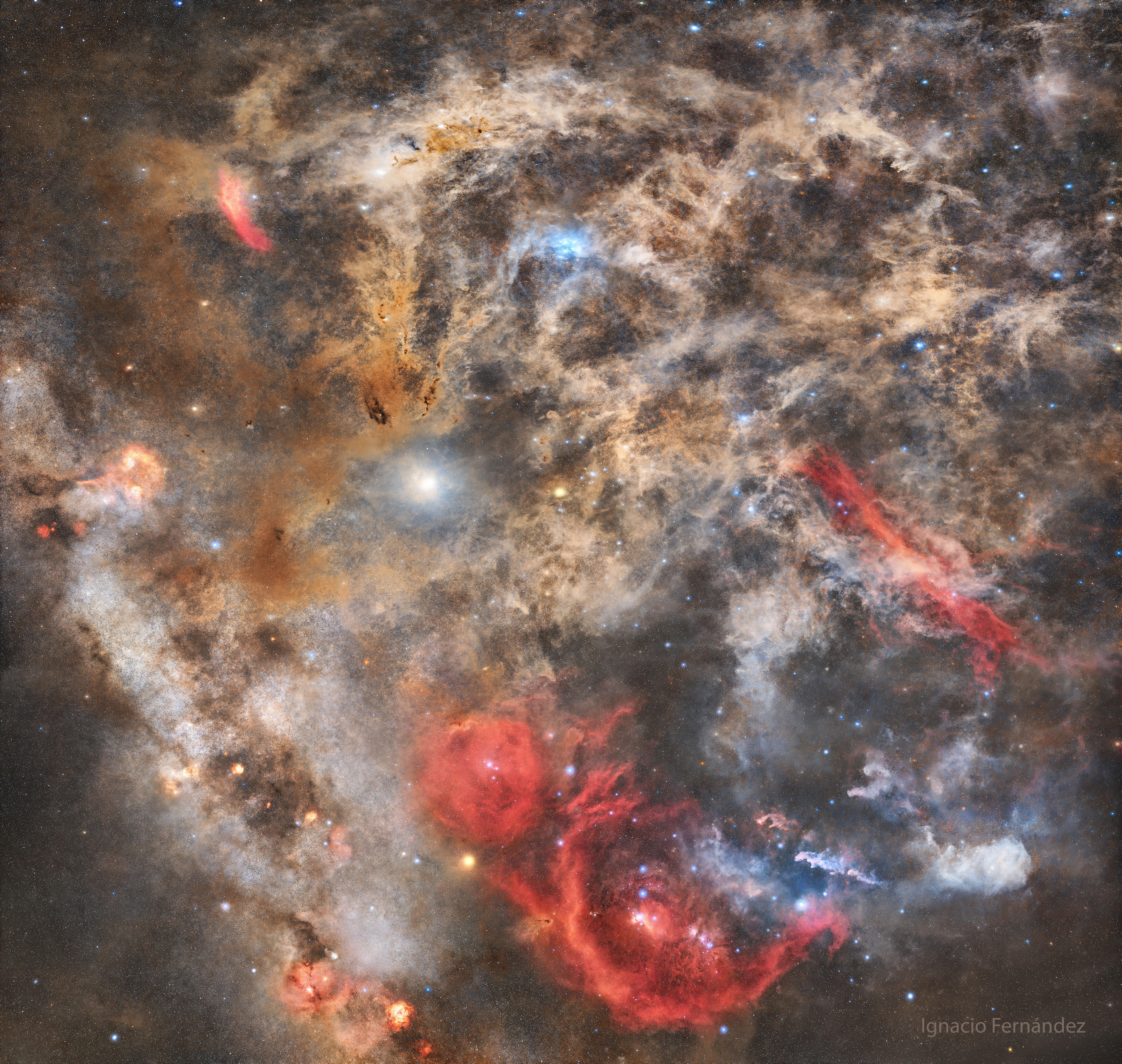
This is a 10MB image. Download and view it in full resolution. Quite amazing work.
Image Credit & Copyright: Ignacio Fernández
Explanation: How well do you know the night sky? OK, but how well can you identify famous sky objects in a very deep image? Either way, here is a test: see if you can find some well-known night-sky icons in a deep image filled with filaments of normally faint dust and gas. This image contains the Pleiades star cluster, Barnard’s Loop, Orion Nebula, Aldebaran, Betelgeuse, Witch Head Nebula, Eridanus Loop, and the California Nebula. To find their real locations, here is an annotated image version. The reason this task might be difficult is similar to the reason it is initially hard to identify familiar constellations in a very dark sky: the tapestry of our night sky has an extremely deep hidden complexity. The featured composite reveals some of this complexityin a 16 hours of sky exposure in dark skies over Granada, Spain.
3 Likes
Awesome one today!
Image Credit & Copyright: NASA, ESA, CSA, STScI; Processing: J. DePasquale (STScI)
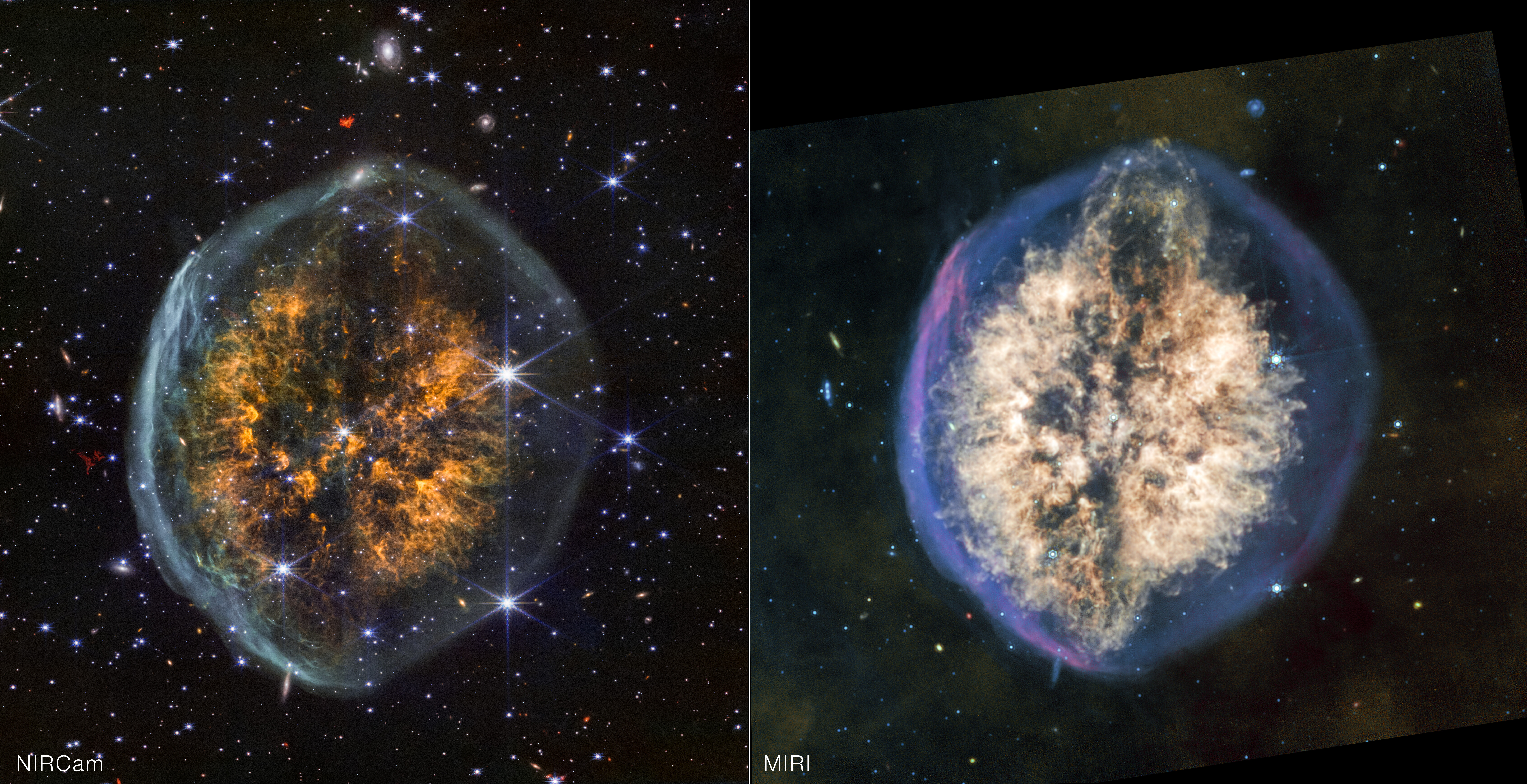
Explanation: What’s going on inside the head of this nebula? Dubbed the Exposed Cranium Nebula for its similarity to the human brain, what created the nebula remains a mystery. One thought is that the Cranium Nebula, also known as PMR 1, is a planetary nebula surrounding a white dwarf star. In this mode, the outer atmosphere was expelled when the original Sun-like star ran out of central nuclear fuel and contracted. A competing thought is that the central star is much more massive, possibly a Wolf-Rayet star, that is ejecting gas and dust via turbulent stellar winds. Adding to the intrigue is the dark vertical central division and the thin outer gaseous shell. The featured image was taken by the Webb Space Telescope in mid- infrared light, while a second image, included as a rollover, is in near-infrared. Future observations may reveal if this brainy system will quietly just fade from view or, many years from now, suddenly erupt in a powerful supernova.
2 Likes
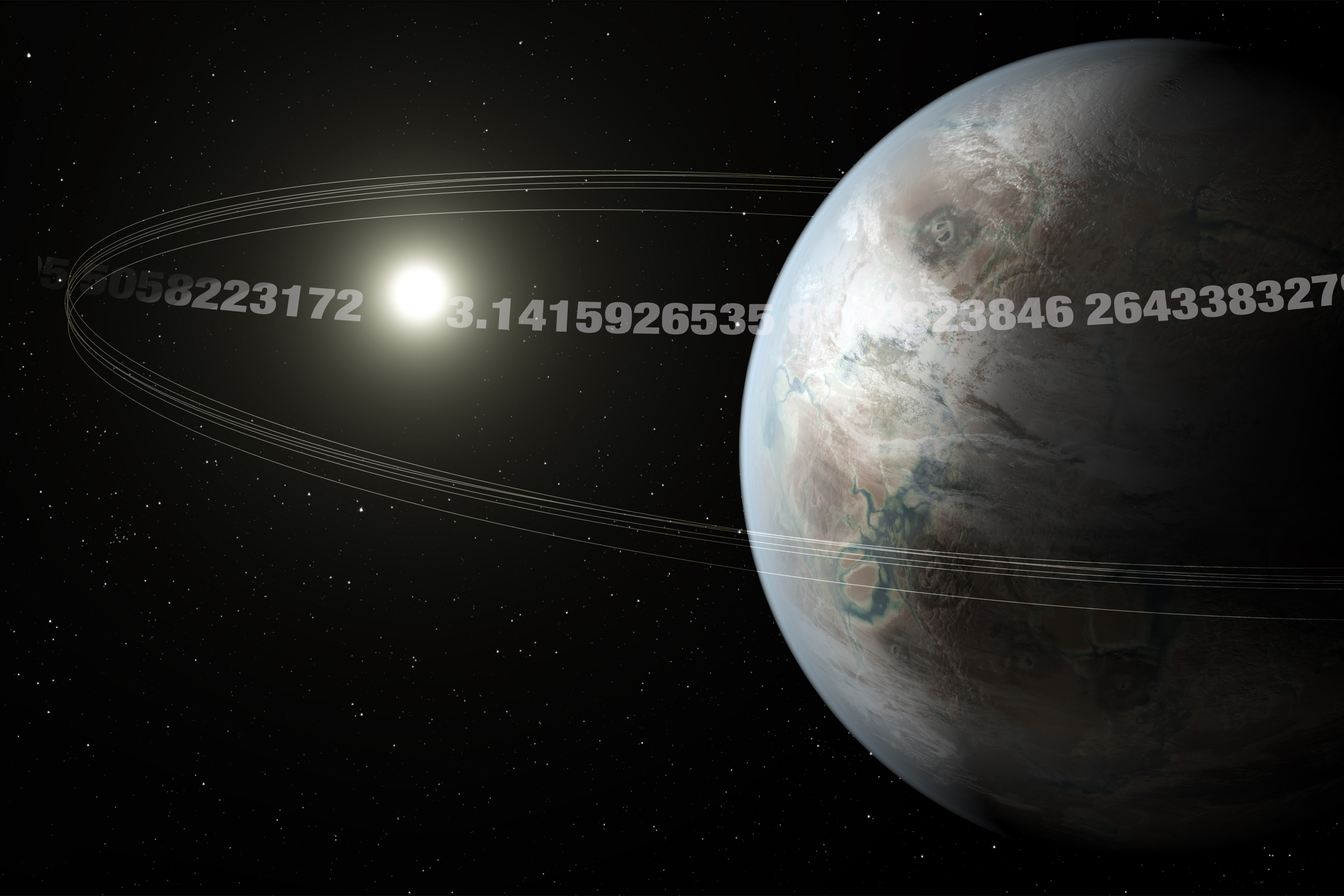
Happy Pi Day
Image Credit & Copyright: NASA Ames/JPL-Caltech/T. Pyle, Christine Daniloff, MIT
Explanation: Want to visit a planet that has 3.14 days in a year? Then plan a trip to K2-315b, an earth-sized planet orbiting around a cool, red, M dwarf star about once every 3.14 days. The exoplanet’s discovery, based on publicly available data from the planet-hunting Kepler Space Telescope’s extended K2 mission, was announced in 2020. K2-315b’s measured orbital period in days is nearly equal to the extremely popular irrational number Pi. That puts the exoplanet so close to its parent star that its surface is likely very warm, baking-hot in fact. And this Pi planet is over 185 light-years away. So instead of trying to arrange for an interstellar vacation to K2-315b, there may be easier and more comfortable ways for you to celebrate Pi day on planet Earth.
3 Likes
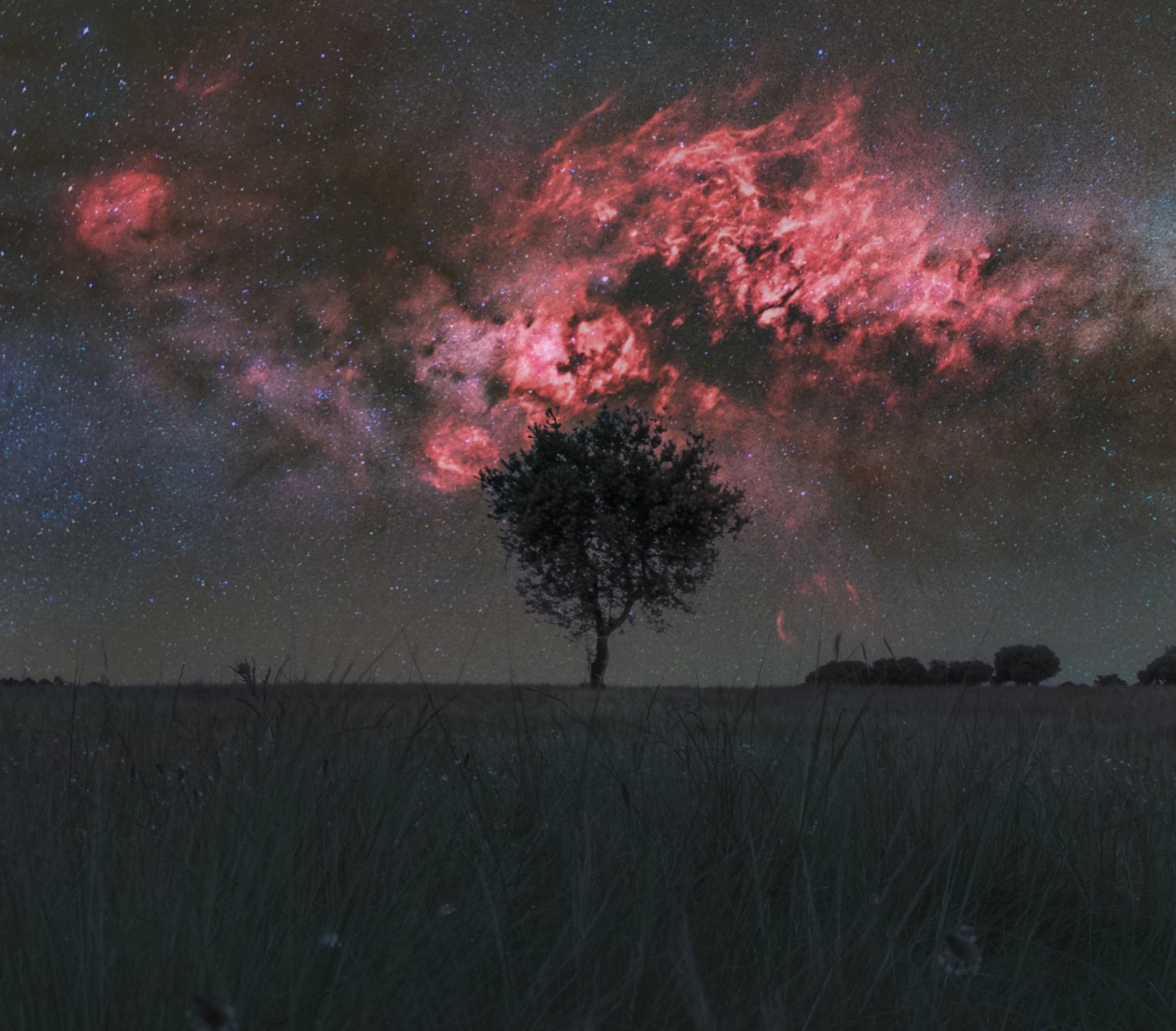
Image Credit & Copyright: 2025 Horacio Lander / AstroHoracio Text: Keighley Rockcliffe (NASA GSFC, UMBC CSST, CRESST II)
Explanation: A lone tree stands in a quiet meadow in Guadalajara, Spain, silhouetted against the Cygnus regionrising above like flames in the night sky. This deep night skyscape is a composite of exposures that reveals a range of brightness and color human eyes can’t quite see on their own. Spanning over a thousand times the angular sizeof the full moon, Cygnus sets the sky afire with active star formation where clouds of gas and dust collapse under gravity until nuclear fusion ignites and new stars are born. These stars ionize the surrounding hydrogen gas, causing it to glow crimson, while tendrils of interstellar dust absorb some of that light and cast dark shadows across the sky. Cygnus is a trove of celestial treasures, notably the Veil, Crescent, and Pelican nebulae, as well as Cygnus X-1, the first confirmed black hole. Cygnus continues to yield fresh science, including a new three-dimensional model of the Cygnus Loop made possible by the Chandra X-ray Observatory.
3 Likes
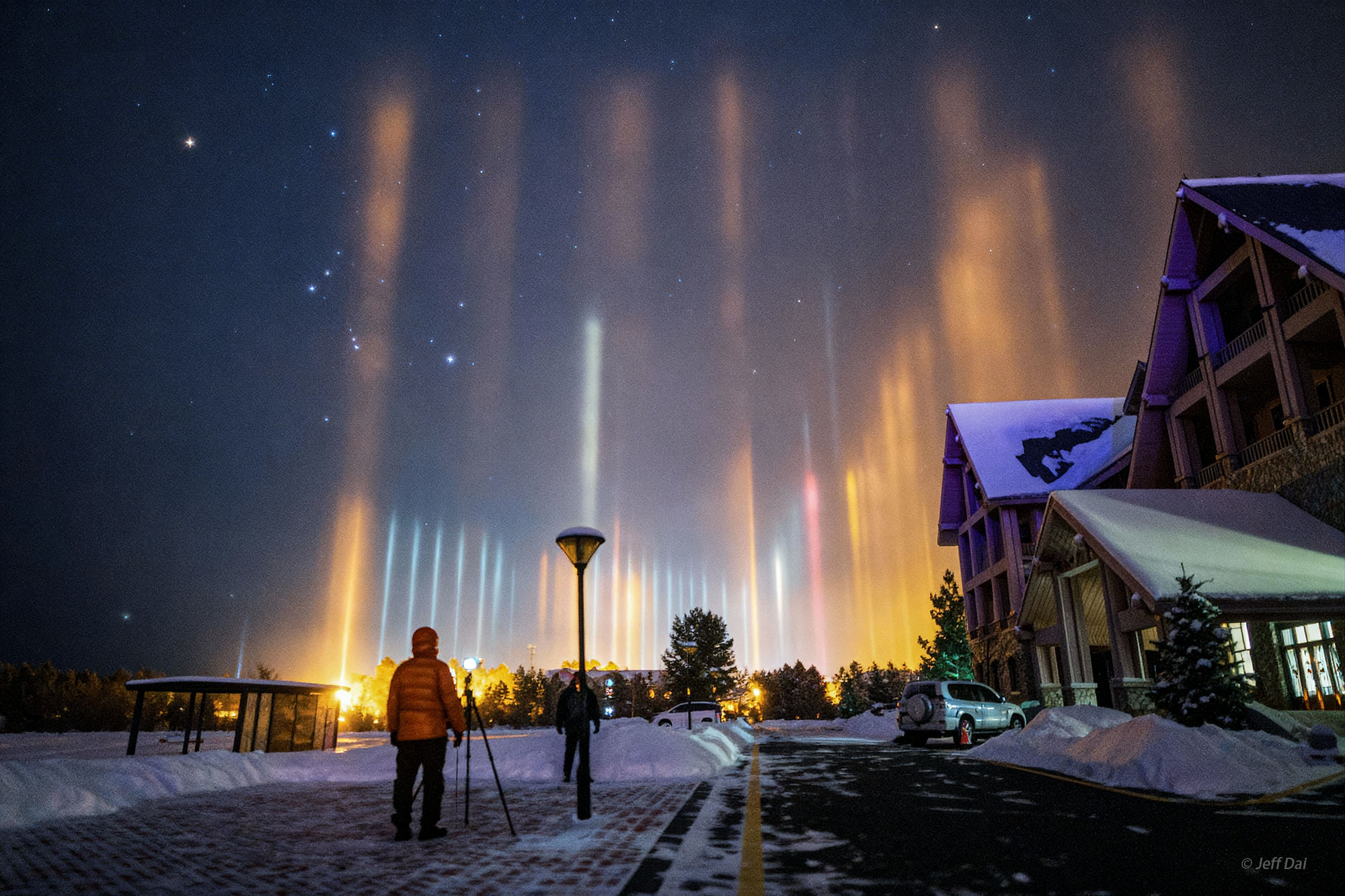
Image Credit & Copyright: Jeff Dai (TWAN)
Explanation: What’s happening at the end of that street? Pictured here are not auroras but light pillars, a phenomenon typically much closer. In most places on Earth, a lucky viewer can see a Sun pillar, a column of light appearing to extend up from the Sun caused by flat fluttering ice-crystals reflecting sunlight from the upper atmosphere. Usually, these ice crystals evaporate before reaching the ground. During freezing temperatures, however, flat fluttering ice crystals may form near the ground and are sometimes known as a crystal fog. These small ice crystals may then reflect not the Sun but ground lights. The featured image captured not only numerous light pillars but also the iconic constellation of Orion, and was taken in Mohe, the northernmost city in China.
4 Likes

Image Credit & Copyright: Esther Goddard, from the Clark University archive
Explanation: Robert H. Goddard, considered the father of modern rocketry, was born in Worcester Massachusetts in 1882. As a 16 year old, Goddard read H.G. Wells’ science fiction classic “War Of The Worlds” and dreamed of space flight. By 1926 he had designed, built, and flown the world’s first liquid fuel rocket. Launched 100 years agoon March 16, 1926 from his aunt Effie’s farm in Auburn Massachusetts, the rocket, dubbed “Nell,” rose to an altitude of 41 feet in a flight that lasted about 2 1/2 seconds. In this posed photo, Goddard stands next to the 10 foot tall rocket, holding the launch stand frame. To achieve a stable flight without the need for fins, the rocket’s heavy motor was located at the top, fed by lines from liquid oxygen and gasoline fuel tanks at the bottom. Widely recognized as agifted experimenter and engineering genius, his rockets were many years ahead of their time. Goddard was awarded over 200 patents in rocket technology, most of them after his death in 1945. A liquid fuel rocket constructed on principles developed by Goddard landed humans on the Moon in 1969.
2 Likes

Image Credit & Copyright: SADR Observatory Team: J-C Dalouzy, P. Bazart, M. Dherbécourt, C. Humbert, G. Leroy, J-P Quéau, H. Talbot, & E. Valin
Explanation: What’s happened to the center of this galaxy? Dramatic dust lanes run across the center of unusual elliptical galaxy Centaurus A. These dust lanes are so thick they almost completely obscure the galaxy’s center in visible light. This is particularly unusual as Cen A’s older stars and oval shape are characteristic of a giant elliptical galaxy, a galaxy type typically low in dark dust. Pictured in this deep image is a complex network of foreground gas and dust, as well as shells of dim stars and a jet projecting to the upper right. Also known as NGC 5128, Cen A is surely the result of a galactic collision where many young dust-creating stars were formed. However, details of the creation of Cen A’s unusually active center and iconic central dust lanes are still being researched. Cen A lies only 13 million light years away, making it the closest active galaxy.
4 Likes
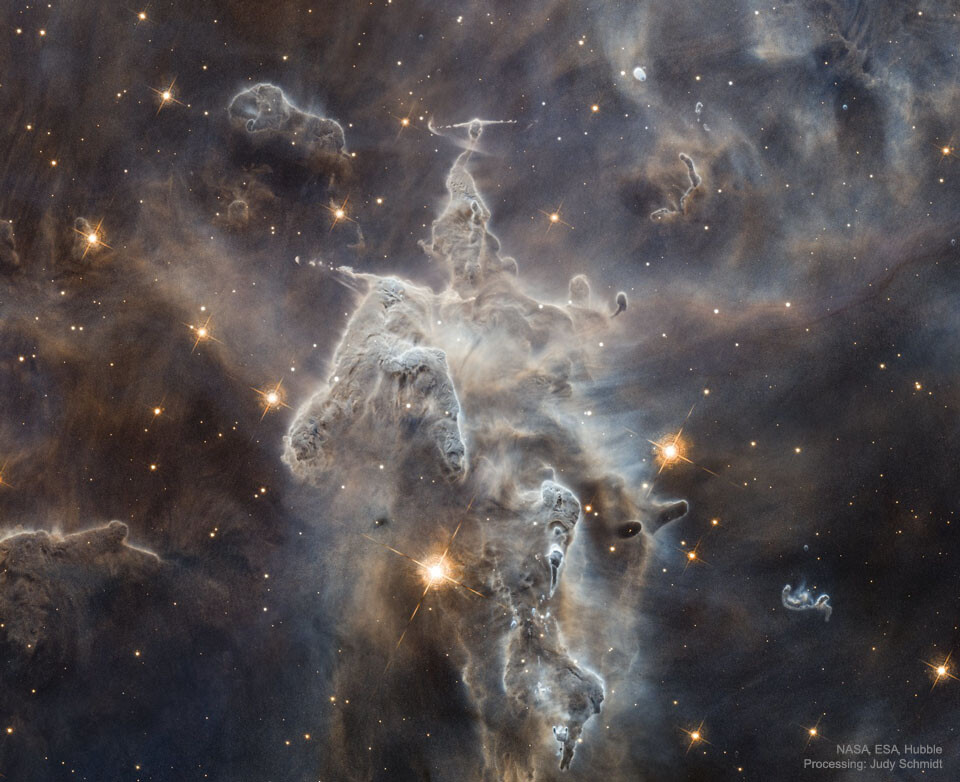


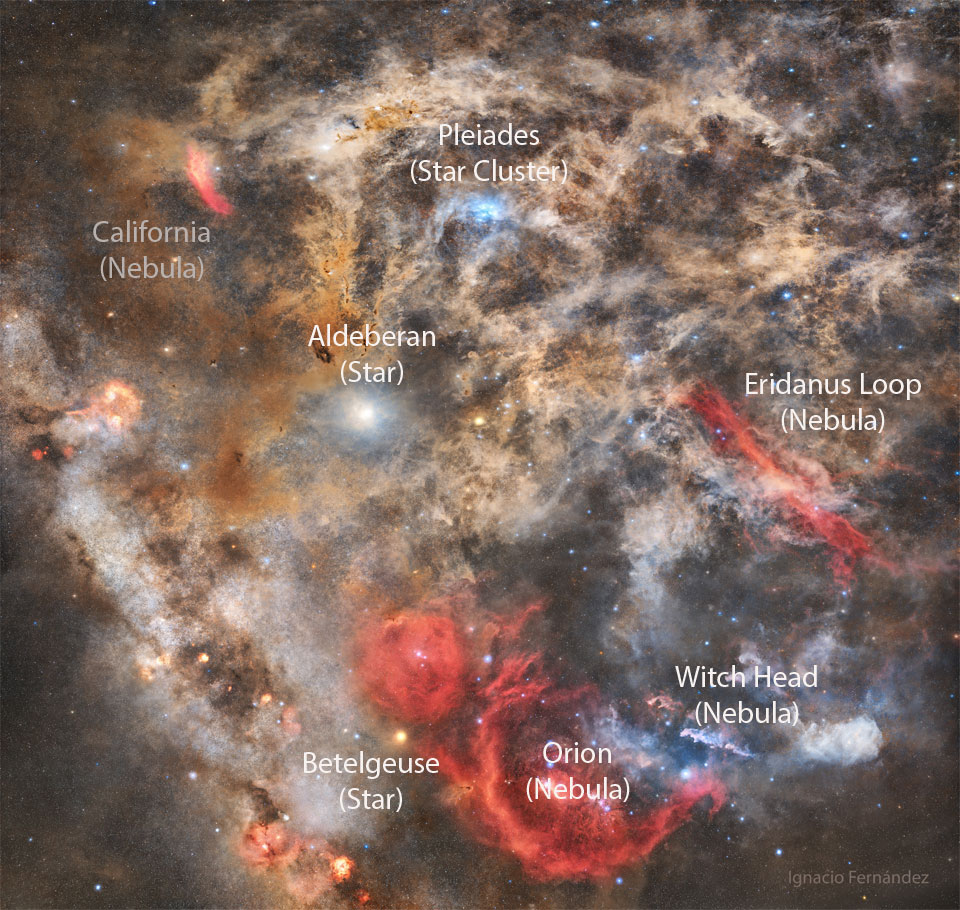


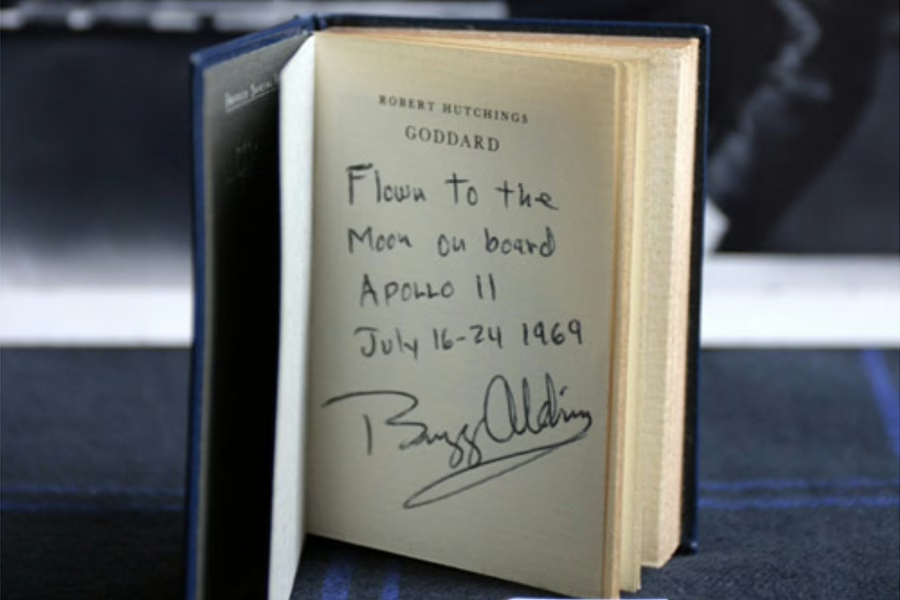

Image Credit & Copyright: Hubble, NASA, ESA; Processing & License: Judy Schmidt
Explanation: Inside the head of this interstellar monster is a star that is slowly destroying it. The huge monster, actually an inanimate series of pillars of gas and dust, measures light years in length. The in-head star is not itself visible through the opaque interstellar dust but is bursting out partly by ejecting opposing beams of energetic particles called Herbig-Haro jets. Located about 7,500 light years away in the Carina Nebula and known informally as Mystic Mountain, the appearance of these pillars is dominated by dark dust even though they are composed mostly of clear hydrogen gas. The featured image was taken with the Hubble Space Telescope. All over these pillars, the energetic light and winds from massive newly formed stars are evaporating and dispersing the dusty stellar nurseries in which they formed. Within a few million years, the head of this giant, as well as most of its body, will have been completely evaporated by internal and surrounding stars.

3 Likes